
By JoAnne Wadsworth, Communications Consultant for the G20 Interfaith Forum, and Katherine Marshall, Vice President of the G20 Interfaith Forum and Senior Fellow at Georgetown University’s Berkley Center for Religion, Peace, and World Affairs
This blog is adapted from an interview with Ndidi Okonkwo Nwuneli conducted in March 2026 by Katherine Marshall as part of the Berkley Center’s Practitioners and Faith-Inspired Development Interview Series—a collection of nearly 400 conversations with activists, religious leaders, and policy specialists exploring how faith shapes development work around the world.
———
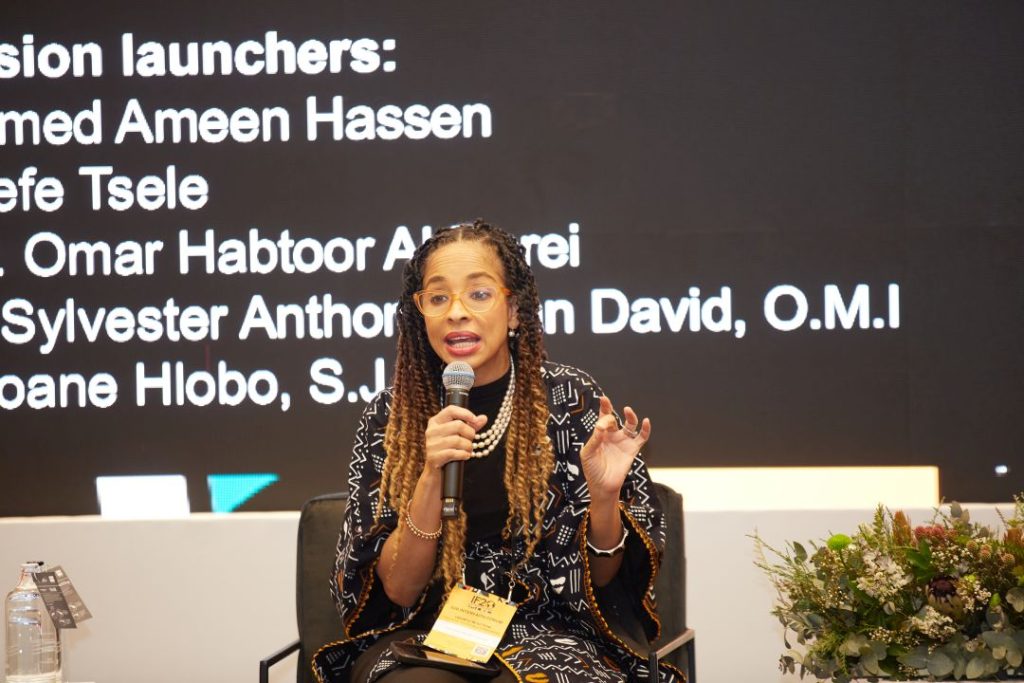
When Ndidi Okonkwo Nwuneli attended the G20 Interfaith Forum in Cape Town in August 2025, she brought a career’s worth of conviction: that Africa’s story must be told differently, that faith communities are among the most powerful forces available to global advocates, and that justice is not delivered from the top down. As the first African President and CEO of the ONE Campaign—the global advocacy organization co-founded by Bono that fights for economic opportunities and healthier lives in Africa—she is in a position to act on all three.
The G20 Moment—and Why Faith Voices Matter
Nwuneli left Cape Town convinced that the moment demands sustained engagement. With the US holding the G20 presidency in 2026 and the UK following in 2027, she sees a narrow and consequential window. ONE is invested in both processes as vehicles for carrying grassroots realities to global leaders—and she is clear that the political cover required to make bold decisions must be built from below, not handed down from above.
She pointed to two issues ripe for faith-grounded G20 advocacy. The first is fair financing and debt restructuring. Crediting the Pope and the global Jubilee community for keeping the moral case alive, she sees continuing opportunities for debt-for-health, debt-for-climate, and debt-for-education swaps. The second is child health. “Across faiths, there is a shared belief that children should not bear the consequences of challenges created by adults,” she said—making the fight for life-saving medicines a natural platform for interfaith action at the G20.
How ONE Mobilizes Faith Leaders
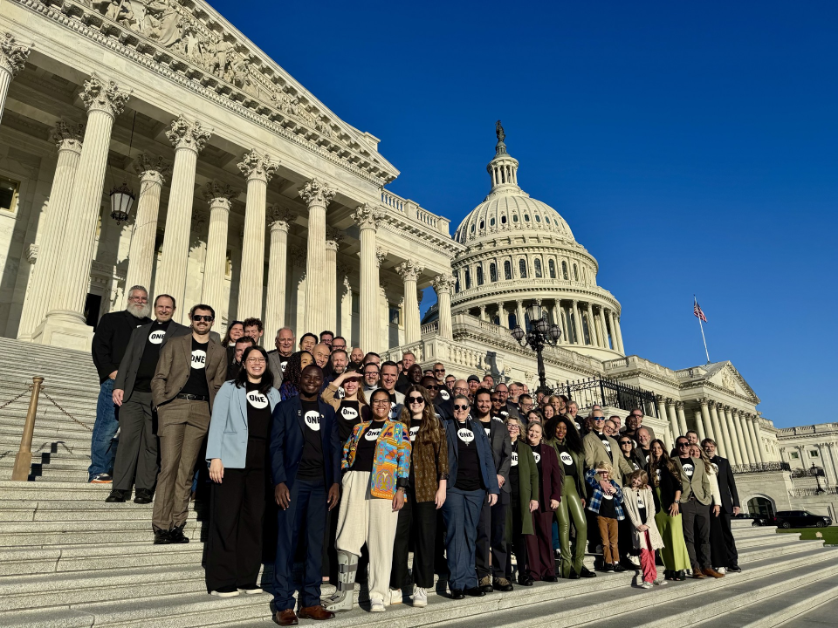
ONE’s engagement with faith communities is structural, not peripheral. In 2025, the organization launched a Global Faith Council spanning Christian, Muslim, Jewish, Mormon, and Buddhist leaders from ten countries. That November, ONE convened 80 American faith leaders in Washington for a week of advocacy alongside their Global Faith Council counterparts—resulting in 160 Capitol Hill meetings, including 17 with Members of Congress. About half of those participants had never before used their voices to shape federal policy.
What struck Nwuneli most was the quality of presence they brought. In a difficult political moment, they checked on furloughed staff, offered prayers, and held steady to a message that transcended partisan lines: that US leadership grounded in compassion saves lives. The Faith Summit also transforms participants themselves. “It empowers them and shifts their worldview,” she said. “They go back to their congregations more rooted in reality, able to be more effective in their roles.”
A Career Built on Changing the Story
Long before ONE, Nwuneli was already fighting the battle she now wages on a global stage: the battle over how Africa is seen. When she arrived in the United States as a teenager from Enugu, Nigeria, she encountered what she calls a dangerous single story—the face of Africa reduced to a hungry child, the face of poverty to a female farmer. It was not the Africa she had grown up in, and she made it her mission to complicate that picture.
That impulse shaped a career spanning McKinsey, the FATE Foundation, and LEAP Africa—an organization she founded to cultivate principled young leaders across the continent, now 24 years old and active in eight countries. It carried her through a relocation to Senegal, where a traumatic family experience became the unlikely catalyst for four companies focused on food, agriculture, and inclusive growth. And it eventually brought her to ONE, when a headhunter described an opportunity to pursue the same work on a global stage. “My first reaction was that advocacy was not for me—I’m a serial social entrepreneur,” she recalled. But Bono and ONE Board Chair Tom Freston were persuasive.
The current crisis in the development sector has only sharpened her framing. Rather than lament what’s been lost with the withdrawal of US development funding, she insists on reorienting toward what’s possible.
“I do not ever want to be quoted as saying, ‘African children will die because USAID has been shut down.’ I want to be quoted as saying, ‘African children are living because of what we collectively are doing to invest in our future.’”
A Faith That Shapes Everything
Running through all of it is a faith that is neither incidental nor decorative. Baptized at ten in an Anglican church in Nigeria—it was, she recalls, what she asked for as a birthday gift—she describes herself today as a non-denominational Christian drawn to communities that unite rather than divide. She spoke candidly about the loneliness and moral confusion she sees in the world today, and about the role people of faith are called to play.
“My anchor is my faith. I don’t know how I would exist in this world today, with the despair we often feel, if I didn’t believe deeply in a living God who fills me every day with peace and joy.”
That conviction finds a striking expression in a reflection from her Igbo language: there is no word for love in Igbo. The phrase used to describe it is “Ahuru m ngi n’anya”—“I see you in my eye.” “The idea is: I actually see you, as a human being, made in God’s image,” she said. “Too often we don’t see people for who they are.” At a time of profound fear and division, she believes that quality of seeing—and of being seen—is both the foundation of justice and the reason ONE exists.
———
JoAnne Wadsworth is the Communications Consultant for the G20 Interfaith Forum (IF20) and acting editor of the Viewpoints blog. Katherine Marshall is a Senior Fellow at Georgetown University’s Berkley Center for Religion, Peace, and World Affairs, Vice President of the G20 Interfaith Forum, and Executive Director of the World Faiths Development Dialogue. She conducted the original interview with Ndidi Okonkwo Nwuneli in March 2026 as part of the Berkley Center’s Practitioners and Faith-Inspired Development Interview Series.