
By Marianna Richardson
– – –
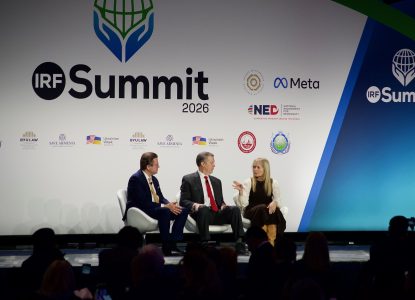
On Monday, February 2nd, the International Religious Freedom (IRF) Summit kicked off in Washington, D.C., bringing together many of the world’s foremost religious freedom experts and advocates. The G20 Interfaith Forum attended the summit, sponsoring a booth and a side session on G20 priorities. This blog is Part 1 of a three-part summary covering the first day of the conference.
Opening Remarks
Katrina Lantos Swett
Katrina Lantos Swett opened the 2026 International Religious Freedom (IRF) Summit by welcoming participants and highlighting the significance of the global coalition gathered to defend freedom of religion or belief. She announced the upcoming IRF dinner themed “Religious Freedom: Democracy at Risk,” featuring speakers such as former U.S. House Speaker Newt Gingrich, Paula White‑Cain, former EU Special Envoy Ján Figeľ, and Moriko Hori of the Women’s Federation for World Peace International.
She reflected on the origins of the IRF Summit, conceived by Ambassador Sam Brownback, noting that what began as an ambitious idea has quickly become “the most important and consequential gathering of religious freedom leaders, advocates, and experts from around the globe.” She described the current moment as both “the best of times” and “the worst of times,” observing that while the movement for global religious freedom has unprecedented momentum, more people than ever live under regimes that restrict or repress their most basic rights of conscience.
She highlighted two prisoners of conscience adopted by the summit—Pastor Jin of China and Faizullah Asimov of Uzbekistan—and affirmed that the IRF community answers the question “Am I my brother’s keeper?” with a resounding yes.
Ambassador Sam Brownback
Ambassador Sam Brownback followed by emphasizing the global nature of the movement and the profound threat it poses to authoritarian regimes.
He stated that dictators fear religious freedom because it represents “the heart of freedom—a soul choosing its own course for this life and beyond.”
He argued that communist, authoritarian, and totalitarian governments attack this right because they know that people of faith often stand up to oppression with courage rooted in spiritual conviction. Brownback described these individuals as living “behind enemy lines,” carrying within them the spirit of God and testifying through their lives of a different, freer way. He characterized the struggle for religious freedom as a defining conflict of the age, asserting that oppressive regimes fear the moral power of faith more than military might.
Brownback concluded by sharing that the idea for the annual IRF Summit came to him during prayer in November 2020, affirming that “God answers prayer,” and expressing hope that the summit would continue to be guided by divine influence as participants work to advance freedom for all.
Pastor Paula White-Cain: Commitment to Global Religious Freedom
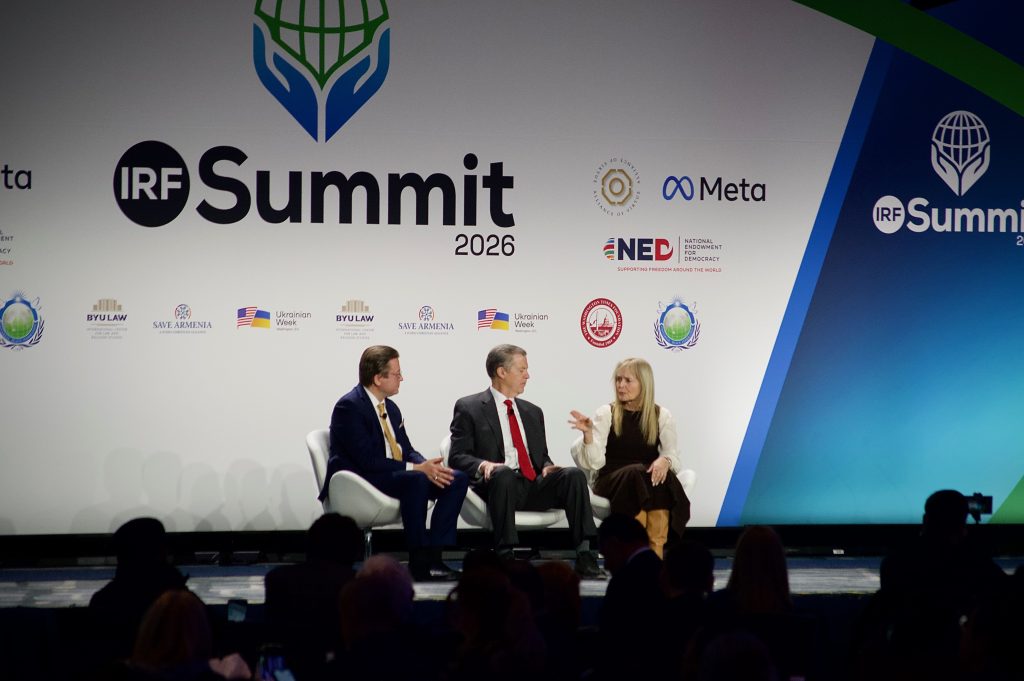
Pastor Paula White‑Cain expressed gratitude for the IRF Summit and described her lifelong commitment to defending freedom of belief. She has traveled to nearly 140 countries and witnessed both the beauty of worship and the suffering of those persecuted for their faith. She noted her current role as Senior Adviser to the White House Faith Office, where religious liberty remains the top priority.
The Moral Center of Religious Freedom
She praised the summit’s nonpartisan spirit and grounded its mission in Article 18 of the Universal Declaration of Human Rights. She emphasized that freedom of thought, conscience, and religion is a fundamental human right—not a privilege granted by governments. Protecting this right means defending the dignity of every person and their ability to live, worship, and raise families without fear.
Global Threats and Human Cost
White‑Cain highlighted severe violations of religious freedom worldwide, including repression of Uyghurs and Tibetans in China, attacks on Christians in Nigeria, persecution of Bahá’ís and other minorities in Iran and Yemen, and rising hostility toward Jewish communities. Drawing on her work in Nigeria and the Democratic Republic of the Congo, she described staggering death tolls and ongoing violence, stressing that behind every statistic is a family, a community, and a life forever changed.
Principles for Action
She outlined three commitments for advancing religious freedom:
- Challenge governments that restrict worship, criminalize conversion, or weaponize blasphemy laws.
- Defend religious freedom universally, not only for one’s own community.
- Remind the world that societies flourish when freedom of belief is protected for all.
She also reflected on past efforts—including the Ministerial to Advance Religious Freedom and the Abraham Accords—as examples of effective international cooperation.
Hope and Collective Responsibility
White‑Cain closed by reminding advocates that their work is personal and urgent. Defending religious liberty protects human dignity and can change lives. She insisted that civil society, diplomacy, and truth are powerful tools, and that united action can bring real consequences for persecutors. She urged the summit to continue building a broad coalition to advance religious freedom worldwide, calling it “the cornerstone” of human dignity.
Temuulen Togochog’s Remarks: A Family’s Asylum Journey and a Commitment to Advocacy
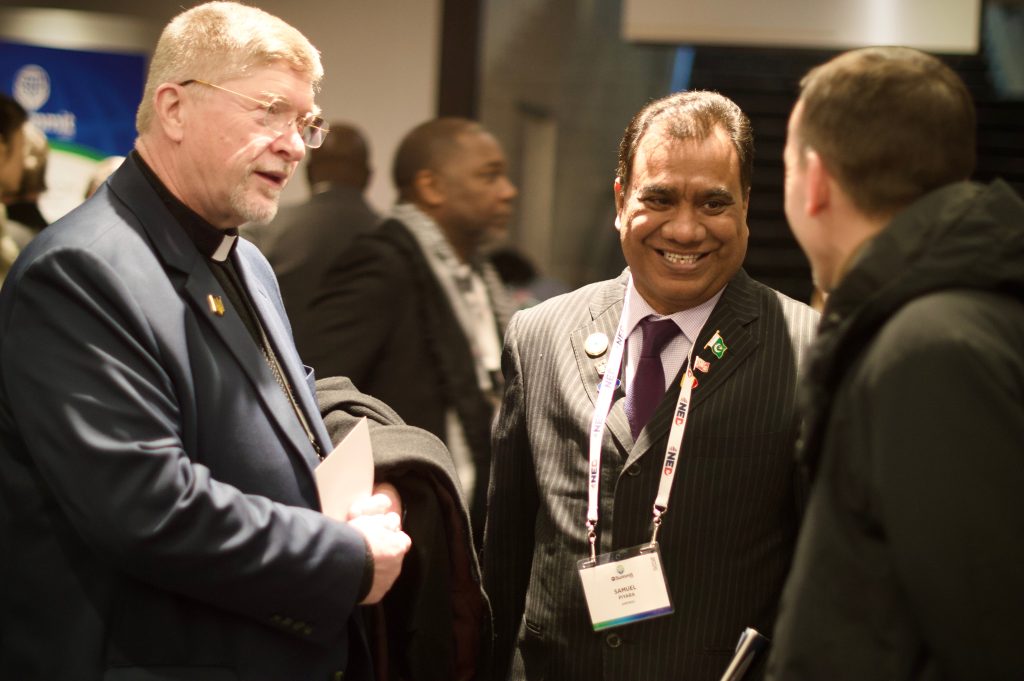
Temuulen Togochog, a Southern Mongolian activist, explained that her parents fled Southern Mongolia to seek asylum in the United States—her father arriving in 1998 and her mother in 2001. Her father founded the Southern Mongolian Action Center and has advocated for ethnic minority rights in China since the late 1990s. After accompanying him to the United Nations at age fifteen, she committed herself to continuing his mission and hopes to inspire a new generation of youth advocates to defend cultural and religious freedom.
The Richness of Mongolian Cultural Identity
She described the beauty and uniqueness of Southern Mongolian culture, emphasizing its sacred vertical script, the art of Mongolian calligraphy, and globally recognized musical traditions such as throat singing, long song, and the horsehead fiddle. She highlighted traditional clothing, jewelry, and headpieces as further expressions of a culture that has preserved generational wisdom for centuries. These cultural elements, she stressed, are deeply tied to identity, spirituality, and community.
Systematic Cultural and Religious Repression by the CCP
Togochog detailed the Chinese Communist Party’s long‑standing efforts to suppress Mongolian culture and religion, particularly since the Cultural Revolution. She explained that the CCP views religious expression—especially shamanism and Buddhism—as a threat to its authoritarian control. As a result, sacred temples have been destroyed, monks and religious figures persecuted, and religious texts and art eliminated. Portraits of the Dalai Lama have been replaced with images of Xi Jinping, and monks and nuns are forced into political re‑education. Although China has rebuilt a few temples in recent years, she described these as hollow gestures that do not restore genuine religious freedom.
Personal Loss and the Global Reach of Oppression
She shared the emotional toll of exile, noting that she has been unable to attend major family events, including funerals, hospitalizations, and weddings. For a culture where family and community are central, this absence causes profound pain. She emphasized that the CCP’s oppressive reach extends far beyond China’s borders, affecting diaspora communities and severing family ties even from across the world.
A Call to Protect Cultural and Religious Freedom
Togochog warned that the CCP’s repression threatens not only Mongolian culture but global peace and diversity. By eliminating cultural and religious pluralism, she argued, the CCP is engaging in cultural genocide to maintain its authoritarian regime.
Quoting Dr. Martin Luther King Jr.’s reminder that “injustice anywhere is a threat to justice everywhere,” she urged people everywhere to unite in defending cultures facing oppression and to work toward a future where all can freely practice their spirituality and preserve their heritage.
– – –
Marianna Richardson is the Director of Communications for the G20 Interfaith Forum. She is also an adjunct professor at the Marriott School of Business at Brigham Young University.