
By Prof. James Taylor Christie, Professor Emeritus of Theology at the University of Winnipeg and a longtime ally and Viewpoints contributor of the G20 Interfaith Forum
———
This is the first in a three-part series in which theologian and ecumenist James Taylor Christie makes the biblical case for “cosmopiety”: the conviction that the world’s faiths are called not to compete but to cooperate. Part I traces the modern interfaith movement from the 1893 Parliament of the World’s Religions to the G20 Interfaith Forum, and introduces the idea that anchors the series. Parts II and III turn to the Hebrew Scriptures and the New Testament in search of its roots.
———
Thinking in Latin
I am blessed. I realized this glad epiphany mere days ago, as I entered my seventy-fifth year on our lovely, fragile, besieged little planet. I am blessed because for virtually all of my adult life I have been privileged to pursue work that brings meaning and joy, and that is, I believe, in congruity with my faith and values. For twenty-five continuous years I served as a minister and denominational leader of The United Church of Canada, and for the twenty years following as Dean of the Faculty of Theology at the University of Winnipeg, and later as that university’s inaugural Professor of Whole World Ecumenism and Dialogue Theology.
During all those years I was influenced, no, shaped, by innumerable mentors. Many were in person; others reached me by their ideas and their writing. Among the latter was the late, great theologian of the Second Vatican Council, Professor Hans Küng of Tübingen.
I had long been an aficionado of Prof. Küng’s work. In the autumn of 1984, in a CBC radio interview conducted by another mentor, the legendary Canadian journalist Peter Gzowski, their conversation proved a Kairos moment for me. Peter asked Prof. Küng how he imagined posterity would view the troubled twentieth century.
Küng replied, “I believe that future generations will look back on the 20th century not so much in terms of war, destruction, and gulag, but rather as that moment in history when the world’s great religions first began to talk to one another.”
I was as struck by the power of that idea as a latter-day Saint Paul on my personal road to Damascus. I knew, in that moment, the purpose to which my life’s work would be dedicated.
But Küng’s bequest did not rest with that single insight. His gifts to me were, in fact, threefold. Earlier that same year, in the Italian city of Riva del Garda, Küng was a prominent contributor to an international, interreligious conference, in the course of which he introduced the Global Ethic. Foundational to that ethic was his iconic truism:
“There will be no peace without peace among religions. There will be no peace among religions without dialogue among religions.”
And then, in 1990, came the third great idea that has shaped my vocational life. Writing in Latin, his favorite mode of personal expression, in an essay for editor Clifton Fadiman’s compendium volume This I Believe, Prof. Küng contributed a reflection entitled “Spero Contra Spem: I Hope against Hope.” He wrote:
Spero unitatem ecclesiarum: I hope for unity among the churches.
Spero pacem religionum: I hope for peace among religions.
Spero communitatem nationum: I hope for community among the nations.
If the Gzowski-Küng interview was an epiphany, and Riva del Garda a call to vocation (amplifying my 1970 call to Christian ministry), then spero contra spem has proved a sort of global job description: an agenda for my life’s work.
What follows, across these three essays, is directed to aspects of our common quest for Tikkun Olam: the mending of the world. It will be grounded in the scriptures of the Judeo-Christian tradition where, I maintain, it all began.

The White City and a New Idea (1893)
How hopeful the world and her future must have appeared in 1893. The nineteenth century, anticipating the even more marvelous twentieth, seemed an age of miracles, and those miracles were on display in Chicago at the Columbian Exposition, better known as the Chicago World’s Fair. To visit the White City was to glimpse the boundless horizons of new discoveries, new technologies, a new world.
The potential was captured not only in terms of science, technology, architecture, transport, and commerce, but in the very heart of humanity; even, one might say, in the Divine. For in 1893 the inaugural Parliament of the World’s Religions (PoWR) was convened. And they came: adherents of religions, faiths, and spiritualities from around the globe. Luminaries such as the renowned Swami Vivekananda, exotic in the Western mind, introduced the Dharmic East to the Abrahamic West.
And something changed in the hearts and minds of those who caught a glimpse of what the world might be like if humanity’s religious expressions could work together for a new kind of world.
And then, in two short decades, the madness of the First World War dashed each and every hope and dream from the global psyche. It would be a full century, until 1993, again in Chicago, before the Parliament reconvened. But the spark ignited in 1893 was not extinguished, despite the choking gloom of the twentieth, most calamitous of the centuries of our Common Era. The idea of interfaith dialogue took root, such that by the opening years of the twenty-first century there had emerged five globe-spanning interfaith organizations dedicated to making real the heady vision of the PoWR. In addition to the Parliament itself, there is the World Conference on Religions for Peace (WCRP), now known simply as Religions for Peace (R4P); the Temple of Understanding; the United Religions Initiative (URI); and the G+ System, now identified as the G20 Interfaith Forum (IF20).
The G8 World Religious Leaders’ Summits, inaugurated humbly in Lambeth, England, in ’05, were transformed into the IF20 in 2014 by the genius of Dr. Brian Adams, then of Griffith University in Brisbane, Australia. In the ensuing decade, continuing leadership has been exercised by a pioneer of law and religion studies, Prof. W. Cole Durham, Jr.
A Word for Our Work: Cosmopiety
Undergirding the evolution of the G+ approach has been a worldview at first implicit and, in recent years, explicit. That worldview is “cosmopiety,” a term coined by Prof. Paul Morris of Wellington, New Zealand, who holds the UNESCO Chair in Interreligious Understanding. I can do no better than to allow Prof. Morris to speak in his own words:
Cosmopolitan religious actors can be referred to as cosmopietists. The more inclusive awareness is extended transnationally as social actors learn about other religious communities that they come to regard as co-religionists. The cosmopietist interacts in unprecedented ways with those of different faiths, and develops personal relationships with them. Cosmopietists understand interfaith endeavours to be sacral in nature, as part of religious life and practice. They acknowledge the existence of other religions, not as peopled by those eternally lost in sin, but as co-cosmopietists who share mutual and reciprocal rights and concerns over religious freedoms. Cosmopietists are increasingly evident among Muslims, Hindus, Buddhists, Sikhs, Jews, and Christians.
Cosmopiety, then, is the lived posture of the interfaith movement. And for the Christian it is, and must be, rooted in the Scriptures of the tradition, or it is rooted in nothing at all.
The Guy in the Ditch
I learned to read scripture with different eyes from Dr. Madeleine Barot of the World Council of Churches. In the late winter of 1973 I was well into my studies for the Bachelor of Theology at the Faculty of Religious Studies at McGill University in Montreal. Convention and tradition were strong then, and it was an extraordinary privilege for any student to be invited to the Senior Common Room, the den of Deans, Dons, Faculty, and those stratospheric persons who seemed to function on a higher plane. And yet there we were, faculty and students alike, rubbing elbows and eagerly awaiting the wisdom that Dr. Barot, on a visit to the Canadian churches, would impart to the meek and the lowly and to the giants of the Faculty alike.
As a senior leader of the WCC, Dr. Barot must have commented on the ever-contentious work of the Council. But for the life of me I do not remember a word she said on that subject. What stands out in my memory is her unqualified insistence on scripturally grounded theology.
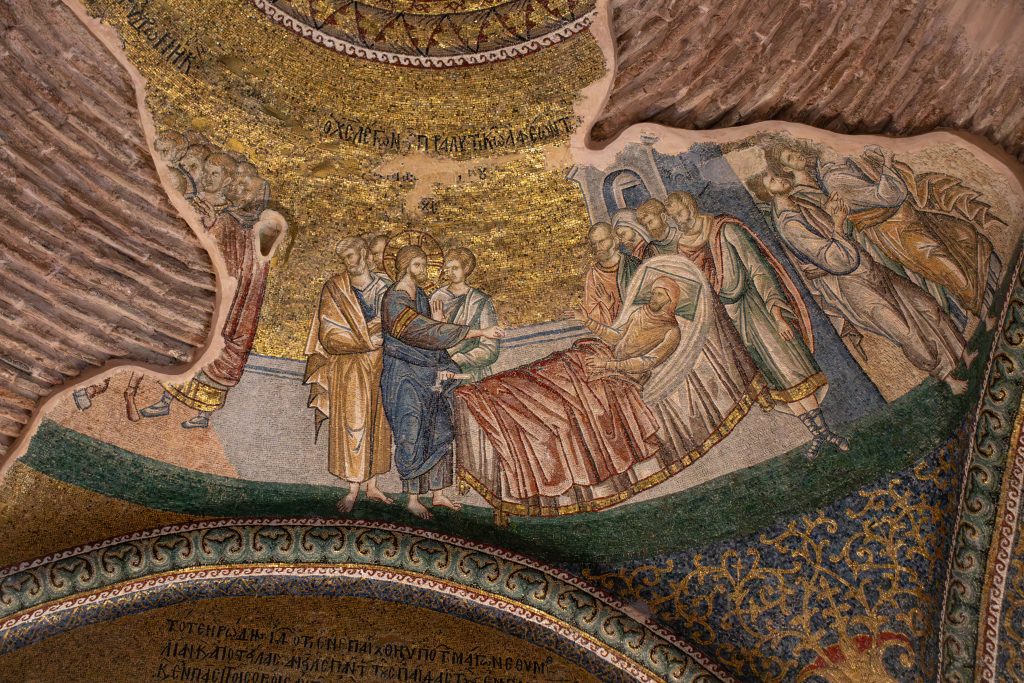
Her case in point was the parable commonly designated the “Good Samaritan” (Luke 10:25-37). Dr. Barot took that well-known, much-loved, and many-layered parable and turned it on its head. Emphasizing the mostly lost humor of Jesus’ preferred, parable-based teaching style, she advised her audience to approach the parables with something like caution, alert for the inevitable twist in the tale.
“If you read a parable and identify with the good guy,” she cautioned, “you have missed the point.”
To her mind, Jesus’ original hearers would have recognized that they themselves were the target of his gently sharp wit. They would have recognized the indifferent passers-by as caricatures of their own leadership. And they knew perfectly well that it was the Samaritan who proved the good neighbor, coming to the aid of the battered and crippled victim in the ditch. The real point of the tale, she observed, was the guy in the ditch.
For the guy in the ditch was a Jew, as the audience were Jews. And as Jews they had been raised to revile the hated other, the Samaritan. And now the guy in the ditch owed his very life to such a person. Forgive the vernacular, but: wow.
And that is the Bible, from Genesis to Revelation: just when the most faithful and devout reader thinks he has got it, there is always one more surprise. And it is precisely at that moment, in what the priest, poet, and theologian John Shea calls “the hour of the unexpected,” that freedom of religion, and freedom in religion, takes our breath away in the wideness of God’s mercy: never contracting, always expanding.
For the Christian, then, cosmopiety must be rooted in the Scriptures of the tradition. Biblical Universalism serves to undergird Christian dialogue in interfaith engagement in general, and the work of the G20 Interfaith Forum in particular. In the two essays to follow, I will trace that universal thread first through the Hebrew Scriptures, and then through the New Testament.
———
James Taylor Christie is Professor Emeritus of Theology at the University of Winnipeg, where he served for some fifteen years as Dean of the Faculty of Theology, founding Dean of the Global College, and Director of the Ridd Institute for Religion and Global Policy. An ordained minister of The United Church of Canada and a past president of the Canadian Council of Churches, he is a pioneer of dialogue theology and “whole world ecumenism,” and the inaugural Ambassador-at-Large for the Canadian Multifaith Federation. A longtime ally of the G20 Interfaith Forum and a frequent contributor to its Viewpoints blog, he writes at the intersection of faith, scripture, and global policy, in the conviction that the world’s religions are called to speak, and to work, with one another.