

JoAnne Wadsworth, Vice Director of Communications for the G20 Interfaith Forum (IF20)
———
On October 16, 2026, the G20 Interfaith Forum held “Plenary 2: Deadline 2030: Extending G20 Horizons” at the University of Utah Institute of Religion in Salt Lake City. With four years remaining until the 2030 deadline for the UN Sustainable Development Goals (SDGs), the session asked what lies on the more distant horizon for peace, prosperity, and care for the planet.
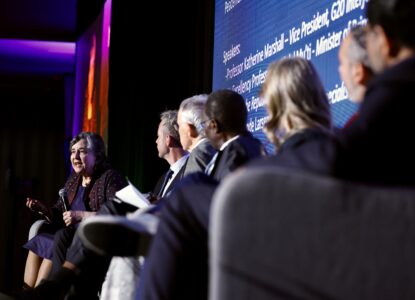
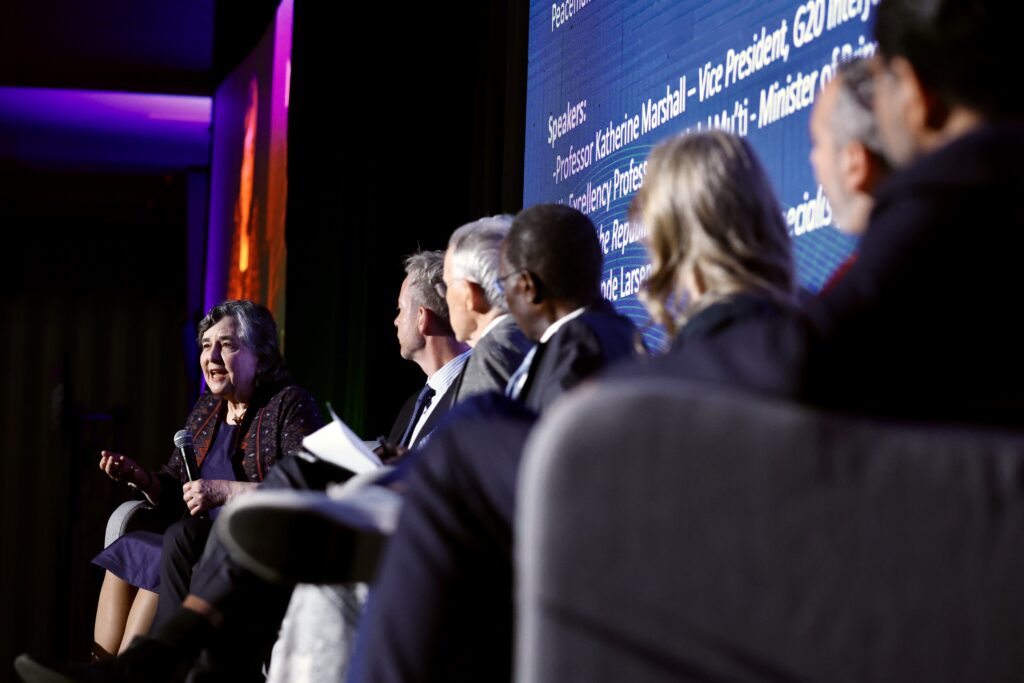
Keynote addresses were delivered by The Honorable Scott Morrison AC, 30th Prime Minister of Australia, and Professor Melissa Rogers, Distinguished Scholar in Faith, Law, and Public Policy at Wake Forest University School of Divinity. Panelists included Professor Katherine Marshall, Vice President of the G20 Interfaith Forum Association; Dr. Esben Lunde Larsen, Senior One Health Specialist at The Pandemic Fund at the World Bank; Reverend Dr. David Beckmann, President Emeritus of Bread for the World; Elissa McConkie Gifford, Director of Humanitarian Services, Welfare and Self-Reliance Services, The Church of Jesus Christ of Latter-day Saints; Steve Messeh, Director of the Center for Faith at the U.S. Department of Agriculture; and H.E. Cheikhna Al Mahfoudh Bin Bayyah, Secretary General of the Abu Dhabi Forum for Peace. Dr. Mohamed Elsanousi, Executive Director of the Network for Religious and Traditional Peacemakers, moderated the discussion.
The Honorable Scott Morrison AC
Morrison argued that politics cannot replace religion. When political promises take on religious characteristics, he said, they cannot be fulfilled and lead generations in the wrong direction.
“Science can tell us what, but it can’t tell us why, and it can’t tell us what direction we should head in. I think that’s where faith comes in: it does provide moral direction and a moral guide.”
Noting that the Latin root of “religion” means “to bind,” Morrison said faith has created sustained moral communities that establish trust between strangers and reject the us-versus-them dualism that externalizes conflict. Violence comes from trying to impose truth by force, and religion and power should never be confused, but that is never an argument for sidelining religion. Moving beyond tolerance to love produces the charity and hospitality that make pluralistic societies possible, and it gave rise to hospitals, schools, and care institutions that modern states have adopted while forgetting their faith origins. That is what human flourishing means, he said, though the phrase is rarely heard at G20 tables, where rights are discussed without reference to their source and risk becoming relative or arbitrary when defined by the created rather than the Creator.
Morrison acknowledged he was preaching to the choir, but said these sentiments do not dominate the tables where he sits. Religion is routinely blamed for the world’s problems, yet the answer to bad religion is not no religion but good religion; the world has enough religion to know how to hate, but not enough to know how to love. He urged faith communities not to vacate the field or be forced from it; to stay salty rather than blending into prevailing culture and politics; to stay humble, infusing society through the good religion they practice rather than coercing others, since the state will not make a holy nation; and to attend to their own governance through transparency, accountability, and integrity.
Professor Melissa Rogers
Rogers said the Forum meets at a time of urgent and daunting challenges but also great hope, and that the IF20 network, launched more than a decade ago, continues to bear good fruit and is needed more than ever. There is growing consensus, she said, that we cannot understand our nations or our world without understanding religion. The Ebola response in West Africa required not only public health, legal, and policy experts but also religious leaders and faith-based organizations, since burial practices were spreading the virus and faith personnel were heroically fighting it. Governments frequently cannot work effectively without partnering with people of goodwill, which calls for greater religious literacy and collaboration.
Rogers also pointed to growing consensus around multifaith groups that forge common strategies based on shared beliefs while maintaining distinct traditions and real disagreements. She called for restoring humanitarian aid where it has been slashed, promoting religious freedom for everyone, everywhere, and speaking up when leaders claim to promote religious liberty while spreading falsehoods about other faiths. Because the executive branch can be notoriously difficult for faith communities to navigate, she urged the IF20 to develop a more robust process for developing recommendations and carrying them through to the G20.
“Providing humanitarian relief for the most vulnerable people in the world is not only the right thing to do, it is the smart thing to do.”
Professor Katherine Marshall
Asked how to close the gap with only four years left to reach the SDGs, Marshall said that for most of human history, people assumed the poor would always be with us. That is no longer true: a decent life for every person is possible, as many parts of the world have shown, and that knowledge brings a responsibility to end extreme poverty. Leaving no one behind is at the core of the IF20’s morality and ethics, she said, and must be translated into policy that moves from bandages to truly sustainable development. The IF20 pairs the message that a better world is possible with practical work on how to achieve it from the community to the global level, with children’s health and care among the most obvious areas for engagement. Through its network of networks, the IF20 can offer framing and practical, doable propositions.
Dr. Esben Lunde Larsen
Elsanousi noted that the World Bank’s goal of delivering quality health services to 1.5 billion people by 2030 was set back by the pandemic, during which faith communities worked on vaccine confidence and access. Lunde Larsen shared that he was born in Denmark with heart failure and underwent surgery at nine months old with a 50 percent chance of survival. He was lucky, he said, but millions are not, and the world needs better health infrastructure, capacity, and workforce. The Pandemic Fund, established in 2022, works with some $11.5 billion to build laboratories, develop health workforces, and more.
Faith-based organizations are key partners, Lunde Larsen said, but they are not yet sufficiently part of the model. He proposed organizing faith communities into national councils that governments can work with, along with financial mechanisms for co-investment, to which faith-based organizations can contribute in cash or volunteer hours. He hoped IF20 participants would help organize such councils, a tangible way for faith actors to gain a seat at the table, and stressed that they must include young people, since reaching the last mile will require both technology and youth.
“The future is built by the youth and they need to be part of the table and the conversation.”
Reverend Dr. David Beckmann
Asked how people of faith can strengthen political commitment to the SDGs, Beckmann said recent decades have seen more progress against poverty than any time in human history, but that progress is grinding to a halt. He attributed this to a shift in the priorities of the world’s most powerful governments, led by the United States, including cuts in aid, mass deportation, disruption of global efforts on climate change, and now war in the Middle East, all of which are increasing poverty and hunger. G20 summits have discussed the SDGs for many years, he noted, but they are absent from this year’s U.S. agenda. Forum participants can urge governments to raise these concerns in December, focusing on specific steps governments may be open to.
Beckmann noted that Latter-day Saints are known for their generosity and expressed hope that it can be brought more fully into national policy debates. Prayer, too, is powerful, he said, because it shapes the people who pray, and public prayer shapes entire congregations.
“Whenever people of faith vote, we should remember God’s special concern about people in need.”
Elissa McConkie Gifford
Elsanousi noted that The Church of Jesus Christ of Latter-day Saints spent $1.58 billion on humanitarian aid and welfare services in 2025, and that Gifford’s predecessor, Sharon Eubank, had observed that material aid alone does not always achieve lasting outcomes, which also depend on relationships, infrastructure, reduced corruption, and the ability to work together. Gifford said that despite such investment, much remains to be done. The Church works to strengthen women and children both by partnering with nonprofits and governments to strengthen systems and by working at the grassroots, opening its meetinghouses during the week for other purposes. On a Saturday, she said, a meetinghouse may be filled with families who have come for nutrition screenings, interacting with government health workers and Church volunteers. Starting with children, literacy, health, and self-reliance, the Church draws on its beliefs and volunteers to strengthen communities through stronger families and individuals.
“We believe in creating an environment where people have the agency to make better choices for them and for their family.”
Steve Messeh
Elsanousi noted that roughly 2.38 billion people worldwide are Christian, 1.9 billion are Muslim, and 1.2 billion are Hindu, a diversity also reflected in the United States, and asked how the USDA engages religious actors inclusively. Messeh said he works every day at the intersection of religion and politics, and that the larger framing for the 2030 goals must be the relationship between government and faith. Today’s problems are too dire to wait for government solutions that are often a dollar short and a minute too late, he said; instead, governments should empower, resource, and walk alongside faith-based organizations. His office works with groups of many backgrounds to ensure people of faith can participate in food and nutrition programs while removing the strings that often come with government funding, which he called good governance. During the COVID-19 pandemic, the USDA partnered with local faith-based organizations to deliver 17 million boxes of food, some 487 million pounds worth $813 million, through the Farmers to Families Food Box program.
“That’s not a political strategy. That’s not a sermon. That’s government and faith communities working hand in hand.”
H.E. Cheikhna Al Mahfoudh Bin Bayyah
Asked how his platforms can help realize the SDGs, Bin Bayyah said he works with many people who have never heard of the SDGs and are not waiting for 2030 to act. He described an effort that delivered one billion meals in a single year with government support and is now repeated every Ramadan, helping people access government assistance and learn how to apply for it. A man rushing to sell his fifty cows because there will not be enough rain for them to survive cannot wait until 2030, he said; people need education, health care, and help now.
Bin Bayyah offered one suggestion: that the IF20 recommend that G20 leaders fast for one day when they meet in Miami, while the religious community prays for them throughout that day to guide them to their best decisions. To help the hungry, he said, you need to feel hunger yourself.
Concluding Remarks
After taking questions from the audience, panelists offered final reflections. Marshall said that because a better world is possible, the task is to bridge the gulfs that remain, including between humanitarian aid and development. Lunde Larsen said science shows that societies without freedom of speech and freedom of religion become corrupt, and that because politicians care about votes, faith communities that organize can mobilize better decisions. Beckmann agreed, adding that people should be organized to reach their leaders wherever they are. Gifford said there is reason for hope, given how much progress has been made since the goals were set through people working together in small groups, and that continued local focus can bring greater change.
Messeh, a Coptic Christian, said that religious freedom policies that protect only the majority and ignore minorities miss the mark.
“We must include the least, the lost, and the land.”
Bin Bayyah closed by reminding participants that it is not right to go to sleep with a full stomach while one’s neighbor goes to sleep hungry, and urged them to remember the hungry around the world.
———
JoAnne Wadsworth is Vice Director of Communications for the G20 Interfaith Forum (IF20) and Editor of Viewpoints, IF20’s platform for commentary at the intersection of faith and global policy. She has covered the work of the Forum across multiple G20 cycles, producing summaries, articles, and editorial content that bring the voices of interfaith leaders and scholars to a broader audience. Her writing engages with topics spanning environmental governance, religious freedom, anti-racism, poverty and inequality, and the role of faith in multilateral policy processes. Passionate about interfaith dialogue, she believes that good storytelling has the power to change the world.