


Religious Liberty, Human Flourishing, and the Foundations of a Free Society
By Dr. Marianna Richardson, Director of Communications for the G20 Interfaith Forum and Member of the ICLRS International Advisory Council
———
The 33rd Annual International Law and Religion Symposium was held October 4–6, 2026, at Brigham Young University in Provo, Utah, under the theme “Building an Infrastructure for Freedom of Religion or Belief.” Hosted by the International Center for Law and Religion Studies (ICLRS) at BYU’s J. Reuben Clark Law School, the annual symposium has convened since 1994 and gathers government, academic, and religious leaders from around the world. In the summary below, Dr. Marianna Richardson reflects on the symposium’s central themes, from religious liberty as a foundation for other freedoms to the relationship between justice and mercy.
The International Center for Law and Religion Studies (ICLRS) Symposium at Brigham Young University brought together legal scholars, government officials, religious leaders, and civil society representatives from around the world to examine the role of religious freedom in sustaining peaceful, just, and flourishing societies. For more than three decades, the symposium has served as one of the world’s leading forums for the discussion of freedom of religion or belief, bringing together participants from scores of countries to explore both the practical and philosophical foundations of religious liberty.
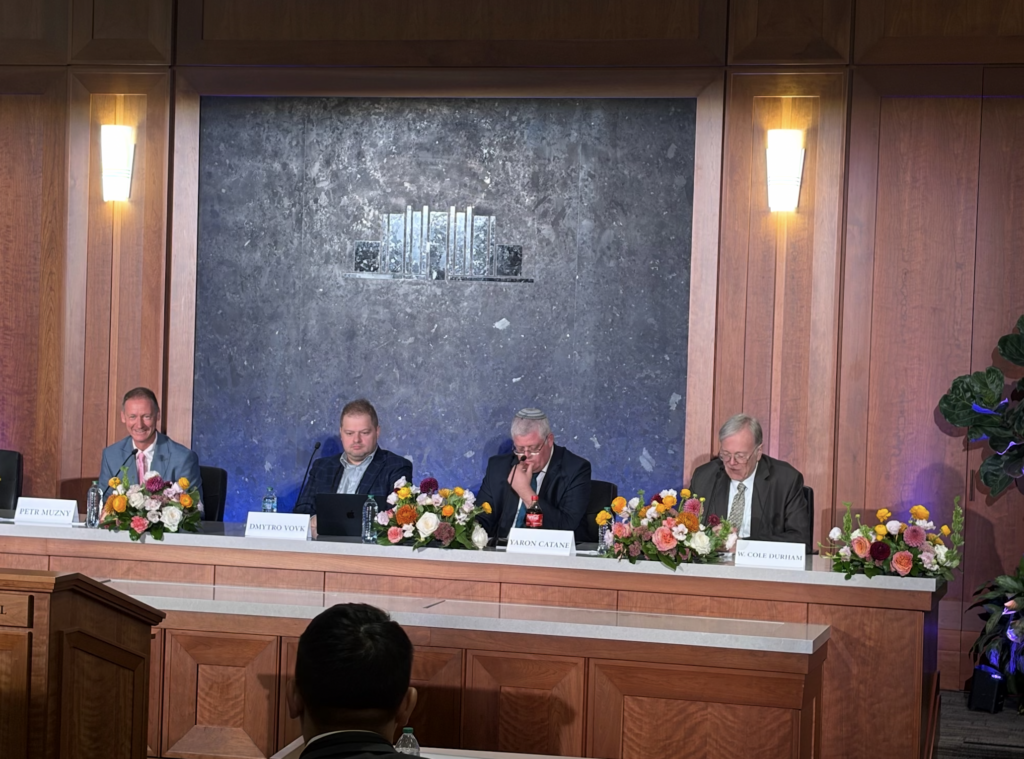
A central theme of the symposium was the understanding that authentic religious belief must arise from free choice rather than coercion. Religious practice loses its meaning when imposed by force, whether by governments, institutions, or social pressure. Participants emphasized that freedom of religion and freedom of conscience are rooted in human agency and moral responsibility. Individuals must be free to seek truth, worship according to their convictions, change their beliefs, or refrain from religious practice altogether without fear of punishment or discrimination.
Several speakers argued that religious liberty is not merely one right among many but serves as a foundation upon which other fundamental freedoms rest. Freedom of speech, freedom of association, and freedom of assembly all depend upon the recognition that individuals possess inherent dignity and the capacity to make meaningful moral choices. Discussions emphasized that the state’s primary role is not to grant rights but to protect preexisting human freedoms from arbitrary interference. Religious liberty therefore functions as an important limitation on governmental power and as a safeguard against authoritarianism. These themes parallel recent symposium discussions describing religious freedom as a cornerstone of other human rights and liberties.
Participants also explored the distinction between the negative and positive dimensions of freedom. The negative dimension of religious liberty involves protecting individuals and communities from coercion and unjust government intrusion. The positive dimension goes further by creating social and legal conditions that allow individuals and faith communities to flourish. A free society does not merely tolerate religious belief; it creates space for individuals and communities to act upon deeply held convictions through worship, education, charitable service, family life, and participation in civil society.
An important area of discussion focused on the relationship between religion, family, and private property. Presenters described these institutions as mutually reinforcing pillars of a healthy and free society. Families serve as the primary setting in which values, culture, faith traditions, and civic responsibilities are transmitted from one generation to the next. Private property provides stability and independence, allowing families and religious communities to sustain themselves without excessive dependence on political authority. The rule of law, therefore, must protect both property rights and religious exercise if families and communities are to flourish. Speakers suggested that weakening any one of these institutions can undermine the strength of the others, diminishing both personal freedom and social stability.
The Philosophical Foundations of Freedom
The symposium also examined the philosophical foundations of human freedom. Several presenters challenged narrowly materialistic or purely empirical understandings of human reason. While empirical science is indispensable for understanding the physical world, participants argued that some of humanity’s most important experiences, including moral obligation, religious belief, love, justice, beauty, and meaning, cannot be fully explained through empirical observation alone. Excluding these dimensions from public discourse risks reducing human beings to economic or biological actors rather than recognizing them as moral agents capable of pursuing truth and transcendence.
Discussion frequently returned to the relationship between justice and mercy. Participants warned that when societies lose sight of transcendent principles and objective moral standards, justice can become vulnerable to political power rather than grounded in human dignity. Religious traditions were presented as valuable contributors to public life because they help preserve moral frameworks that encourage both accountability and compassion. In this view, genuine justice requires not only the fair application of laws but also a commitment to mercy, reconciliation, and the protection of human dignity.
A Universal Right in a Divided World
Throughout the symposium, speakers highlighted the growing global importance of protecting freedom of thought, conscience, and religion amid rising political polarization, social fragmentation, and ideological conflict. Recent ICLRS gatherings have similarly focused on themes such as peacemaking, human dignity, flourishing, and the protection of conscience rights across diverse societies. Participants stressed that religious freedom is not solely a concern for religious communities but a universal human right that contributes to social cohesion, democratic resilience, peaceful coexistence, and the common good.
The symposium concluded with a call for continued collaboration among governments, faith communities, academic institutions, and civil society organizations. Protecting religious liberty requires both strong legal protections and a culture of respect that recognizes the dignity and conscience of every person. In an increasingly interconnected world, participants affirmed that freedom of religion or belief remains essential to building societies characterized by justice, peace, and authentic human flourishing.
———
Dr. Marianna Richardson is the Director of Communications for the G20 Interfaith Forum (IF20), where she writes regularly on how faith communities contribute to the G20 agenda, from interreligious education to economic equity and Africa’s development priorities. She serves on the International Advisory Council of the International Center for Law and Religion Studies at Brigham Young University and has received the J. Reuben Clark Law School’s Wendy C. Archibald Meritorious Service Award. She is also an adjunct professor of management communication at the BYU Marriott School of Business. Her writing on the Forum includes “Becoming a Network of Networks: G20 Interfaith Forum” in the Journal of Nonprofit Innovation (2025), and she holds a master’s degree from Johns Hopkins University and a doctorate from Seattle Pacific University.