

By Marianna Richardson
On Tuesday February 3, the G20 Interfaith Forum hosted a side event at the 2026 International Religious Freedom Summit entitled, “Faith, Policy, and the Future: A Cohesive Vision for the G20 Interfaith Forum.” This two-part blog series summarizes that event. Watch the full session here.
Introduction: A Moment of Opportunity and Responsibility
Across the world, religious communities are stepping into a pivotal moment. The challenges facing humanity—economic instability, technological disruption, climate change, and widening inequality—are global in scale and moral in nature. The G20 Interfaith Forum (IF20) has emerged as a vital platform where faith leaders, scholars, policymakers, and civil society actors work together to bring ethical insight and human-centered values into global decision-making. As the United States hosts the G20 this year, IF20 is preparing a series of policy reports, convenings, and collaborative initiatives designed to influence the international agenda and elevate the moral voice of the world’s religious traditions.
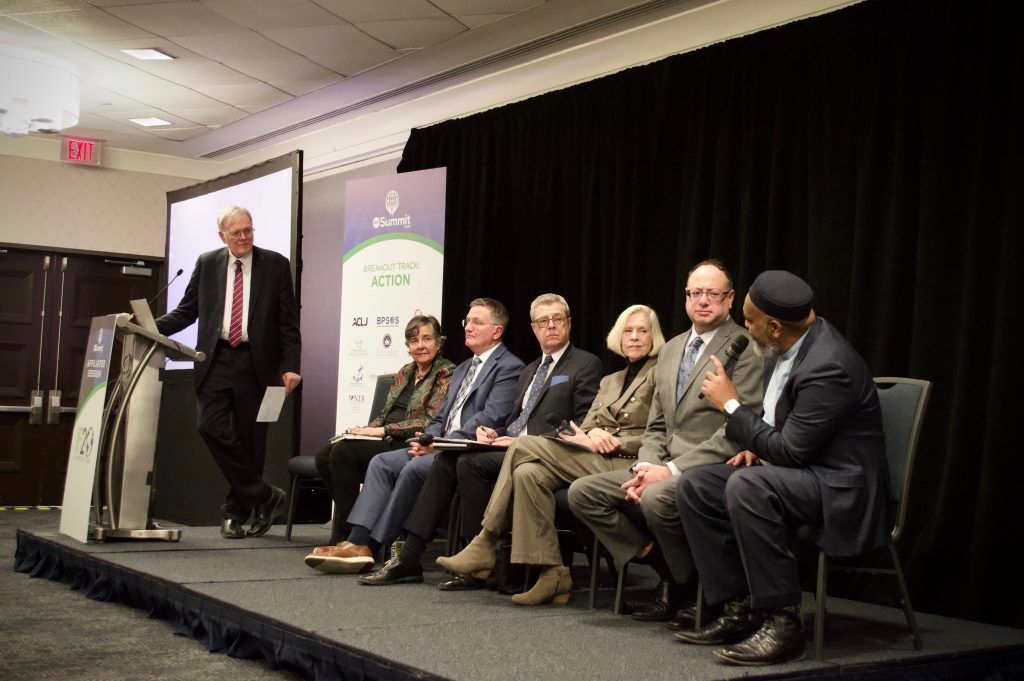
During the International Religious Freedom Summit, IF20 sponsored a side event that brought together the key themes, insights, and commitments as IF20 prepares for this year – G20 USA 2026. The speakers included Pres. W. Cole Durham, Jr., president of IF20; Katherine Marshall, vice president of IF20; Marianna Richardson, IF20 director of communications; Brian Grimm, founding president of the Religious Freedom & Business Foundation; Eric LeCompte, executive director of Jubilee USA Network; Brett Scharffs, director of the International Center for Law and Religious Studies; and Imam Mohamed Magid, executive Imam of All Dulles Area Muslim Society (ADAMS) Center. The message expressed throughout the panel was a shared conviction that the world has the resources, knowledge, and capacity to build a more just and compassionate future. Faith communities have a critical role to play in shaping it.

Preparing Policy Frameworks for Global Impact
Developing Four Core Policy Reports
The IF20 is producing four major policy reports this year, each aligned with the priorities set by the G20 host country while reframing those priorities through the lens of religious values and ethical responsibility. Over the next several months, experts across the Forum’s networks will contribute feedback, with preliminary versions presented at the Washington Policy Forum at Georgetown University. Polished reports will be released at the G20 Interfaith Forum in Salt Lake City.
Each report addresses a central global challenge:
- Economic Growth for the Common Good
- Energy Security for a Sustainable Future
- Artificial Intelligence and the Human Future
- Interfaith Engagement and the Sustainable Development Goals
These reports are not merely academic exercises. They are intended to influence the thinking of world leaders, shape policy debates, and highlight the contributions of faith communities to global problem‑solving.
Reframing G20 Priorities Through Religious Insight
Economic Growth for the Common Good
The first U.S. priority—unleashing economic prosperity—is often framed in terms of reducing regulatory burdens to stimulate growth. The IF20 reframes this as a moral question: How can economic systems promote the common good? How can growth be paired with justice, equity, and service to the vulnerable? Faith communities, with their deep experience in poverty alleviation and community development, offer essential perspectives on these questions.
Energy Security for a Sustainable Future
The second priority—energy security—raises urgent ethical concerns. The IF20 emphasizes that energy policy must be aligned with sustainability, climate responsibility, and stewardship of creation. Religious teachings across traditions call for care of the earth and protection of future generations. The report will explore how faith communities can support sustainable energy transitions and advocate for policies that balance security with environmental responsibility.
Artificial Intelligence and the Human Future
The third priority—technological innovation—has become one of the most pressing moral issues of our time. The IF20’s report on AI focuses on how emerging technologies can be developed in ways that protect human dignity, promote justice, and serve the common good. It asks, How do religious values inform our understanding of AI? How can we ensure that technological progress does not undermine human relationships, exacerbate inequality, or erode ethical norms?
Interfaith Engagement and the Sustainable Development Goals
The fourth report will address the United Nations Sustainable Development Goals (SDGs), which are now halfway through their intended timeline. The argument is that the SDGs were “engineered for failure” because they largely ignored the role of religion, even though none of the goals can be achieved without genuine partnership with faith communities. These priority policy papers will call for systematic, substantive engagement with religious actors, not symbolic gestures. The goals is to outline concrete ways to integrate faith-based contributions into global development strategies.
Artificial Intelligence and Interfaith Dialogue: A Growing Imperative
Why AI Belongs in Interfaith Conversations
AI is reshaping society at a pace that outstrips public understanding and regulatory capacity. Yet its intersection with interfaith engagement remains underexplored. The IF20 has spent the past three years building a global conversation around AI ethics, human dignity, and the responsibilities of faith communities in shaping technological futures.
Four Ethical Priorities for Faith Communities
One speaker outlined four key concerns:
- AI should not be blamed for all societal problems—regulation, not scapegoating, is needed.
- Religious leaders must counter AI-driven isolation by fostering human connection, especially among youth.
- Communities must learn to critically evaluate AI-generated information, including deepfakes and misinformation.
- Interfaith cooperation is essential to combat intolerance and disinformation amplified by AI systems.
These concerns have led to the creation of an AI Interfaith Task Force, bringing together technologists and religious leaders to develop ethical guidelines and advocate for international standards.
Lessons From Global Dialogues
The IF20’s AI discussions began in New Delhi in 2023, shortly after the release of ChatGPT. Early conversations were marked by uncertainty, but Pope Francis’s call for AI to be accountable, impartial, and secure provided a moral anchor. Subsequent meetings in Pune, Brasília, and South Africa deepened the conversation, introducing powerful analogies—AI as a Trojan horse, AI as a tool like a gun—and highlight the urgent need to protect youth from misinformation and emotional manipulation.
– – –
Marianna Richardson is the Director of Communications for the G20 Interfaith Forum. She is also an adjunct professor at the Marriott School of Business at Brigham Young University.