
By JoAnne Wadsworth, Communications Consultant, G20 Interfaith Forum
– – –
On February 26, 2026, the G20 Interfaith Forum’s Anti-Racism Initiative, in cooperation with the International Academy of Multicultural Cooperation (IAMC), held a webinar entitled “Same Colonizers, Different Ships? The Construction of Amazon’s Africa Headquarters in Cape Town and Its Ecological Costs for Indigenous People.”
Speakers included Gaob Martinus Fredericks, a historian of Khoi and San life in the Cape region, former biophysical and environmental specialist for the City of Cape Town, and a leader of the Nama people descended from a long line of Nama chiefs; and Danab Dr. Gregg Fick, interim leader of FINSA (First Indigenous Nation of Southern Africa), an organization fighting for First Nations status, self-determination, and self-governance for the Khoi and San people of Southern Africa. Marita Anna Wagner, a German theologian who studied at the Universities of Pretoria and Cape Town, lived in Observatory, and became directly acquainted with the Amazon construction project and the resistance of Indigenous communities against it, moderated the discussion.
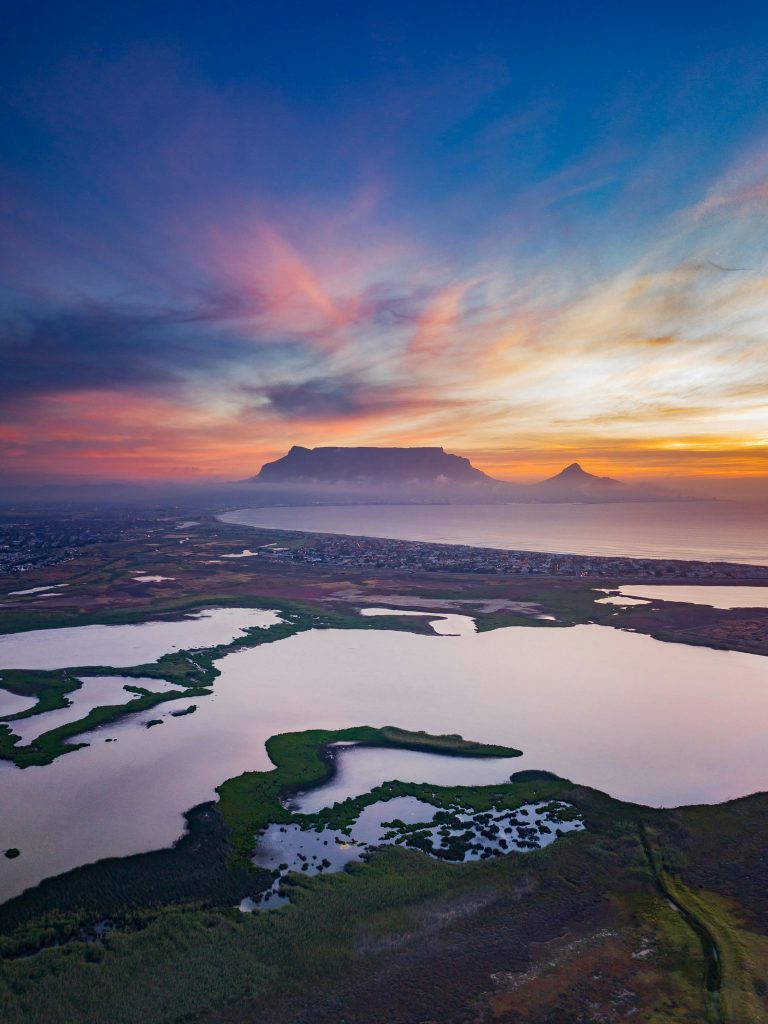
Wagner opened by noting that the Amazon construction project in Observatory, Cape Town, is emblematic of the intersection of global capitalist power, escalating ecological crisis, and ongoing struggles over Indigenous representation and land rights. She introduced the site’s location — where two rivers, the Liesbeek and the Black River, converge — and invited both panelists to present their accounts.
Gaob Martinus Fredericks
 Fredericks began with a historical survey tracing the Cape’s entanglement in global trade from as early as 1000 BCE, through the age of exploration and the arrival of the Dutch East India Company, and up to the present. He described how Jan van Riebeeck, learning from the fatal mistake of Portuguese Viceroy Francisco de Almeida — who was killed at the very site where the Amazon building now stands after he arrested Khoi women and children — took a softer approach, using trade and local intermediaries to gain a foothold. That foothold led to permanent settlement, and eventually to the series of Khoi-Dutch wars and the systematic dispossession of the Khoi and San people from their ancestral lands.
Fredericks explained that the confluence of the Liesbeek and Black Rivers — a site the Khoi knew as Kamarodi Kais, meaning “where the stars gather” — served multiple interlocking functions for the Indigenous community: as seasonal grazing land, a place of cultural and inter-tribal exchange, a site for spiritual practice and celestial navigation, and ancestral burial ground. He argued that the Amazon headquarters, now obstructing sight lines between Observatory and Table Mountain, severs a sacred portal that Indigenous people have used for centuries.
On the choice of the site, Fredericks was direct:
“By the developers forcing to use that particular site, they created division amongst Indigenous people” — co-opting some through financial incentives while creating proxy leaders to circumvent the requirement of free, prior, and informed consent. He described this as a blueprint now being replicated across the Western Cape and beyond. In his view, the pattern is unchanged from earlier colonial eras: “It’s not just a matter of the wooden ships that came here early in the 1400s, 1652. The impact is very much the same.”
Fredericks also addressed the broader marginalization of the Khoi and San people within post-apartheid South Africa: their languages are absent from the official curriculum and declared extinct in school textbooks; their ancestral lands are being auctioned off internationally; and the amended Employment Equity Act actively reduces employment opportunities for so-called “coloured” people — the administrative category under which Indigenous Khoi and San descendants are classified. “Your language is an indicator of your identity,” he said. “It links you to your customs, your cultures, your traditions, and finally to your ancestral land.”
Danab Dr. Gregg Fick
Fick grounded his presentation in the sacred significance of the Two Rivers (Twee Riviere) site as understood by the Khoi and San community. He described it as the place where newborns were cleansed in ceremonies analogous to baptism, where young people underwent rites of passage, where elders fished and gathered, and where, in the adjacent Black River Cemetery, over 6,000 Indigenous people are buried — many of them victims of diseases, including the Spanish flu, that colonialists deliberately spread through infected blankets.
Fick recounted FINSA’s legal battle against the construction, in which they secured a court victory — only to learn that the judge who issued that ruling, Judge Goliath, subsequently survived an assassination attempt. Despite this, Fick said his message to Indigenous people globally is one of possibility:
“We might not have money, we might not have weapons, but there is an opportunity that we can use to fight with them. And we fought them, and we won.”
Fick explained that the so-called “coloured” classification — a legacy of apartheid’s racial coding system, under which identification numbers ending in codes such as 087, 088, and 089 legally designate a person as a “bastard” — persists in South African governance today despite being formally repealed in 1991. He argued that this erasure is not incidental but structural: the South African government has rejected recommendations from both the South African Human Rights Commission and the United Nations Special Rapporteur regarding the rights of the Khoi and San people, while using proxy leaders to present a false impression of Indigenous consent at international forums.
He also drew attention to the role of mainline churches — Anglican, Catholic, and Dutch Reformed — which were made custodians of Indigenous land under the Mission Stations and Reserves Act, and which are now selling that land rather than returning it.
“If you take the people’s language, you take the people’s land, then you take the people’s life,” Fick said. “And this is also part of a genocide.”
He emphasized that the Khoi and San are a spiritual, not merely religious, people: “We might, in our own language, speak to Him as Chiqua, but He is our Creator.”

Question and Answer Session
Why is this not simply a local Cape Town issue?
Fick argued that the tactics deployed against the Khoi and San — bribery, manufactured proxy leadership, legal attrition — are not unique to South Africa, but part of a global strategy affecting Indigenous and Aboriginal communities from Australia and New Zealand to the Americas. He called for the formation of an Indigenous and Aboriginal United Nations: “We need to join forces, we need to become one… we cannot fight an international neo-colonial system if we’re going to do it on our own.”
What other challenges do the Khoi and San face?
Fredericks described a layered dispossession: fishing in ancestral waters has been criminalized; pristine ancestral areas have been fenced off as commercial conservation parks; sacred plants like rooibos have been commercialized under the Nagoya Protocol, which vests control in the state rather than in Indigenous communities. “Without land, we cannot survive,” he said. “It is taking us spiritually away from our ancestral connection.”
Concluding Remarks
As the session closed, Fredericks expressed hope that the webinar could seed a broader movement of awareness and direct networking across Global North and South:
“We are interconnected, we are linked to each other in a very, very strange way. What happens in the Global South also affects people in the Global North, and vice versa.”
Fick closed with a call to self-determination rooted in Indigenous identity rather than external recognition:
“We don’t need their recognition to be human. We are humans. And therefore, we have the right to fight for our right to self-determination and for equality. And I believe that we will achieve that if we do it as a united force.”
Wagner thanked both panelists for opening their lived experience to a global audience, and invited participants to contribute personal narratives to the G20 Interfaith Forum web blog. The webinar recording is available on the Anti-Racism Initiative’s website and the G20 Interfaith Forum’s YouTube channel.
– – –
JoAnne Wadsworth is a Communications Consultant for the G20 Interfaith Association and acting editor of the “Viewpoints” blog.