
By JoAnne Wadsworth, Communications Consultant, G20 Interfaith Forum
———
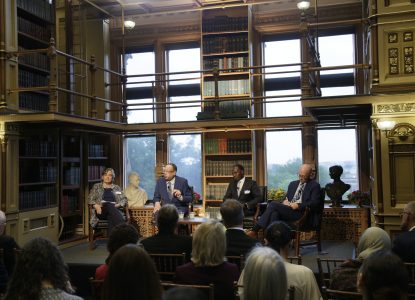
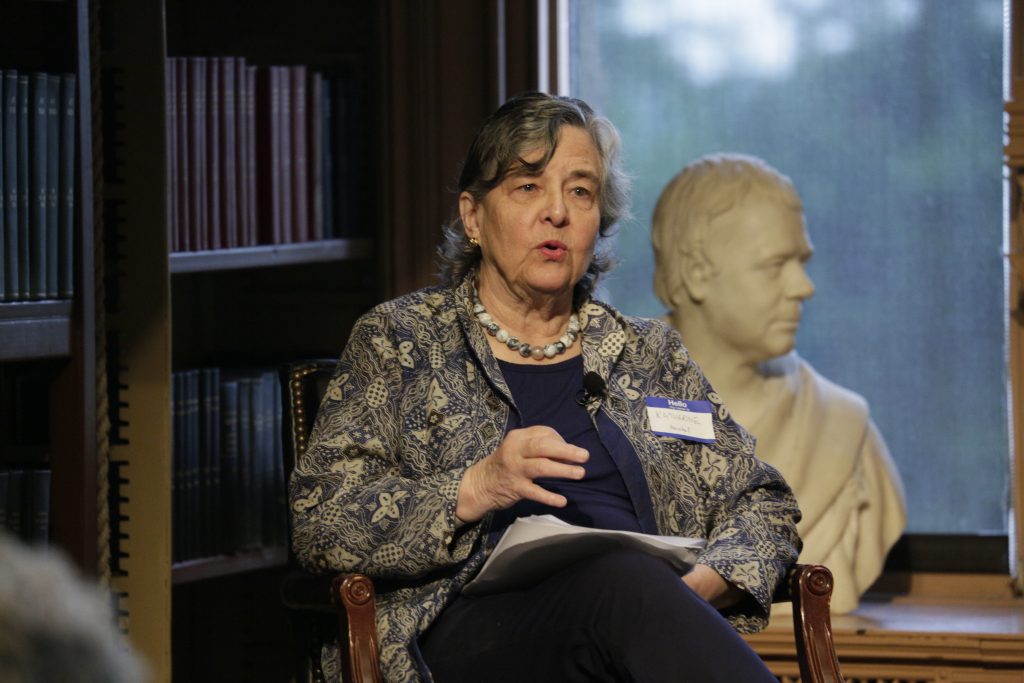
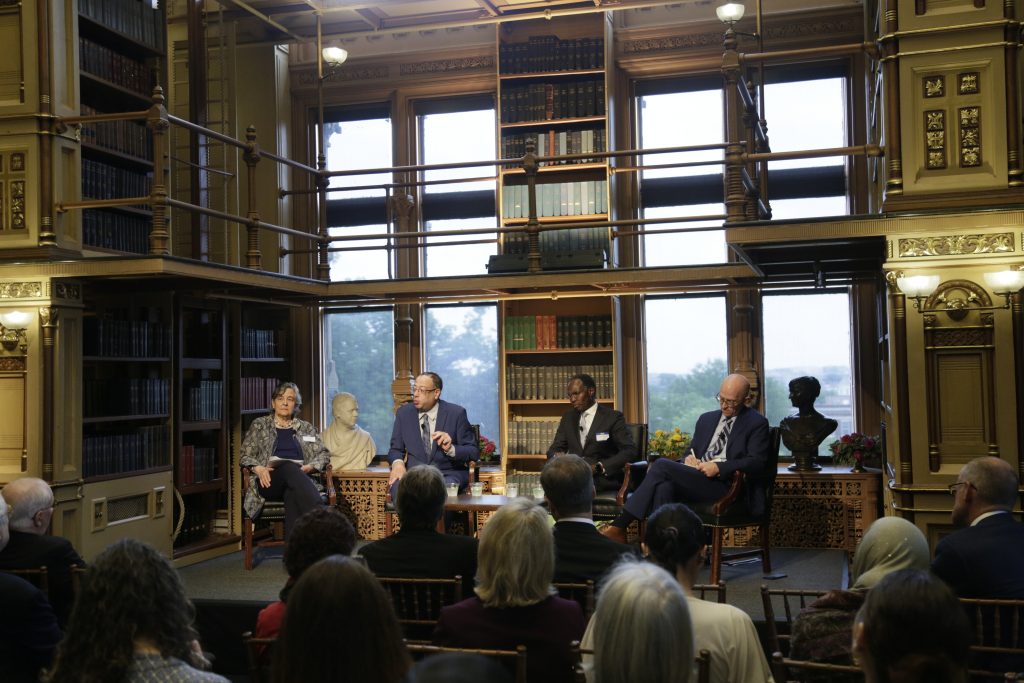
On May 26th, the G20 Interfaith Forum (IF20), in partnership with Georgetown University’s Berkley Center for Religion, Peace, and World Affairs and Brigham Young University’s International Center for Law and Religion Studies (ICLRS), convened a select group of scholars, practitioners, and policy experts in the historic Riggs Library at Georgetown University. Over the gathering, participants worked together to discuss, challenge, and refine a set of IF20 policy papers organized around three focus areas for the coming G20 cycle. This summary—the first in a four-part series—covers the opening focus area: economics and finance. Because the meetings were held under the Chatham House Rule to encourage candor, the discussion is presented thematically, and no remarks or quotations are attributed to individual participants.
Setting the Stage: Faith and the G20 Agenda
The gathering opened with a sober reading of the moment: a world strained by war, displacement, deepening inequality, and the lingering effects of pandemic—an interlocking “polycrisis” that no single nation or sector can resolve alone. Against that backdrop, participants argued that the world’s faith traditions, which claim the allegiance of a clear majority of humanity and share a deep commitment to justice and peace, have a vital role to play in shaping policy—yet remain largely on the margins of the rooms where economic decisions are made.
Much of the framing returned to a single metaphor: the distance between the policy table and the people it is meant to serve. Too often, it was observed, faith actors complete only the “first mile” of engagement and then repeat it, never reaching the “last mile” where the voiceless actually live. The purpose of the meetings was to ask honestly what has worked, what has not, and why—and to sharpen IF20’s papers ahead of an October working session and the wider G20 process, with an eye toward the current U.S. presidency and the United Kingdom’s in 2027.
“The best indicator of real, lived policy is how resources are allocated and spent.”
From Deregulation to the Common Good
The first policy paper began under the banner of “Unleashing Economic Prosperity through Deregulation,” echoing a stated priority of the current G20 presidency. In discussion, its working title shifted to “Economic Prosperity for the Common Good”—a reframing meant to keep the engagement constructive while insisting that any deregulatory agenda be judged by whether the poor and most vulnerable are protected and share in the gains. Participants stressed that the paper remains a draft, offered for revision before October and the work of many hands rather than any single author.
The economic picture they surveyed was stark. Heavy sovereign debt, persistently high prices, severe food shortages, and stalled access to essentials such as fertilizer were described as a slow-moving emergency, with tens of millions pushed toward poverty and children dying from preventable causes. Drawing on the ancient tradition of Jubilee—the conviction that a resource-rich world is meant to be shared, and that debts must periodically be released—participants tied long-standing faith teaching to the live questions of debt relief and restructuring now before the G20. There was cautious hope that, with bipartisan and administration support, real progress on debt could come this year.
“It is absolutely incumbent on us to build a world where we are all protected from having too much or too little—a world where we all have enough.”
The Missing Middle and the Limits of Inclusion
A recurring theme was the gap between the enormous potential of faith-based institutions and the meager support they receive. Religious communities and faith-rooted NGOs are often the closest actors to the people they serve and the best read on local context, yet multilateral bodies—including the G20—have scarcely tapped them. Participants warned that the development landscape is shifting fast, with international NGOs withdrawing from conflict zones, and that faith-based organizations on the front lines will have to adapt rather than wait for a return to the old order.
Two practical concerns anchored the conversation. The first was the “missing middle”: the small and medium-sized enterprises that drive jobs and growth in developing economies but fall between microfinance and the formal economy. The second was inclusion—the persistent gap between good resolutions and actual implementation, with groups such as persons with disabilities too often left behind even in the programs designed to help them.
“The potential of faith-based institutions and NGOs is yet to be utilized by multilateral leadership. They’re the closest to communities, they know the context better than anyone else, and yet they receive very minimal support.”
Justice, Markets, and Moral Foundations
A more philosophical thread asked what genuine economic justice requires. Participants observed that the poor are rarely poor for lack of “stuff”; more often they are excluded from the systems that make prosperity possible—clear title to land, access to honest courts, and the simple ability to register a business and take part in the formal economy. On this view, rule of law, secure property, and free and fair exchange are not technical afterthoughts but the institutions of justice on which everything else depends—and policy is secondary to getting them right.
The discussion drew on long traditions of moral reasoning—distinguishing the justice of fair exchange from justice according to need, and invoking the principle of subsidiarity, which holds that problems are best solved by those closest to them rather than handed up to distant experts. Several voices cautioned that secularism is not a neutral backdrop but carries its own assumptions, and that markets cut loose from their moral foundations drift toward treating everything, and everyone, as a commodity.
“The market has been severed from its fundamental moral foundations, and now we have a hyper-commodification of individuals—visible in data collection, surveillance, and so much else.”
Engagement Without Instrumentalization
The open discussion turned candid on a hard question: how should faith communities relate to governments that may wish to engage them, use them, or ignore them altogether? Some participants pressed for franker engagement, arguing that defending democratic institutions and the dignity of the vulnerable is itself a moral task. Others worried about “instrumentalization”—the risk that religious actors become tools of whatever political agenda is ascendant, particularly when they depend on government funding.
The group did not resolve the tension, but a shared instinct emerged: authentic engagement is a long-term relationship grounded in mutual respect and knowledge, not a transaction. Dependence, several cautioned, quietly reshapes mission.
“When you make a deal with the devil, you are always the junior partner.”
Toward a Practical Recommendation
As the session moved toward action, several threads converged on a concrete possibility. If the G20’s stated appetite is for deregulation, participants suggested, faith advocates might channel it toward removing the barriers that keep small and medium enterprises from thriving: easing access to land ownership, banking, and business registration so that good, job-creating businesses are not regulated out of existence. The aim, they agreed, is to move beyond microfinance—which has lifted many out of abject poverty but rarely into the formal economy—and to help entrepreneurs, many of them women, cross into stable, growing concerns.
Running through the practical talk was a call for honest self-examination. Participants acknowledged that faith actors too often work, and complain, in parallel rather than together, and that they sometimes say what feels good rather than what moves decision-makers. Several urged IF20 to gather concrete case studies that governments can actually use, and to resist simply repeating the “first mile.”
“Where is the autopsy of why interfaith efforts are failing?”
The summary closes on that challenge—an invitation to candor, collaboration, and a clearer path from conviction to measurable policy impact. The conversation continues in the next three installments of this series, covering the gathering’s remaining focus areas.
———
JoAnne Wadsworth is a Communications Consultant for the G20 Interfaith Forum Association and Editor of the Viewpoints Blog, IF20’s platform for commentary at the intersection of faith and global policy. She has covered the work of the Forum across multiple G20 cycles, producing summaries, articles, and editorial content that bring the voices of interfaith leaders and scholars to a broader audience. Her writing engages with topics spanning environmental governance, religious freedom, anti-racism, and the role of faith in multilateral policy processes. She is based in the United States.