

JoAnne Wadsworth, Vice Director of Communications for the G20 Interfaith Forum (IF20)
———
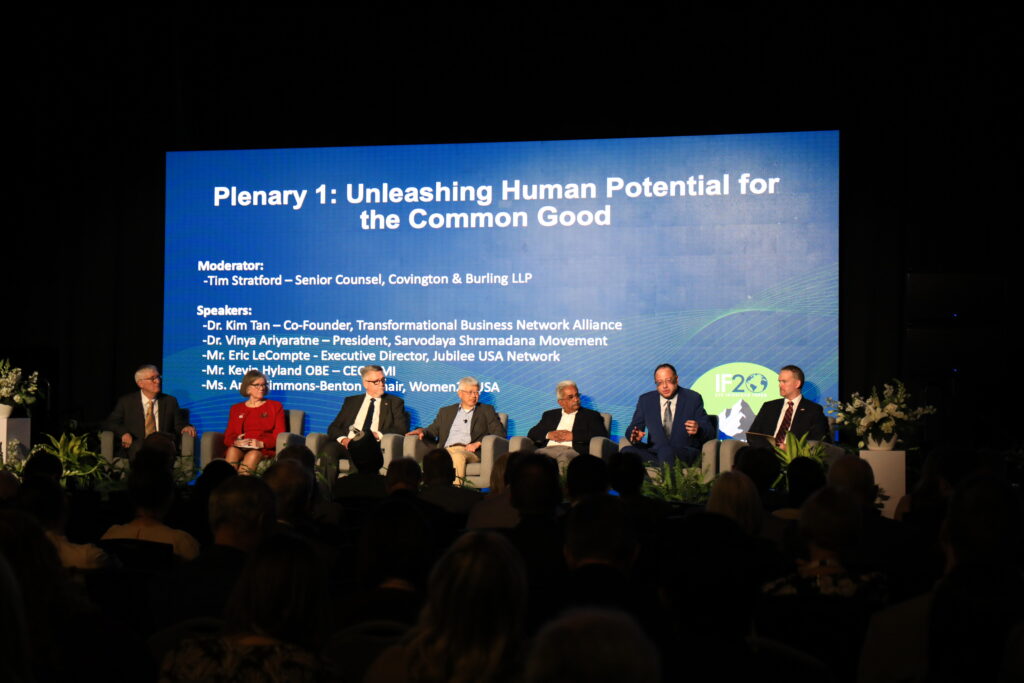
On October 16, 2026, the G20 Interfaith Forum opened the first full day of its 2026 Forum with “Plenary 1: Unleashing Human Potential for the Common Good” at the University of Utah Institute of Religion in Salt Lake City. The session explored how the G20 and faith communities can support entrepreneurship, address unsustainable debt burdens, and strengthen social protection for those left behind.
Ambassador Jamieson Greer, United States Trade Representative, delivered the keynote address. Panelists included Dr. Kim Tan, Co-Founder of the Transformational Business Network Alliance; Dr. Vinya Ariyaratne, President of the Sarvodaya Shramadana Movement; Eric LeCompte, Executive Director of Jubilee USA Network; Kevin Hyland OBE, CEO of SMI; and Anne Simmons-Benton, Chair of Women20 USA. Timothy Stratford, Senior Counsel at Covington & Burling LLP, moderated the discussion. President W. Cole Durham and Vice President Katherine Marshall of the G20 Interfaith Forum Association offered welcome addresses.
Welcome Addresses
Durham welcomed participants to Salt Lake City and explained that the Forum’s program takes into account the three priorities chosen by the United States for its 2026 G20 presidency, adapted to fit the work of the IF20. Marshall added that the program blends those priorities with other issues the IF20 has long considered important.
“Our ambition is to bring the best of religious wisdom and religious experience into the global governance system, as exemplified in the G20 itself.”
Marshall described 2026 as a stock-taking year between cycles of G20 meetings, in which a number of partner organizations had proposed their own sessions and academic partners, especially Georgetown University, had helped ensure the Forum’s proposals are rigorous enough to influence the G20 agenda. With roughly three-quarters of the world’s population claiming a religious affiliation, and faith-based NGOs employing thousands, the IF20 functions as a network of networks, she said. Its policy recommendations draw on the experience and wisdom of those networks and institutions.
Ambassador Jamieson Greer
Greer said every faith tradition expects people to work, yet God does not measure human worth in economic terms, and faith teaches us to help and stand with the poor and needy. He asked what kind of society we are trying to create, what policies support it, and what faith communities can do. Ordinary people already know the answer, he said, citing a 2021 Pew survey in which people named family, then occupation, material well-being, friends, and good health as their greatest sources of meaning. People want these things together, and communities with robust opportunities to work and produce are safer than others. Offshoring, by contrast, frayed local economies, bringing increased poverty, drug abuse, and premature deaths. People should be able to meet their economic needs in their own towns.
“A global economy and international economic policy should operate to bless a society and not the other way around.”
A long-term commitment to free enterprise has lifted generations out of poverty, Greer said, but efficiency and profit maximization should not be pursued at all costs, and some policies meant to correct capitalism’s excesses can also hurt people. Even in developed countries, a rush toward finance and technology has drawn economies away from agriculture, production, and factories, leaving many people feeling like victims of the system rather than part of it. From scripture’s earliest pages, he noted, from Adam’s labor by the sweat of his brow to the command to labor six days, humanity was meant to produce, not merely consume. Governments should provide fair trade and economic opportunity and make thoughtful corrections where things are unfair.
Faith communities have a role as well. Historical experiments such as the nineteenth-century Transcendentalists and the United Order of The Church of Jesus Christ of Latter-day Saints may not have endured, Greer said, but they shared the idea that all should contribute as producers first and consumers second. Families were once units of economic production and have become units of consumption. When faith communities support families, promote self-reliance, uphold the rule of law, and encourage civic responsibility, they help the economy and counter the sense that the system is rigged. They can also combat corruption, dishonesty, and forced labor; discourage addictive gambling; encourage living within one’s means; preach against envy and greed; and promote wise stewardship. Faith communities look toward eternity, he added, while business often looks only to the next quarter, and he would like the business world to think at least a year ahead.
Dr. Kim Tan
Tan invests in businesses that tackle poverty, education, and social issues among marginalized groups. Some fifty years ago, he noted, the GDP of several African countries exceeded that of Singapore and Taiwan; those Asian economies transformed themselves through enterprise, while many African economies did not. Aid and charity will always have a place, he said, but lasting change requires enterprise.
“For long-term transformation of our society, we need enterprise.”
Tan described a chain of schools that costs $5 per child per month and now employs 100,000 teachers; a call center inside a Singapore prison that pays incarcerated workers and rehires them at a city call center upon release, now expanding to nine prisons in Indonesia; a business employing survivors of trafficking in the Philippines to edit real estate photos for U.S. clients; and an ecotourism venture that has restored 40,000 acres in South Africa and is expanding into Uganda. His network aims to be faith-based but not faith-biased, he said, and often works around governments, which can create obstacles when businesses become too large or successful.
Dr. Vinya Ariyaratne
Ariyaratne traced the Sarvodaya Shramadana Movement to the late 1950s, about a decade after Sri Lanka’s independence, when volunteers began sharing their labor to meet community needs, inspired by Buddhist and Gandhian teaching. Over the years, he said, the movement has come to understand development as an awakening that begins in individuals and spreads through families, communities, and society. Each person who works to meet a community need is also transforming themselves spiritually; this psychological infrastructure comes first. The movement began with volunteers building roads in the 1950s.
“We build the road and the road builds us.”
Sarvodaya’s model organizes communities into groups, identifies their needs, meets them with support from external resources, and then launches entrepreneurship, before communities share their own experience and resources with others. Over nearly seven decades, the movement has reached about 15,000 communities, some 5,000 of which now function as independent legal entities, and it avoids businesses such as gambling and alcohol that are legal but not ethical. Ariyaratne called for a regulatory environment that encourages values-based economic sharing, and for connecting communities as networks so they have a voice when harmful policies arise.
Eric LeCompte
LeCompte said the story he would share is a familiar one, found in the oldest scriptures and traditions.
“The story is this simple: God has given us a rich and abundant, resource-filled world. And we’re closest to God, we’re closest to one another when we’re sharing those resources among us.”
In the Torah, he explained, debts were to be forgiven, slaves set free, and land left fallow every seven years, and all of this was done again in the Jubilee year, protecting people from becoming too poor or too rich. For 25 years, Jubilee USA Network has built a global campaign around that vision, and debt relief remains one of the last bipartisan coalitions in the United States. One in ten people on the planet lives in extreme poverty, and 23 million more have fallen into extreme poverty in the past year.
Having just returned from meetings of the IMF, World Bank, and G20 in Bangkok, LeCompte said there is not much good news coming out of international meetings, but the G20 continues to lead on debt relief, debt swaps, improved debt restructuring, and economic stability. Recent announcements signal that creditors who fail to negotiate together and ensure social protections will need to offer more relief. These policies matter everywhere, he said, because when trading partners fall into crisis, food and fuel prices soar at home. The Jubilee promise can move forward only if faith communities keep working to make right what has gone wrong and build a world where everyone has enough.
Kevin Hyland OBE
Hyland said each of the roughly 50 million people in trafficking and modern slavery is being failed. One hundred years after the 1926 Slavery Convention, a large body of binding international instruments and national laws exists, and only a handful of countries have not outlawed slavery, yet the crime continues to thrive: 99 percent of victims are missed, and 99.9 percent of perpetrators go unpunished. Trafficking corrupts economies and destabilizes security, he said, and persists because it is lucrative and offenders get away with it.
Hyland outlined a six-point plan from the Santa Marta Group: ensuring government procurement does not fund trafficking, through due diligence and supply chain transparency; pursuing tainted money and using it to fight trafficking and compensate victims; examining much more rigorously how technology facilitates exploitation; enforcing existing international instruments, such as the U.S. Tariff Act; bringing international bodies such as the G20 to the forefront of the response; and calling leaders to lead ethically. Among the largest forms of exploitation today, he noted, are scam compounds where people are held and forced to commit fraud, so that a victim in Southeast Asia is made to steal a pension from a victim in the United Kingdom.
“We owe it to those girls, those boys, those women and those men, that we will fight their cause because many of them can’t.”
Anne Simmons-Benton
Simmons-Benton said we have one world, and enough resources if we share them well. This year’s Women20 brought together more than 100 delegates from 15 countries with deep expertise, producing not a two-page communiqué but chapters of recommendations: a guidebook of case studies, policy recommendations, and metrics, along with advocacy briefs. Women make up 42 percent of the global agrifood workforce and are stewards of food and biodiversity; closing gender gaps in agrifood systems would add $1 trillion to global GDP, lift 45 million people out of food insecurity, and give 245 million people greater resilience to shocks.
The W20 also called for strong investment in care systems, including elder care, child care, and disability care, which benefit both women and men and generate economic growth, as well as recommendations on decent work, education and STEM, artificial intelligence, women’s access to capital and markets, women’s health, the planet, and safety and security. The faith community can play a vital role because it is on the ground serving the poorest of the poor, she said, and if women are half the planet and faith groups represent some 80 percent, together they can amplify these priorities.
“Helping a woman helps the next generation, helps the family unit. But if we don’t look through that lens, we’re never going to solve these problems.”
Moderated Discussion
What are your takeaways from the panel, and what counsel would you give for working with governments?
Greer said he often finds international organizations repeating last year’s talking points, but he had heard creativity, pragmatism, and action from the panel. Governments often partner with faith groups on humanitarian work as a transfer of wealth, which does not create lasting relief. What he heard instead were fundamental solutions that help people create wealth in their own towns, regions, and countries, which matters in an era of unprecedented economic migration because it allows people to stay home with their families and jobs. His office is action-based, he said, and he invited faith groups to bring granular, creative ideas for making the world more stable and economically viable.
Concluding Remarks
Stratford invited each panelist to share a final takeaway. LeCompte said faith offers broad ideas and concepts, but advocates must get down to what is actionable, such as the debt swaps prioritized by the U.S. Development Finance Corporation, because structural policies create permanent change. Ariyaratne emphasized how directly international trade policies affect households, and the need to build resilience at the grassroots, household, and community levels. Tan described the Transformational Business Network as an organization of frustrated philanthropists and repentant bankers whose largest investors are now sovereign wealth funds, and invoked tikkun olam, the call to repair a world in disrepair, as the reason faith communities are at the table.
Hyland said he is seeing a movement from words to action, even when action is unpopular; outlawing child chimney sweeps once caused outrage, he noted. Standards must not make life worse for poorer communities, and the hardest governments to work with can produce the best outcomes with diligence. Simmons-Benton, whose W20 theme this year was radical collaboration, thanked Greer for his values-based remarks and urged participants to move beyond their comfort zones and work together, because it is time to act.
———
JoAnne Wadsworth is Vice Director of Communications for the G20 Interfaith Forum (IF20) and Editor of Viewpoints, IF20’s platform for commentary at the intersection of faith and global policy. She has covered the work of the Forum across multiple G20 cycles, producing summaries, articles, and editorial content that bring the voices of interfaith leaders and scholars to a broader audience. Her writing engages with topics spanning environmental governance, religious freedom, anti-racism, poverty and inequality, and the role of faith in multilateral policy processes. Passionate about interfaith dialogue, she believes that good storytelling has the power to change the world.