

JoAnne Wadsworth, Vice Director of Communications for the G20 Interfaith Forum (IF20)
———
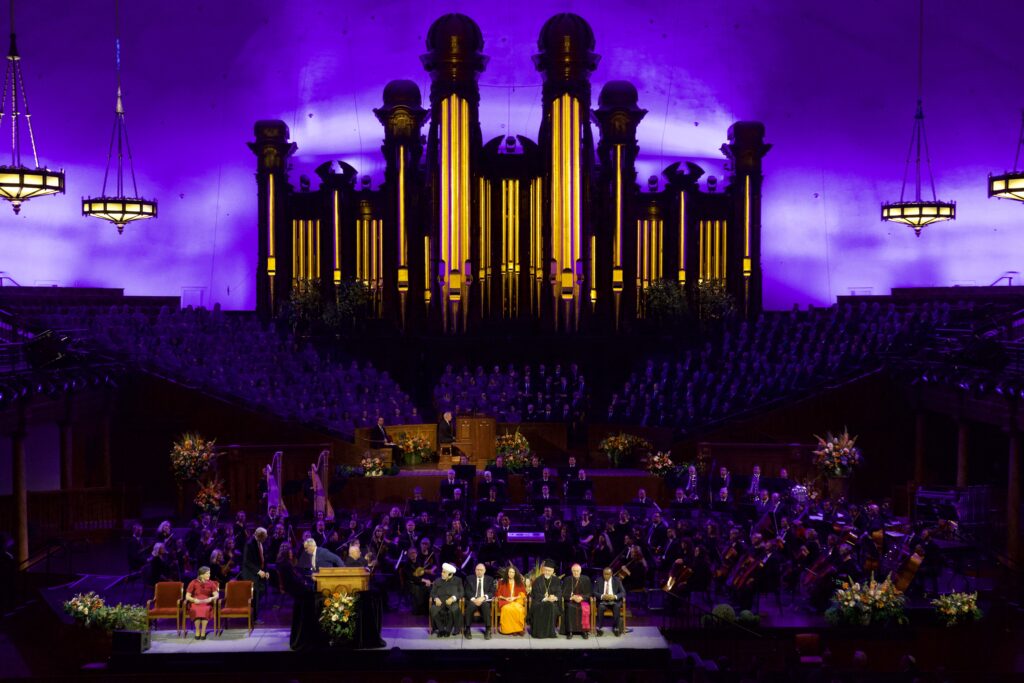
On October 15, 2026, the G20 Interfaith Forum held the Opening Ceremony and Welcome Concert of its 2026 Forum, “Resilient Hope, Shared Future,” at the Historic Tabernacle at Temple Square in Salt Lake City. The Tabernacle Choir and Orchestra at Temple Square performed throughout the evening.
Speakers included Sheikh Mohammed bin Abdulkarim Al-Issa, Secretary General of the Muslim World League, who delivered the opening keynote as guest of honor;
Archbishop Gabriele Caccia, Apostolic Nuncio to the United States of America, who delivered a message on behalf of the Holy See; President Dallin H. Oaks, President of The Church of Jesus Christ of Latter-day Saints, United States, who hosted the evening; Professor W. Cole Durham, President of the G20 Interfaith Forum Association; Professor Katherine Marshall, Vice President of the G20 Interfaith Forum Association; His Virtue Sheikh-ul-Islam Allahshukur Pashazadeh, Chairman of the Caucasus Muslims Board; Elder Metropolitan Emmanuel of Chalcedon, Elder Metropolitan of Chalcedon of the Ecum
enical Patriarchate, Türkiye; Pujya Sadhvi Bhagawati Saraswati, Secretary-General of the Global Interfaith WASH Alliance, India; Rabbi Mark Dratch, Executive Vice President Emeritus of the Rabbinical Council of America and Chair of the International Jewish Committee for Interreligious Consultations (IJCIC); and Dr. Francis Kuria Kagema, Secretary General of Religions for Peace. President Michael O. Leavitt of The Tabernacle Choir at Temple Square, former United States Secretary of Health and Human Services and former Governor of the State of Utah, conducted the ceremony. The Right Reverend Alastair Redfern, former Bishop of Derby and former Member of the House of Lords, United Kingdom; Assistant Bishop in the Dioceses of Bath and Wells and Salisbury, Church of England; and Chair of The Clewer Initiative, offered the opening prayer. Lord Russell Rook, Partner at the Good Faith Partnership and Member of the House of Lords, offered the closing prayer.
President Michael O. Leavitt
Leavitt noted the symbolism of the choir’s participation, since The Tabernacle Choir was founded by religious refugees, and drew on his years in government to describe how faith leaders catalyze action through trust. As Governor of Utah, he called on residents to provide foster care for children, but people did not respond until faith leaders engaged. Later, working with Ethiopia’s minister of health to get people tested and treated for AIDS, he remembered that lesson and visited the Patriarch of the Ethiopian Orthodox Church, whose trusted call to action moved people to respond.
“A government can use taxes to build a clinic, but it often takes the trust of a faith leader to get people to walk through the door. Faith cannot compel. It depends on freedom to survive. That is why protecting religious freedom must never end.”
Sheikh Mohammed bin Abdulkarim Al-Issa
Al-Issa began by distinguishing hope from mere optimism. In Islam, he said, despair is considered a departure from faith, and hope is both a duty and a sustained endeavor.
“Optimism waits for things to improve on their own. Hope, however, is a decision taken by people of living conscience and a willingness to do hard work for tomorrow.”
That duty is being tested today by escalating hate speech, he said. History teaches that violence begins with words, which serve as a gateway to hatred, and digital platforms now amplify them. Because hate speech often borrows the language of religion, faith leaders must be the first to reject it. Lasting impact requires work, beginning with the family’s role in shaping children, followed by education and wider society, with spiritual influence running through all three.
The real threat, Al-Issa said, is allowing differences to harden into walls of hatred. Any unjust war, including one waged in the name of religion, serves evil rather than God. People must not hate a religion because of those who claim it and do wrong, nor use religion to shield wrongdoers.
Archbishop Gabriele Caccia
Delivering a message on behalf of the Holy See, Caccia noted that when G20 leaders gather in Miami in December, they will take up economic growth, energy security, and artificial intelligence. Beneath these seemingly different subjects lies one question: whether the progress we seek will serve the human person. Pope Leo XIV raised that question in his encyclical Magnifica humanitas, warning against imagining that everything, including the mystery of the human person, can be reduced to data and performance.
“Technology offers extraordinary possibilities, but it does not tell us what is good. We still need to ask the questions of whom progress is serving and whether it is serving them well. This is where faith leaders have something to offer.”
Faith leaders bring not technological expertise but their traditions, Caccia said, and when people know who they are and what they believe, they can meet one another more honestly. Resilient hope is not optimism about the future, he suggested, but the decision to build it together without losing sight of the human person at its center. He closed by reading a letter from the Holy See to the Forum.
President Dallin H. Oaks
Oaks welcomed delegates to the world headquarters of The Church of Jesus Christ of Latter-day Saints, calling the assembly the most prominent gathering of faith leaders ever to convene in Salt Lake City. He said he had been deeply impressed by their biographies and that the Church fully supports the cause that brought them together.
The IF20’s approach, Oaks said, is broader than what any community does separately: it cares for the world’s most vulnerable and achieves cooperation without compromising religious commitments. Faith-informed perspectives have a meaningful place in global policymaking, he said, but even more important are the relationships built at gatherings like this one to promote peacemaking.
“I commend you for your efforts to be peacemakers in this world. We want to be part of your efforts, and I invoke a blessing on all of you as we go forward.”
Professor W. Cole Durham
Durham, President of the G20 Interfaith Forum Association, thanked the choir and paid tribute to the religious leaders taking part in the ceremony. Reflecting on the history of the Tabernacle, he recalled growing up with stories of how its builders used the soft power of rawhide to hold its structure in place. The pioneering work of the Forum, he said, likewise relies on soft power within the G20.
Since 2014, Durham explained, the IF20 has worked each year to further the G20’s aims while caring for the most vulnerable and ensuring that faith-informed perspectives have a seat at the diplomatic table. Its mission is to translate religious values into action and dialogue into “diapraxis,” making the energy, acumen, and light of religious communities part of the framework of our time.
Professor Katherine Marshall
Marshall said the Forum builds on twelve years of commitment to the idea that the finest of religious values and experience belongs at the G20 table, and that questions of justice and fairness run through the economic agendas G20 leaders will address in December. Religious communities sustain care through crises, help rebuild shattered lives, and keep hope alive when institutions falter, she said. Ideas are contested, but participants share solid common ground, and religious communities can achieve far more working together than separately.
“Our test of prosperity must begin with what it means for those with the least resources and power. Peace, prosperity, and human development are possible everywhere, for everyone on our beautiful planet.”
His Virtue Sheikh-ul-Islam Allahshukur Pashazadeh
Pashazadeh conveyed the greetings of the President of Azerbaijan to the gathering.
“Facing the challenges of this world, dialogue among religions and civilizations, and joint action between religions and secular communities, matters more than ever.”
He said he was honored to take part in discussions on establishing a permanent religious advisory council within the IF20, and that it is now time for the council to be established and begin its work. He expressed hope that its recommendations on building global peace will prove useful to political leaders, and thanked the United States, its people, and The Church of Jesus Christ of Latter-day Saints for hosting the Forum.
Elder Metropolitan Emmanuel of Chalcedon
Metropolitan Emmanuel, whose church has lived in Constantinople for seventeen centuries, noted that in Greek the word “shared” in the Forum’s theme shares a root with the word for community. When the Apostle Paul addressed the Athenians, he said, Paul did not begin with what separated them, but with the God who made all people. Variety belongs to creation itself: no two leaves of the same tree are entirely alike, and in the choir, the bass does not ask the soprano to come down to his range. The music is beautiful because the voices remain different.
The original meaning of patience, he observed, is “to remain underneath”: to bear the weight and not walk away. The earth, too, belongs to our shared future, and when humanity neglects that responsibility, the consequences are evident in our rivers and forests.
“A crisis with man’s relationship with God becomes a crisis with his relationship with creation.”
Real dialogue is measured in years, he said, by people who return again and again to the same table, and it requires the courage to ask those within one’s own tradition who use the name of God against their neighbor to change.
Pujya Sadhvi Bhagawati Saraswati
Saraswati, who grew up in Los Angeles and has lived in India for thirty years, found the Forum’s theme in the Tabernacle itself. Its pioneer builders walked more than a thousand miles to worship according to conscience, she said, and built not a fortress but a place to sing: a handcart that becomes a choir. Human progress, she said, rests on three trainable beliefs: that I can act now, that my actions matter, and that I can imagine a future that does not yet exist.
“Hope is not a mood we wait for. It is a capacity we build. Therefore every house of worship on this planet is a school of hope.”
Before the world’s brokenness can be fixed, Saraswati said, people must heal what is broken within and between themselves. Recalling the Vedic phrase India chose for its G20 presidency, that we are one earth and one family sharing one future, she said that every G20 decision is a family decision, measured by how it cares for the most vulnerable. Like voices in a choir, the world’s religions need not become the same; they can sing the same song of hope.
Rabbi Mark Dratch
Dratch recalled the prophet Ezekiel’s vision of a valley of dry bones, the remains of a people who said their hope was lost. Despair did not have the last word: God restored their hope, and the prophet Zechariah later called the returning exiles “prisoners of hope.” Despair cuts people off from the future, Dratch said, while hope keeps them tied to it.
The Jewish people have been prisoners of hope throughout history, he said. In 1877, Naftali Herz Imber wrote “Hatikvah,” “The Hope,” turning Ezekiel’s lament into the words “our hope is not yet lost.” Five days after the liberation of a concentration camp, survivors gathered for a service and sang those very words. Faced with today’s challenges, Dratch said, the reasonable conclusion is despair, but faith refuses that conclusion; as the late Rabbi Jonathan Sacks observed, optimism requires no courage, but hope does.
“We are not without hope. We hold fast to God, to one another, and to a future we cannot yet see but we are willing to work for starting today. We are, each and every one of us, prisoners of hope.”
Dr. Francis Kuria Kagema
Kuria said the gathering itself gave him hope, because it already symbolized togetherness. The world faces a polycrisis, he said: strain on the planet, ongoing conflict, growing migration, mainstream xenophobia, and eroding trust as artificial intelligence accelerates disinformation. Building a shared future requires resilience grounded in the inherent worth of every being, and peace, since flourishing cannot exist amid violence.
Religious freedom is essential, Kuria said, so each tradition can teach and uphold its own virtues. Compassion, mercy, and charity need not be invented anew; they are already present in sacred traditions around the world, and must be applied to conflict and to climate change, whose burden falls hardest on the poor and vulnerable who are least responsible for it.
“As faith leaders, we share a moral responsibility to act. We must imagine a world of sacred shared flourishing.”
Concluding Remarks
Between addresses, The Tabernacle Choir and Orchestra at Temple Square performed “Oh Come Ye Nations of the Earth,” “Look Up,” “Thou Gracious God Whose Mercies Lend,” “I Sing the Mighty Power of God,” and “Peace Like a River.” The choir closed the evening with the pioneer hymn “Come, Come, Ye Saints,” after which Lord Russell Rook offered the closing prayer. The ceremony ended with a group photograph of the faith leaders.
The Forum continued October 16–17 at the University of Utah. The full program is available at the 2026 Forum program page.
———
JoAnne Wadsworth is Vice Director of Communications for the G20 Interfaith Forum (IF20) and Editor of Viewpoints, IF20’s platform for commentary at the intersection of faith and global policy. She has covered the work of the Forum across multiple G20 cycles, producing summaries, articles, and editorial content that bring the voices of interfaith leaders and scholars to a broader audience. Her writing engages with topics spanning environmental governance, religious freedom, anti-racism, poverty and inequality, and the role of faith in multilateral policy processes. Passionate about interfaith dialogue, she believes that good storytelling has the power to change the world.