

JoAnne Wadsworth, Vice Director of Communications for the G20 Interfaith Forum (IF20)
———
On October 15, 2026, the G20 Interfaith Forum opened its 2026 Forum in Salt Lake City with a Disagree Better-sponsored session entitled “Peacemaking through Disagreeing Better” at the Historic Tabernacle at Temple Square.
Speakers included Governor Spencer Cox, Governor of Utah, who launched Disagree Better
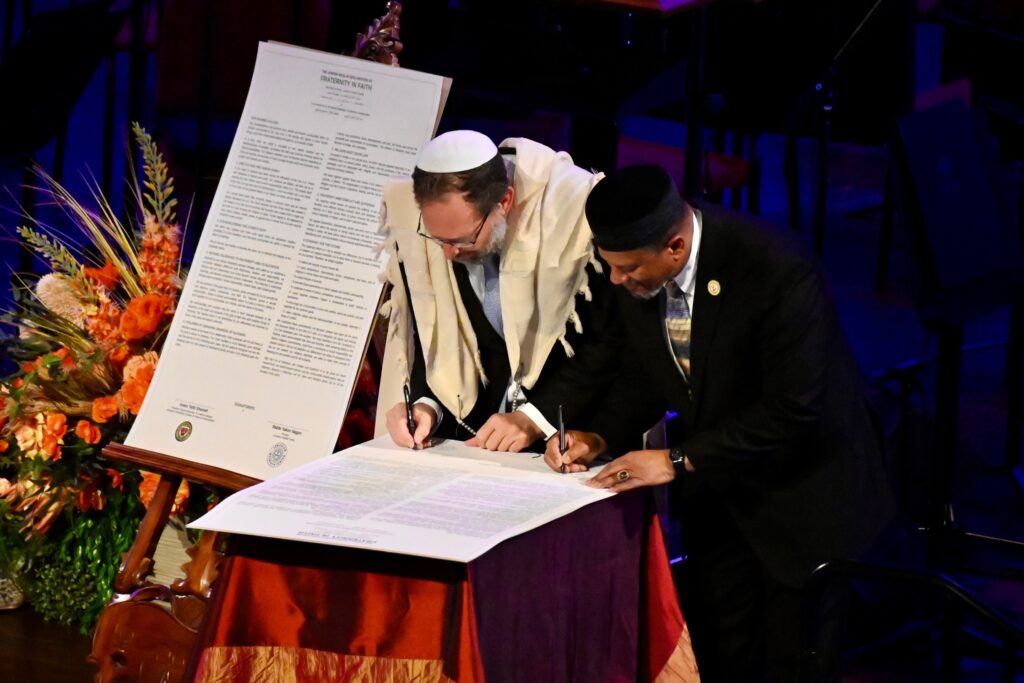
as chair of the National Governors Association in 2023; Governor David Beasley, leader of Breaking Bread Together, former Governor of South Carolina, and former Executive Director of the UN World Food Programme; and Martin Luther King III, humanitarian, civic leader, and Ambassador for Global Human Rights. Sarah Jane Weaver, Editor of the Deseret News, moderated the discussion. The session closed with the signing of the Jewish–Muslim Declaration of Fraternity in Faith, presented by Imam Dr. Talib Shareef, President of the International Coalition for Peace and Reconciliation and of Masjid Muhammad, The Nation’s Mosque; and Rabbi Dr. Yakov Nagen, President of The Jerusalem Interfaith Center.
Lord Russell Rook, Partner at the Good Faith Partnership and Member of the House of Lords, opened what he called the largest interfaith gathering in Utah’s history, and Governor Cox welcomed participants on behalf of the state, describing faith in Utah not as a passive word but an active verb: a sacred commitment to love one’s neighbor and leave things better than one found them.
Rook explained why the Forum chose to begin with disagreement. The interfaith movement, he said, has become skilled at agreeing well but has not yet learned to disagree well. He offered three commitments for the week, summed up as ICU: integrity, speaking and hearing the truth while admitting we are not always right; charity, speaking and listening in love; and unity, paying the cost of acting together and seeking deeper friendships rather than won arguments. The people best placed to help the world disagree well, he said, are its faith communities.
Governor Spencer Cox
Asked what lies at the root of today’s polarization, Cox, who has recently written a book on the subject, said the deeper problem is a loss of connection and belonging. As churches and civic associations declined, social media promised a connection it could not deliver, and its algorithms rewarded outrage. Because people are tribal, many settled for hating the same people to
gether, until politics became a religion of its own.
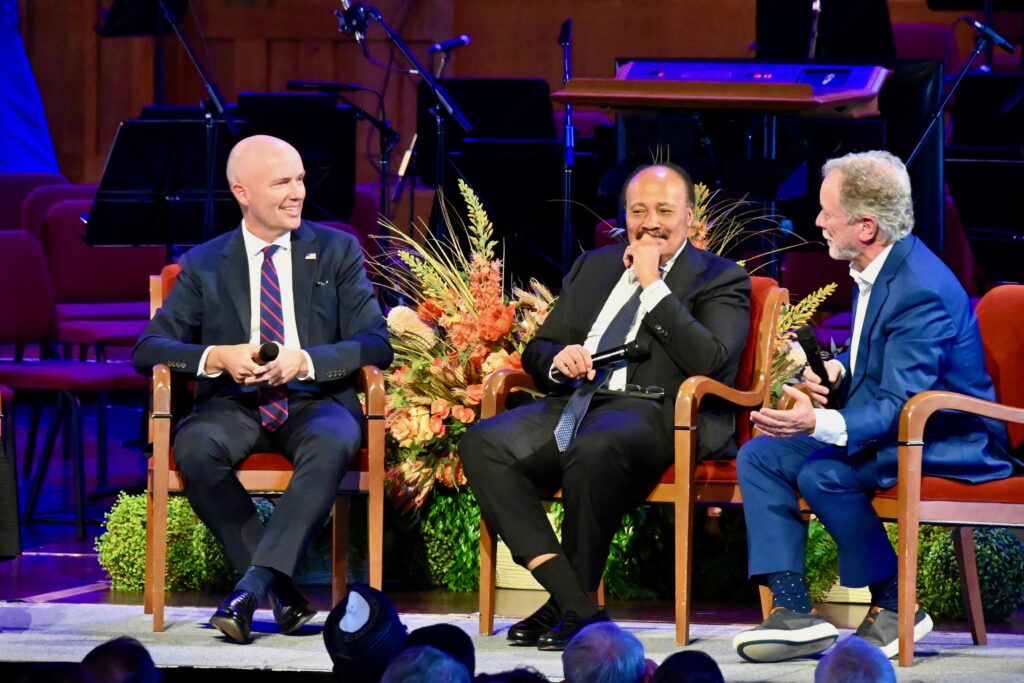
If the social sciences have a theory of everything, Cox said, it is community. People feel unmoored by forces beyond their control, yet often do not know the neighbor next door, where they could actually make a difference. He is most worried about homes and neighborhoods: five years ago, 5 percent of Americans had lost a family member or close friend over politics, and that figure is now five times higher. Disagreeing better does not mean abandoning one’s principles, he said, but holding them with curiosity, empathy, and charity.
“Politicians are not worth it. We are not worth it. We are not worth losing a single friend or family member—we will let you down every time. So value your friends more than you value the politics.”
Governor David Beasley
Beasley said Americans are not as divided as they appear, though they are divided and on a bad trajectory. Six years in conflict zones showed him what happens when people stop talking to one another. His remedy is to sit down and break bread together, because sharing a meal makes it harder to hate someone, even when disagreements remain. He traced that conviction to his youth at one of South Carolina’s first racially integrated schools, and to years of feeding the hungry that taught him even the most ruthless people bear the image of God. One cannot love God, he said, without loving God’s image in others.
He recalled the 2015 shooting at a historic African American church in Charleston, South Carolina, after which the victims’ families went on national television just two days later to forgive the gunman.
“Love is the most powerful weapon on the planet. It is the only thing that will carry us through this division and chaos.”
Beasley also noted that 87 percent of members of Congress identify as Christian, yet spend the week fighting, which he called inexcusable. Faith, he said, should move leaders from looking good for their followers to actually doing good.
Martin Luther King III
King said people can disagree without being disagreeable, and warned that the nation’s current course is not sustainable. Drawing on his father’s final book, Where Do We Go from Here: Chaos or Community?, he urged a choice of community over chaos. Human beings are not monolithic, he said; each of us has a different fingerprint, and that diversity is how God made us. Communities are sustained by their values and by leadership, especially faith leadership, and community advances when faith brings people together rather than pulling them apart.
Asked how his family endured tragedy, King recalled that his father was assassinated when he was ten years old, his uncle drowned under mysterious circumstances in 1969, and his grandmother was killed in her church.
“I could have easily chosen to hate. But I’m so grateful for what my family taught me: to hate the act, but not the person.”
His father sought to eradicate poverty, racism, and violence, King said, and that work continues. People need to see love and humanity again and again, because so much around them is inhumane, and humanity is far better than what mainstream and social media promote.
Moderated Discussion
If every person is created in the image of God, why don’t we treat one another that way?
King said emotions get in the way, and that better communities, like strong marriages, take work. The civil rights movement was carried by a relatively small number of committed women and men, yet it changed the world. The challenge now is to keep young people from losing hope, and to ask how a nation with so much wealth still has people without food or shelter. The United States can, must, and will do better, he said.
Why does listening matter?
Cox said belonging and purpose are the two most powerful forces on earth, and people are desperate for both. Politicians are good at talking but need to get better at listening; simply asking someone to say more about why they hold a view creates instant connection. Listening to understand rather than to argue, he said, is how an enemy becomes a friend. King added that listening is a matter of simply doing it, and that building what his father called the beloved community requires love practiced every day; when he wakes up worried, he chooses one small thing to do. Beasley said he resists discouragement, as when children in Yemen were starving while he worked to open ports, by seeing each child not as a statistic but as his own little brother or sister.
Concluding Remarks
Weaver closed by asking each panelist for a call to action. Beasley challenged attendees to break bread during the Forum week with someone different from them. King urged them to be ashamed to die until they had done something, however small, to make the world better. Cox offered a single word: hope.
Rook thanked the panelists for one of the most life-giving panels he had heard in a long time, saying they had given the audience a reason to hope, and invited attendees to meet the people seated around them.
The Jewish–Muslim Declaration of Fraternity in Faith
Rook then reminded the audience that IF20 is about doing, not only hearing. At the 2025 IF20 Summit in Cape Town, Jewish and Muslim leaders issued a call for a new vision of Jewish–Muslim fraternity. Imam Dr. Talib Shareef and Rabbi Dr. Yakov Nagen returned to Salt Lake City with its fruit.
Imam Dr. Talib Shareef
Shareef said much of the world is exhausted by conflict, and that suffering in the Middle East has normalized distrust between peoples who share far more than divides them. The greatest danger, he argued, is not disagreement but the hardening of hearts: when people stop recognizing one another’s dignity, violence becomes easier and suffering becomes statistics. Citing the Qur’anic teaching that humanity was made into nations and tribes in order to know one another, he said his years of dialogue with Nagen had convinced him the two communities are called not merely to coexist, but to co-elevate. Peace is not only the absence of war, he said, but the presence of justice, dignity, compassion, and mutual responsibility, and building it belongs to people of faith, educators, and civil society as well as governments and diplomats.
“Our scars should not divide us. They should make us healers.”
Rabbi Dr. Yakov Nagen
Nagen described a fraternity that exists not despite different religions but is deepened, enriched, and blessed by them, and called it fitting that they had gathered in a Christian house of prayer, completing the circle of the Abrahamic family. When ego dominates, he said, we see only ourselves; when we make room for God, we make room for the other. Real differences exist between the two faiths, but they should not diminish love.
“Let us not just ask, ‘Can I tolerate you?’ but, ‘What can I learn from you?’”
Nagen gave the audience homework: to find someone from another tradition who can become a source of friendship, wisdom, and blessing, remembering that before we belonged to different nations and religions, we belonged to one human family. Shareef and Nagen then read the Declaration aloud, signed it, and invited all in attendance to add their signatures. The full text of the Declaration is available here.
———
JoAnne Wadsworth is Vice Director of Communications for the G20 Interfaith Forum (IF20) and Editor of Viewpoints, IF20’s platform for commentary at the intersection of faith and global policy. She has covered the work of the Forum across multiple G20 cycles, producing summaries, articles, and editorial content that bring the voices of interfaith leaders and scholars to a broader audience. Her writing engages with topics spanning environmental governance, religious freedom, anti-racism, poverty and inequality, and the role of faith in multilateral policy processes. Passionate about interfaith dialogue, she believes that good storytelling has the power to change the world.