
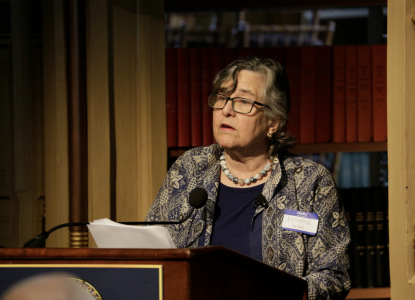
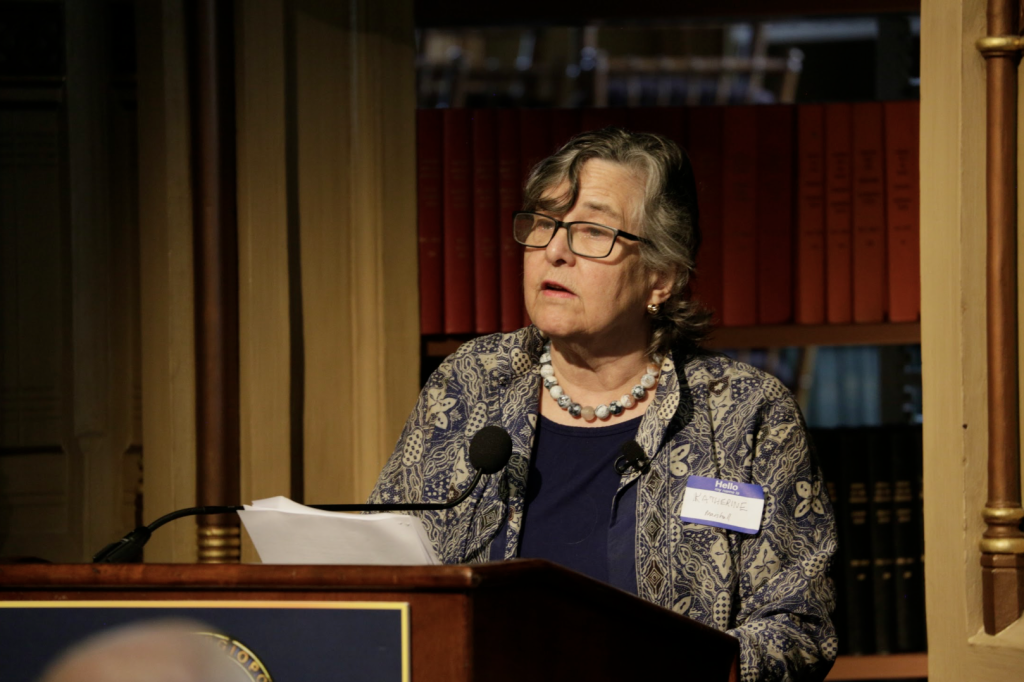
By Katherine Marshall, G20 Interfaith Forum Vice President.
– – –
On May 26, 2026, the G20 Interfaith Forum (IF20) met in partnership with Georgetown University’s Berkley Center for Religion, Peace, and World Affairs and Brigham Young University’s International Center for Law and Religion Studies (ICLRS). These remarks were given by Katherine on this first day of policy meetings regarding the G20 Interfaith Journey.
Introductory Remarks
We are delighted to have you here. A warm welcome!
Looking at and to Cole Durham, the founder of the IF20, I want to set today’s and tomorrow’s discussions in the context of a continuing journey, one that in this case, today, has taken us into the heart of the G20, that is a symbol in some sense of the role of power and especially its realpolitik dimensions, in world affairs.
At the center of our efforts is a conviction that faith/religion/spiritual concerns have vital, constructive roles to play in the central questions Tom Banchoff has outlined: In a simple metaphor, how religious voices and experience can be assured seats at a table or, to be a bit more practical, the many shifting tables where decisions are made and power is exercised. The G20 epitomizes that table.
So we need to ask, continually and in different ways, how religious beliefs, traditions, and experience engage in any issue (and I note that the word “engage” will come up time and time again here)? How and how far is the religious dimension significant, and why does it matter? And, the final and sharpest question: how does that translate into policy, policy action, and programs? A central goal here is to translate the insight about religion’s complex multifaceted significance into the rather different language and lived realities of the mechanisms that shape global agendas. We are looking to practical experience but also to a prophetic voice, beyond jargon and tired ideas.
And we highlight often a difficult notion and an assumption we hold deeply: we aim to bring the best of religious traditions, ideas, and experience, to the G20 table, and we present care for the vulnerable, those left aside and behind, as a if not the central, shared “gift” of the complex worlds of religion.
Let me address three questions, quickly.
First, why the G20? Second why and how the IF20? And third, our hopes for today.
The questions remind me forcefully that this is a journey. Two often used metaphors come to mind. First, the last mile, the final rocky and ill traced path to the place where the voiceless, those left behind are situated. Far from the G20 tables, from heads of state and their immediate entourages are the people who, for many of us, are at the very center. But there’s another image that comes up periodically: a relentless trudging along the first mile, again and again. The notion here is that we walk the first mile, with determination, well, creatively, but then stall. Then start over, and repeat the process again and again. We here are determined to keep the last mile, the people there, constantly in our minds, and, still more important, to move us and our efforts beyond that first mile.
Why G20?
First question: why the G20? Founded in 1999 as a finance minister platform to address economic dimensions of world problems, the G20 came into its current form, largely under US leadership, in 2008. Informal, without a formal statute or secretariat, it offers something that is tough in other forums: flexibility, a size theoretically small enough to do something meaningful, but more inclusive than the G7 or G2. The G20 has played vital roles at crucial times, with the COVID crisis a prime example.
Over the years the G20 has taken on new shapes, with an array of groups around it, government ministries, civil society, private actors, special task forces, all aiming to influence and to shape agendas. 13 formal engagement groups and an array of others work each year. For the past two years the G20 process has included a large “social summit” just before the leaders’ meeting, to engage the array of civil society actors. We hear, from the Trump administration but also from others, that the process is rather out of hand, so this year we see a far less ambitious agenda and, more specifically, a sharply diminished role for the engagement groups in the formal procedures. But the process continues nonetheless.
The G20 Interfaith was born in 2014 and has worked and grown since then. I have been part of the events since 2015. It began as a largely academic venture, during Australia’s G20 presidency. Notably with Germany’s 2017 presidency, we were told, and internalized, that we, as the G20 Interfaith Forum, must focus on policy action and on the G20 feature of the rotating country led presidency.
I want to emphasize the central premise of the IF20: it operates as a network of networks. In other words, we know, as the Berkley Center and WFDD, how many richly conceived efforts work to bring faith voices into development, humanitarian, and peacebuilding work. IF20 cannot and does not aspire to recreate this capacity, but to draw on it, collaborate, radically (as Anne Simmons-Benton who leads the W20—women–challenges), and amplify that work. These networks include the interfaith organizations, scholars, operational NGOs, and those within governments charged with engaging with religious communities, in wealthier countries but still more those further from core power.
The G20 Interfaith Forum is thus an idea, an ideal, a hub of a multispoked network. It has operated with a small and dedicated team, largely volunteers, building on our knowledge and experience. A central goal today is to solidify and to ensure that our work is inclusive and creative, but also robust and professional, drawing on the best ideas and asking two difficult questions: how will that translate into policy? And what is our legitimacy and authenticity as we claim to present a religious or interreligious perspective?
Purpose of the Georgetown Meetings
So today’s and tomorrow’s events are part of a process focused, in the IF20 spirit, on the 2026 agenda, led by the United States. We have framed today and tomorrow as a Policy Forum and a workshop. You will challenge the draft papers, and we will sharpen and refine them in the months ahead, as we look to the annual G20 Interfaith Forum. That event will take place in Salt Lake City, in October. Here I point to Whitney Clayton as well as to Cole and other team members, including Nicole Sterling, a pillar of support, who are deep into planning for the event. And, as Tom mentioned, we have 2027 and the UK presidency very much in our sights. Tomorrow we will, in a true workshop fashion, set the discussion in the context of the Sustainable Development Goals, the SDGs, turning our question around, to focus both on what the IF20 has proposed in recent years and where we see the agenda heading in the coming years.
To bring us back to today, we are focusing on the third challenge I began with: how does experience and teachings translate into policy and action proposals? We begin, today, with the 2026 priorities, and ask you to advance us on the questions Tom put to us: how might we engage and build on this opportunity? That is a demanding, even heroic ask, but it is the reason all of are here, and why the Berkley Center, Georgetown University, and, I add, the World Faiths Development Dialogue (WFDD) that I lead have taken on the challenge. Here I point to David Saperstein, our Board chair, and Midori Miyazaki, who has supported WFDD through its 25 year history.
Welcome to the journey!
How IF20 Fits Within G20 Economic Goals
Economics and finance (ie money), we should remember, are the G20’s central mandate. If a G20 goal for 2026 is to “get back to these basics”, that certainly spotlights its role in addressing the polycrisis through available economic instruments and the core manifestations of the immediate and longer term crises—unsustainable debt and insufficient spending on human development, meaning especially health, education, food, and water. And while the G20 focuses on policy, at the broadest levels, the best indicators of real, lived policy often can be seen in how resources are mobilized and spent.
The background paper highlights many areas where religiously linked communities are involved in “agenda item 1”: economic prosperity, deregulation, and (a priority added since the initial formulation by the US administration) trade. As Tom indicated, the 2026 G20 agenda looks rather different from the picture seen from the teachings and practice of most religious communities, but there are reminders of reality and overlap. One reminder, that I draw from my own experience, is that a single focus on poverty and serving those left aside can alienate the many who may be closer to the center, or the ideals of a middle class. Broad understandings of welfare, flourishing, and prospering are needed for both political and ethical reasons. An interesting link, that goes back to a part of the IF20’s origin story, is between religious freedom and regulations as one element, and a society’s functioning. More fundamentally, notions of freedom are tied to and sometimes challenge social cohesion and notions of solidarity and common action for the common good.
Let me end with a quotation in today’s Washington Post, from a missionary doctor evacuated from DRC and the Ebola affected areas:
“You see this amazing mix of fear and courage and hopelessness and beauty and ugliness.”
That combination seems an apt image of today’s broader situation!
– – –
Katherine Marshall is a senior fellow at the Berkley Center for Religion, Peace, and World Affairs at Georgetown University. She serves as the vice president of the G20 Interfaith Association and executive director of the World Faiths Development Dialogue. With over three decades of experience at the World Bank, Marshall has been at the forefront of addressing development issues in the world’s poorest countries, with a particular focus on the intersection of religion and global development.