
By JoAnne Wadsworth, Communications Consultant, G20 Interfaith Forum
———
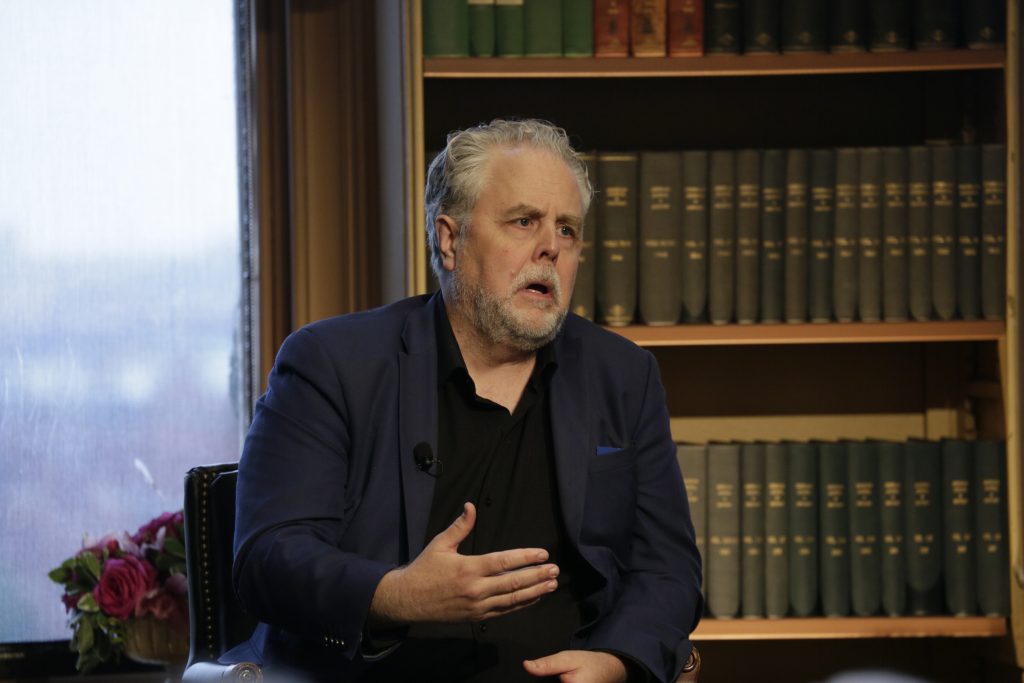
This blog is drawn from a recent episode of the G20 Interfaith Forum Podcast, Sustainability in an Innovating World, featuring a conversation with John C. Havens. Havens is the Global Director for Planet Positive 2030 at the Institute of Electrical and Electronics Engineers Standards Association (IEEE SA). An author of multiple books on sustainable technology development and an expert on the intersection of faith, environmental protection, and AI, he shares a unique perspective on what’s needed to change the direction of tech development in an innovative—yet fragile—world. You can watch the full conversation here: LINK.
When John C. Havens describes his path into the ethics of artificial intelligence, he doesn’t begin with engineering. He begins with theology. Before he became a leading voice on sustainable technology, Havens went to college intending to become a minister in the Christian tradition, studying history and theater along the way. He credits that training—particularly the discipline of exegesis, the careful study of texts and sources—with shaping how he now approaches technology. As he put it, he didn’t realize at the time how deeply he was being equipped to study sustainability, a field he has formally worked in for only about four years.
That faith-rooted lens sits at the core of his work: a conviction that the planet, the biosphere, and the full diversity of humanity should be prioritized at the very beginning of any design process—whether the product is a technology, a policy, or a market. Too often, he argues, sustainability and ethics are treated as an afterthought, addressed only once harm has already been done. Things get built first, and then a reactive, crisis-oriented logic of “ethics as an afterthought” takes over—rather than one that asks, at the outset, how we can take care of things well.

Who’s Not in the Room?
One of the simplest and most powerful questions Havens has learned to ask contains just five words: Who’s not in the room? He traces it to his work on IEEE’s Ethically Aligned Design, a foundational document on AI ethics. Its first version was written almost entirely by experts from North America and Europe, and when it went out for global feedback, more than half of the responses pointed out that it was thoroughly Western in orientation. Rather than treat that as criticism to deflect, Havens treated it as an invitation, helping launch a chapter on classical ethics that drew in non-Western ethical framings.
He illustrated the stakes with a story about a young colleague from New Zealand named Caleb, who comes from a Māori tradition. Caleb explained that when conversations about data default to assumptions rooted in Silicon Valley or the West, it can function—often unintentionally—as a kind of colonialism, because it signals that no one thought to ask for another tradition’s perspective. Havens was struck, too, by the Māori practice of leaving recording devices—even a pencil—outside sacred spaces, so that people can truly be in community with one another, with nature, and with the holy. The lesson, for Havens, is that inclusion isn’t about extracting information from everyone; it’s about widening the circle so that consensus becomes a form of verbal community and peacebuilding, rather than a single answer imposed on all.
This is where he finds deep resonance with Ubuntu ethics—the principle that “I am because we are.” For Havens, that isn’t only a warm sentiment but something close to a physical reality: just as he exists because the water he drinks exists, he exists because other people exist. It is a framing IF20 knows well, having made “Ubuntu” the theme of a recent gathering, in keeping with its longstanding commitment to leaving no one behind.
Say What You Mean by “AI”
If Havens has one practical plea for faith leaders, policymakers, and technologists alike, it’s this: be specific about what you mean by “AI.” Lumping every tool under one label, he warns, is itself a source of harm.
He offered a vivid example. At a recent gathering, a speaker described using an AI tool to help rescue 150 women and children from sex trafficking—work Havens, as a parent, called among the most important anyone could do. When he asked what kind of AI it was, the answer was deep learning, a technique well suited to analyzing photographs and recognizing patterns. Crucially, it could run on two laptops. Contrast that, Havens said, with generative AI and large language models, which depend on massive computing power and a global build-out of hyperscale data centers—buildings three times the size of a football stadium that often draw on potable water in places where no one has measured how much the local aquifer even holds, while nearby communities foot the electricity bills.
The point is not that one tool is good and another evil, but that responsible conversation requires naming the application and reckoning honestly with its costs. If you say “AI” without saying which application, he cautions, you will cause harm. Before any tool is deployed, he believes, we should be able to answer a basic question: how much water is nearby?
The Planet as Actor, Not Resource
Havens believes faith communities have a distinctive contribution to make here—one rooted in the idea that the planet is an actor, not a resource. He pointed to Pope Francis’s 2015 encyclical Laudato Si’, which reframed humanity’s relationship to creation around stewardship rather than dominion. If a loving creator made the living world, Havens reasons, then we are called to be its caregivers—stewards, not merely users.
He noted that many Indigenous traditions treat water as sacred, even as a personage worthy of reverence, and suggested that Westerners who find that strange might pause to consider the central role water plays in their own traditions, from baptism to the symbolism of the Holy Spirit. Whether or not one worships water, he argued, its sacredness is also a physics-based reality: you cannot keep drawing it down indefinitely and pretend the supply is limitless.
That conviction reframes the central question entirely. The question, Havens insists, is not how AI will help the planet, but how we help the planet—and all the people and species within it—flourish first. Only then should we ask what tool, AI or otherwise, can serve that goal. Anything else, he says, leaves us depleting sacred resources that cannot be replaced.
From Productivity to Flourishing
The conversation closed on the theme that first drew Havens to this work: human happiness. Drawing on the science of positive psychology—a field he came to study after the death of his father, a psychiatrist—he distinguished fleeting good moods from the deeper Greek idea of eudaimonia, a flourishing that encompasses an entire life and community. He recalled the documentary Happy, which contrasts a rickshaw driver in modest circumstances, beaming amid a large and loving family, with the widow of a Japanese man who died from the stress of relentless productivity.
That contrast, for Havens, captures the danger of a culture that preaches productivity and efficiency as ends in themselves—values he hears echoed at the highest levels of generative-AI funding. His faith leads him somewhere else: to the conviction that every person has worth simply by being born, and that our charge is to love others and care for the planet rather than to step aside and let technology set the pace. Citing Colossians 3 and its call to set one’s mind on things above, he framed the present moment as a reckoning over what we will put first—other people and the planet, or the tools we are promised will fix everything.
It is a fitting message for an organization built on the conviction that religious wisdom belongs at the policy table. As AI reshapes the world, Havens offers IF20’s audience both a warning and an invitation: to slow down, to ask who’s not in the room, and to design for flourishing from the very start.
———
JoAnne Wadsworth is a Communications Consultant for the G20 Interfaith Forum Association and Editor of its Viewpoints blog. In that role, she covers the Forum’s webinars, regional meetings, and podcast conversations, translating the work of faith actors and policymakers for a global audience. Her writing focuses on the intersection of faith and policy—the space where religious wisdom meets real-world challenges in areas such as sustainability, human rights, and emerging technology. She is based in the United States.