

By JoAnne Wadsworth, Communications Consultant, G20 Interfaith Forum
———
This is the second in a four-part series covering IF20’s draft discussion papers, three of which were developed in response to one of the priorities of the 2026 U.S. G20 presidency. This post gives an overview of “Energy Security for a Sustainable Future,” developed under the auspices of the G20 Interfaith Forum together with Georgetown University’s Berkley Center. Like the others in the series, it remains a discussion draft, and the full paper is available for those who want the detail behind this summary.
The first paper in this series asked what economic prosperity means if the poorest are left out of it. The second takes up a harder question; one where the faith sector and the G20 host country stand far apart.
Under the heading “Unlocking Affordable and Secure Energy Supply Chains,” the United States has made energy security one of its three priorities for the 2026 G20 presidency, and an Energy Abundance Working Group is focused on market-driven production, permitting reform, and lower consumer costs. In sharp contrast to previous presidencies, the administration has not acknowledged climate change as a problem and is seeking to exclude it from the agenda.
The world’s leading religious and interfaith communities have spent a decade arguing for close to the opposite: a rapid transition to renewables, funded by the wealthy nations most responsible for human-driven climate change. The paper does not gloss over that gap. It asks whether, despite it, there is any ground on which a real conversation could happen.
What the Paper Covers
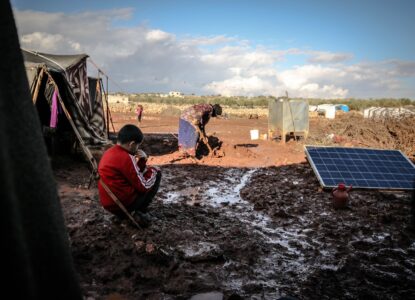
It begins with the abundance agenda in the administration’s own terms, including Energy Secretary Chris Wright’s argument that development in low-income countries requires access to fossil fuels, given that some two billion people still cook and heat by burning wood, with indoor air pollution estimated to kill over two million people a year.
It then sets out the climate context that agenda leaves aside. Global emissions are roughly 5% higher than a decade ago, and existing national plans would deliver only about a 12% cut by 2035. The $300 billion in annual climate finance pledged at COP29 is far from being met. Meanwhile the external debt of low- and middle-income countries reached a record $8.9 trillion in 2024, even as roughly 730 million people still lack electricity.
The longest section surveys where religious and interfaith communities actually stand, and the finding is a striking degree of unanimity. Christian, Muslim, and Jewish bodies alike have called for rapid decarbonization paired with debt relief and climate finance, and have largely declined to affirm any positive transitional role for fossil fuels, including leaders in the Global South. The African Bishops Conference has called for an end to fossil fuel expansion. A March 2026 manifesto of Catholic bishops across the developing world called for an immediate halt to new exploration and production while affirming that energy must be a right rather than a commodity. The World Council of Churches, which once distinguished the luxury emissions of the rich from the survival emissions of the poor, has since resolved that no new fossil fuel projects can be developed. Islamic Relief has called for ending exploration, production, and use of coal, oil, and gas outright. At a conference in Santa Marta, Colombia, in April 2026, religious organizations called on governments to endorse a fossil fuel non-proliferation treaty.
The paper notes the exceptions. The Cornwall Alliance rejects climate science outright and argues that decarbonization condemns poor countries to continued poverty. More significant is Pope Francis, who in Laudato si’ allowed that short-term solutions and less harmful alternatives could be legitimate while renewables were still out of reach—language that did not reappear in Laudate deum in 2023.
That leaves the gap the paper is most concerned with. If the promised finance and debt relief do not arrive at the necessary scale, and they have not, what becomes of the hundreds of millions of people who have no power now? On that question, the paper observes, neither camp is talking to the other. For the administration, energy abundance and climate skepticism are core principles; for green transition advocates, the climate crisis holds the same status. Engagement across the divide is treated as consorting with the enemy, and no real conversation is taking place.
What the Paper Recommends
For religious and interfaith communities, three recommendations:
- More fully address the continued role of fossil fuels in global development. Keep insisting that wealthy nations fund the transition, while acknowledging that this support has not materialized and that some countries have no practical alternative in the meantime.
- Insist on social justice and sustainability criteria for new fossil fuel projects. Where projects proceed regardless of opposition, press for terms that expand energy access for the poor rather than enriching elites, alongside a parallel build-out of renewables.
- Be open to engaging advocates of an abundance agenda. Faith communities cut across national and political boundaries, and can carry a conversation others cannot. Engaging is not the same as endorsing.
For G20 governments, three more:
- Welcome faith communities as trusted partners. More than three-quarters of the world’s population identifies with a religious community, and the faith sector has standing in precisely the places where energy access is worst. Bring it into consultations as a planning partner, not as moral cover.
- Acknowledge energy access and sustainability as compatible goals. Developing countries should not have to choose between an agenda that ignores climate change and one that demands immediate phase-out.
- Accelerate climate finance transfers to the Global South. Focus on near-term commitments rather than long-term promises. The faith sector is a capable advocacy and implementation partner for governments willing to move.
One more post will follow in this series, covering IF20’s paper on AI and emerging technologies. All three remain discussion drafts, written to open conversation rather than close it—and this one is arguably the hardest of the three, since it asks faith communities to hold a firm position and stay in the room at the same time. Those working on energy access, climate finance, or a just transition are encouraged to read the full paper and weigh in ahead of the Salt Lake City gathering in October.
———
JoAnne Wadsworth is a Communications Consultant for the G20 Interfaith Forum Association and Editor of the Viewpoints blog, IF20’s platform for commentary at the intersection of faith and global policy. She has covered the work of the Forum across multiple G20 cycles, producing summaries, articles, and editorial content that bring the voices of interfaith leaders and scholars to a broader audience. Her writing engages with topics spanning environmental governance, religious freedom, anti-racism, poverty and inequality, and the role of faith in multilateral policy processes.