
By JoAnne Wadsworth, Communications Consultant, G20 Interfaith Forum
———
This is the fourth and final post in a series covering IF20’s draft discussion papers for 2026. The first three responded directly to the priorities of the U.S. G20 presidency, while this one engages with the Sustainable Development Goals (SDGs) more broadly. The full policy brief, entitled “The SDG Framework: Faith Engagement and Challenges” was written by Katherine Marshall, Vice President of the G20 Interfaith Forum Association, Executive Director of the World Faiths Development Dialogue, and senior fellow at Georgetown University’s Berkley Center for Religion, Peace, and World Affairs, and Luisa Banchoff, WFDD. Produced by IF20 in collaboration with WFDD and the Berkley Center, the brief was informed by a workshop held at Georgetown in May focused on the IF20’s broader global agenda. The full paper is available for those who want the detail behind this summary.
The U.S. Presidency of the G20 has focused the 2026 G20 agenda on economic issues (a narrower scope than prior years), also limiting the scope by, for example, less involvement of G20 the engagement groups. The 17 SDGs, endorsed unanimously by 193 UN member states in 2015, nonetheless remain a focal point for international affairs. The brief takes a hard look at the slowing progress towards achieving the goals by the deadline of 2030, with more than 80% of the 169 SDG targets reported to be off track. A tenth of the global population still lives in poverty. More than two billion people are moderately or severely food insecure. Progress has slowed across health indicators. Numerous and interconnected factors account for slowing progress: the COVID-19 pandemic, intensified interstate conflict, accelerating climate change, declining development aid and humanitarian spending, and an uncertain future for the international development field itself. The brief takes on the question of how faith actors work to address gaps in progress and help to shape a post-2030 agenda.
What the Brief Covers
The brief concentrates on the first four SDGs (no poverty, zero hunger, good health and well-being, quality education); these cover the most urgent needs facing the world’s most vulnerable communities and form the basis for achieving the other goals. The brief paints a sobering picture. Only one in five countries is expected to halve its national poverty rate by 2030, and low-income countries spend just 2% of GDP on social protection, reaching under a tenth of their populations. Between 638 and 720 million people experienced hunger in 2024. COVID-19 cut life expectancy by nearly two years, and tuberculosis is once again the leading cause of death from a single infectious agent. More than 270 million school-age children and young people were out of school in 2023, and among those in school, only 58% of primary students reached minimum proficiency in reading.
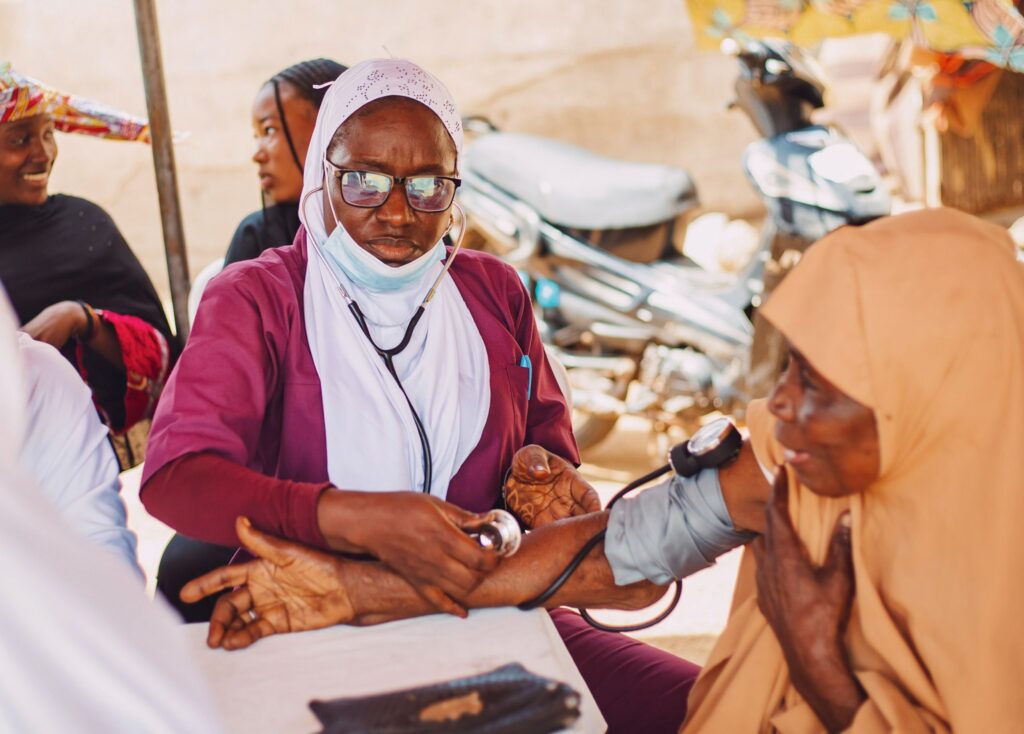
The brief maps faith-linked engagement across each of the four goals, providing an overview of the work that religious communities are already doing to end poverty and hunger and provide quality health care and education. The list of efforts is extensive, including well-recognized international organizations such as Aga Khan Health Services, the Community of Sant’Egidio, Fe y Alegría, Islamic Relief Worldwide, Lutheran World Relief, and the Tzu Chi Foundation, as well as more local and regional organizations such as Sarvodaya Shramadana in Sri Lanka and Akshaya Patra in India. The brief identifies a crucial issue affecting much of the development field: religious roles are seldom explicitly accounted for in measurements of SDG progress at global or national levels, which means that many contributions that could be built upon are overlooked or not well understood.
The brief argues that faith actors and communities are vital allies in the effort to achieve the SDGs. Not only do they enjoy high levels of trust that outside organizations can take decades to build, but they shape local attitudes on such sensitive topics as vaccination, girls’ education, and climate change. At the same time, faith-inspired institutions can bridge the gap between the official language of the SDG Framework and how its concepts are actually understood in local contexts. At a time when development budgets have been slashed and business-as-usual has been upended, people of faith bring a long-term vision and commitment to changing their communities for the better.
What the Brief Proposes for Beyond 2030
The brief offers five proposals for the development agenda that will build upon the SDGs post-2030. These proposals are intended to catalyze discussion at the upcoming G20 Interfaith Forums in the U.S., the U.K., and beyond.
- Consolidate, deepen, and integrate the goals. While the bold and comprehensive vision of the SDG framework has achieved much, the breadth of the 17 goals and their checklist structure has sometimes led to fragmented approaches. A post-2030 framework should concentrate on the most pressing issues and make explicit their interconnected nature. Faith leaders should be more involved in reformulating the vision of the goals post-2030.
- Prioritize localization. Implementation of the goals has remained largely top-down and technocratic despite commitments to shift more decision making to local actors. Communities on the ground need to be more actively involved in setting targets, implementing projects, and evaluating progress. Religious institutions are already embedded where state and NGO mechanisms are weak or absent, and they should therefore be included more deliberately in these processes.
- Renew the emphasis on peace and social cohesion. Faith communities already mediate local conflicts and join formal peace talks. The brief calls on religious actors to use their moral authority to build bridges rather than sow division.
- Integrate actions on climate, environment, and biodiversity across the agenda. The negative impacts of climate change now touch every area of development. As such, these efforts should be integrated into goals and targets related to poverty, hunger, health, and livelihoods rather than treated as a separate area of focus.
- Elevate the ethical use of technology. AI technology, including AI-assisted medical screening and teaching tools, could scale effective interventions, but only with robust ethical guidelines. Religious actors can play important roles in shaping such guidelines for the use of AI.
That closes out IF20’s discussion papers for 2026. Three of them meet the G20 where it currently is. This one asks what happens when the deadline arrives and the targets have not been met, and argues that the answer depends partly on whether the world starts counting the contributions it has not been counting. All four remain drafts, open for comment ahead of the Salt Lake City gathering in October.
———
JoAnne Wadsworth is a Communications Consultant for the G20 Interfaith Forum Association and Editor of the Viewpoints blog, IF20’s platform for commentary at the intersection of faith and global policy. She has covered the work of the Forum across multiple G20 cycles, producing summaries, articles, and editorial content that bring the voices of interfaith leaders and scholars to a broader audience. Her writing engages with topics spanning environmental governance, religious freedom, anti-racism, poverty and inequality, and the role of faith in multilateral policy processes. “The SDG Framework: Faith Engagement and Challenges” was written by Katherine Marshall, who has worked on international development for more than four decades, including thirty-five years at the World Bank, with a sustained focus on the countries and communities with the least.