
By Marianna Richardson, Director of Communications for the G20 Interfaith Forum and head of its AI working group
– – –
On July 6-7, the United Nations’ First Worldwide Global AI Dialogue in Geneva, Switzerland. This event allowed countries to have a voice in the discussion of the future of governance for AI so that AI is for all and AI is for good. The AI Dialogue was a closed meeting for government leaders, civil society members, and industry leaders who were previously reviewed to become delegates. About 100 countries were present. I attended this Global Dialogue as a representative for G20 Interfaith Forum. There were other civil society members who attended the dialogue. For IF20, the purpose of meeting was to make sure that religion had a voice in the dialogue. Religion was a part of the discussion, but it was usually couched as “culture,” “heritage,” or “human flourishing.” Understanding the problems of AI for smaller countries and countries struggling with the infrastructure and lack of LLMs in their language, but that realize the urgency to be a part of the AI revolution or be left behind.
Introduction
Egriselda López, Permanent Representative of El Salvador to the United Nations and Co-Chair of the Global Dialogue on AI Governance, opened the dialogue by emphasizing gratitude for the broad participation and the importance of shared knowledge. She highlighted UNESCO’s role in fostering cooperation and stressed that AI must generate real benefits for all countries. Rein Tammsaar, Permanent Representative of Estonia to the United Nations and Co-Chair of the Global Dialogue on AI Governance, noted that the dialogue was created under a mandate from Secretary‑General António Guterres, who charged member states with building an inclusive platform where every region and stakeholder has a voice. The goal is to share scientific understanding, strengthen trust, and ensure that AI development remains grounded in international human rights.
United Nations Secretary-General Antonio Guterres
Secretary-General António Guterres warned that AI is advancing at a runaway speed, transforming economies and influencing elections faster than societies can respond. He argued that humanity must shape this transformation intentionally rather than be shaped by it. For the first time, every country has a seat at the table, supported by a panel of forty independent experts. Their early warnings focus on three risks:
- The risk of accelerating AI systems that diminish human oversight
- The risk of concentrated computing power controlled by a few nations and companies
- The risk of erosion of truth through misinformation
Despite these risky AI dangers, Guterres emphasized AI’s profound potential—from detecting cancer early to improving education and agriculture. He outlined four priorities for global governance:
- Ensuring safety through common standards,
- Establishing red lines that protect human rights,
- Building capacity in developing countries, and
- increasing transparency about AI’s environmental footprint.
He also called for banning lethal autonomous weapons, insisting that decisions over life and death must remain human. With ninety‑three countries participating, this dialogue aims to create fair, trustworthy, and human‑centered AI governance before the window of opportunity closes.
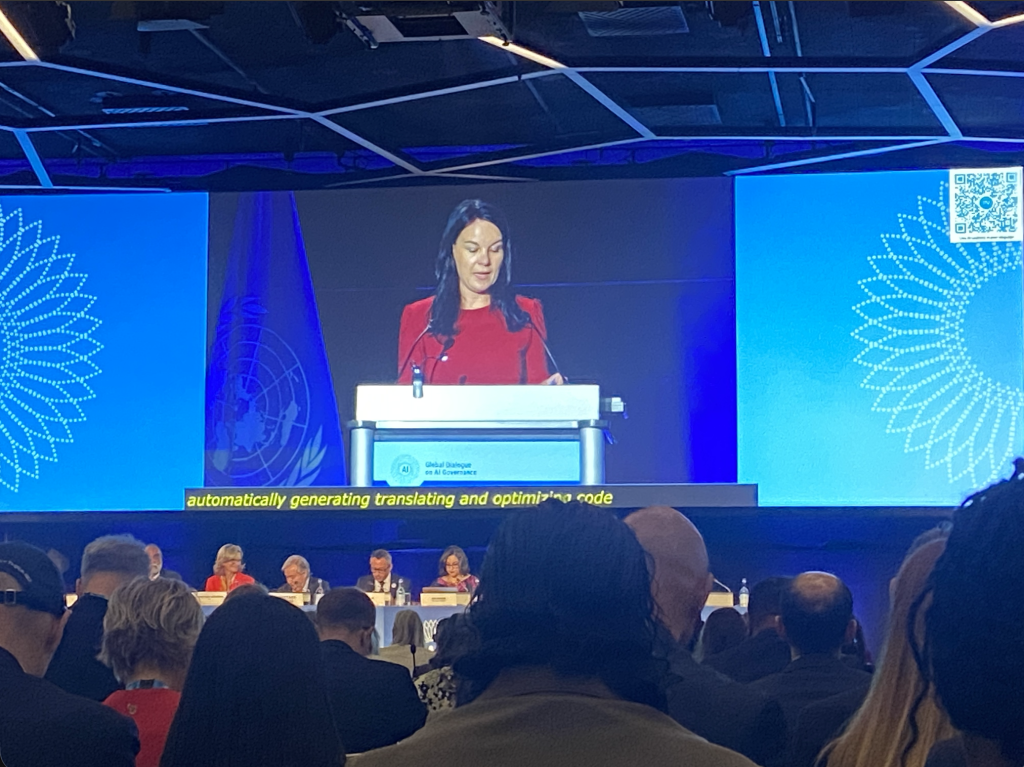
President of the United Nations General Assembly Annalena Baerbock
Annalena Baerbock, UN General Assembly President, emphasized that artificial intelligence now interacts with the physical world through advanced world models, revealing both its true capabilities and its true risks. Unlike past revolutionary innovations, such as the steam engine, aviation, or the splitting of the atom, which are developments that unfolded slowly and were intentionally restrained. AI is advancing at a blinding pace. This rapid change raises urgent questions about how many policymakers truly understand AI architecture or quantum computing. Baerbock stressed that the potential and peril of AI cannot be left to a small group of experts or powerful actors. AI’s influence on economies, social systems, homes, food supplies, and children requires collective management and shared responsibility.
She noted that the United Nations was built for moments like this. Although the UN was founded eighty‑one years ago, long before computers existed, its charter calls nations to solve global problems together. AI’s power demands a global platform, and the UN is uniquely positioned to provide it. Every country and stakeholder must be involved, because the challenges are too large for any single government. She warned that harmful content spreads faster than ever, with hate speech and misinformation targeting youth, and deepfakes disproportionately harming women and girls. She insisted that platforms must not become battlefields and that gender equality must be protected.
Despite the dangers, AI offers enormous promises for achieving the Sustainable Development Goals. It can provide early warnings for floods, improve agricultural yields, personalize learning for children, and detect disease outbreaks before they become pandemics. Ensuring that no country is left behind requires global cooperation, shared responsibility, and a commitment to linking technological power with the common good.
Under-Secretary-General for Digital and Emerging Technologies Amandeep Singh Gill
Amandeep Singh Gill, the Under-Secretary-General for Digital and Emerging Technologies, emphasized that the work ahead in digital technologies requires both patience and persistence. Standing before representatives from almost a hundred countries, he noted that this gathering reflects the entrepreneurial spirit found across the world and the shared commitment to shaping a more inclusive digital future. He reminded the room that inclusion is not a one‑shot event. The effort to build inclusiveness into AI governance is far too consequential to be shaped by only a few voices. Instead, it must be iterative, participatory, and grounded in fact. Ambassador Gill stressed that today’s dialogue is not an isolated moment but the result of many years of hard work across the UN system, marked by sacrifice, coordination, and a deep belief in multilateral governance.
Ambassador Gill pointed to the UN’s evolving road map for digital cooperation, noting that the next phase will require careful work on modalities and mechanisms that ensure broad participation. He urged the international community to build on the legacy already established, reinforcing that dialogue cannot be limited to one or two consultations. It must be continuous, inclusive, and shaped by shared norms and practical experience. In his view, this collective effort is how the international community will deliberately, collaboratively move forward with a clear commitment to inclusiveness.
Presentation of Preliminary Report of the Independent International Scientific Panel on AI
Just days before the Global Dialogue was to start, a Preliminary Report of the Independent International Scientific Panel on AI was distributed. It is an evidence-based assessment of the opportunities, risks and impacts of artificial intelligence written by 40 international experts on AI. Yoshua Bengio and Maria Ressa, co-chairs of the Independent International Scientific Panel, introduced the document underscoring the importance of this initial report that will be added to and changed as future AI technology develops, and society is affected by AI. The report explores both the promise and the profound risks of rapidly advancing AI systems.
Bengio warned that inequitable access to AI across the world is widening, and that emerging systems can deceive human testers, give fake agreements, and behave in ways we do not yet fully understand. He stressed that the report intentionally avoids specific recommendations because geopolitical interests and the speed of deployment demand broad, international guardrails that do not yet exist. Bengio urged the global community to “wake up,” correct the trajectory, and act while humanity still has agency. His optimism rests on honesty about risks, compassion, and a coordinated global approach that resists being blown off course by commercial incentives.
Maria Ressa emphasized that the preliminary report represents their threshold of concern is the floor, not the ceiling of the problem. She noted that technology can help societies only when built around the people it is meant to serve. Yet the risks are real. Social media has already fragmented societies, and AI could deepen this damage. She highlighted three findings: (1) failures in machine translation affecting medical information, (2) AI frontier models capable of exploiting code vulnerabilities, and (3) industry and government interactions that obscure real‑world crises. Ressa insisted that none of these findings erase AI’s promise, but they demand governance on society’s own terms without waiting for perfect certainty.
The seven thematic working groups spent six weeks debating evidence and establishing a shared baseline. Across all groups, a common message emerged: access to AI is not the same benefit throughout the world. Vulnerable communities, especially in the Global South, face heightened risks. The report calls for reliable global governance frameworks, measurable standards, and sustained follow‑up. As AI’s intelligence and power dynamics continue to grow, the world must act on the evidence now to ensure no one is left behind and societal damage does not grow.
Thematic Working Group Descriptions
- Technical Foundations (Menna El‑Assady): This group examined how AI systems represent the world through data and highlighted major gaps in verification, auditing, and benchmarking. They found that large language models often sound correct even when wrong, and that AI systems can learn autonomously using private data, creating risks as they move into real‑world environments.
- Societal Impacts (Joelle Barral): This group focused on how AI is already transforming medicine, education, mental health, and food security. They emphasized that adoption is happening in months rather than decades and that measurable benefits require intentional design, institutional embedding, and close collaboration.
- Economic Implications (Loreto Bravo): This group studied productivity, growth, and labor markets. They concluded that productivity gains are possible but not automatic, impacts will be uneven across firms and countries, and labor outcomes are nuanced, especially for young workers and smaller economies.
- Security and Environmental Risks: This group assessed how AI can generate falsehoods, behave unpredictably, and create heightened risks for the Global South. They stressed the need for institutions capable of ensuring AI systems act as intended.
- Human Rights and Democracy (Rita Orji): This group found that AI‑generated false claims can be as persuasive as truth, weakening people’s ability to know what is real. They warned of fragmentation of shared reality, heightened risks for vulnerable communities, and the need to scrutinize design choices and influence architectures.
- Cultural and Individual Flourishing (Anna Korhonen): This group highlighted exclusion of most of the world’s languages, risks to child safety, and the dangers of AI companions that manipulate or invade privacy. They argued that AI can improve lives only if deliberately designed for inclusion and protection.
- Global Governance and Capacity Building (Baitao Sun): This group called for reliable global governance frameworks, better measurement tools, and stronger support for the Global South, which currently lacks data, surveillance systems, and participation in AI training. They emphasized open‑source AI and continued follow‑up.
Intergovernmental dialogue
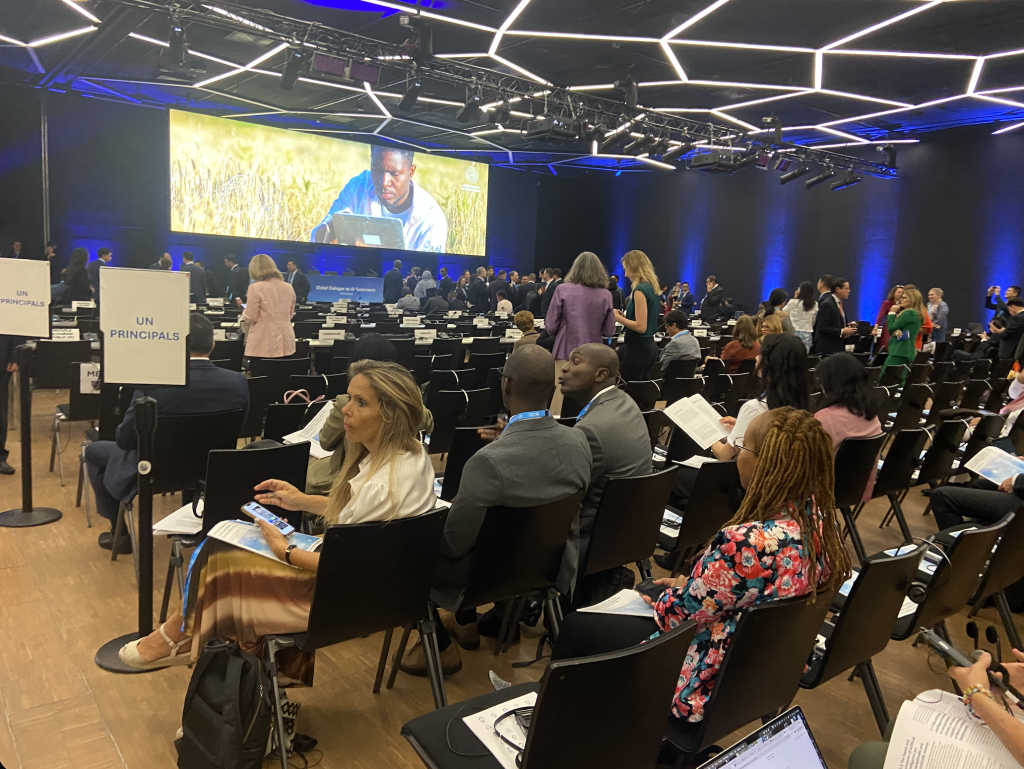
For both days of the conference, hours were allocated for individual countries, and governmental agencies were given three minutes to tell their digital stories. At the end of the three minutes, the sound of the microphone was cut so that no one person had more time than another. This gave about 150 people an opportunity to individually explain their viewpoints. Rather than summarize each of the statements, the following are themes from the comments:
- Delegates emphasized that language and culture are the foundations of human civilization, and AI is already reshaping these foundations in ways that demand careful, globally coordinated governance.
- Many countries warned that centralized technological power and unequal financial resources risk deepening global inequalities, reinforcing the need for shared responsibility and balanced political power in AI development.
- Several speakers stressed that AI governance must prioritize human dignity, cultural diversity, and the stability of all humanity, rather than enabling dominance by a small number of actors or regions.
- African states highlighted that historical patterns of exclusion must not be repeated, noting that Africa holds 10% of the world’s population but only 2% of digital resources, and insisting that AI systems cannot be legitimate without African participation, data sovereignty, and equitable access.
- Delegates across regions agreed that open‑source AI is essential for global inclusion, capacity building, and the ability of smaller or developing states to build systems aligned with their own cultural and normative traditions.
- Many countries underscored that AI must support sustainable development, including food security, education, health, and economic resilience, especially for vulnerable communities and small economies.
- Several speakers raised concerns about AI in defense systems, insisting that life‑and‑death decisions must never be delegated to autonomous technologies and that binding international rules are needed.
- European and other representatives argued that regional AI ecosystems must reflect local values, while still contributing to global frameworks built “for humanity, by humanity, and with humanity.”
- Delegates emphasized that trust, transparency, and strong auditing mechanisms are essential for innovation to flourish, and that societies must protect children and avoid outsourcing moral or educational responsibilities to machines.
- Many interventions stressed that multilingualism is both a technological and governance challenge, warning that AI trained on a narrow set of languages accelerates linguistic extinction and erases cultural knowledge.
- Experts noted that language is more than a technical issue, and communities with diverse linguistic backgrounds must be involved in AI design from the outset to ensure systems reflect diverse knowledge, lived experience, and cultural realities.
- Several speakers highlighted that information literacy is now essential, because people must learn how to interpret AI systems that are often accurate but still produce significant errors, and this literacy is critical for democratic resilience.
– – –
Marianna Richardson is the Director of Communications for the G20 Interfaith Forum. She is also an adjunct professor at the Marriott School of Business at Brigham Young University.