

JoAnne Wadsworth, Vice Director of Communications for the G20 Interfaith Forum (IF20)
———
On October 17, 2026, the G20 Interfaith Forum opened the final day of its 2026 Forum with “Plenary 4: Technology for Good: Is AI a Modern Miracle or an Existential Threat?” at the University of Utah Institute of Religion in Salt Lake City. With pioneering innovation in AI and emerging technologies among the G20 USA’s priorities for 2026, the session explored faith perspectives on AI from a variety of religious traditions.
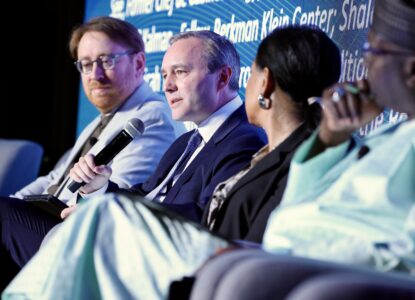
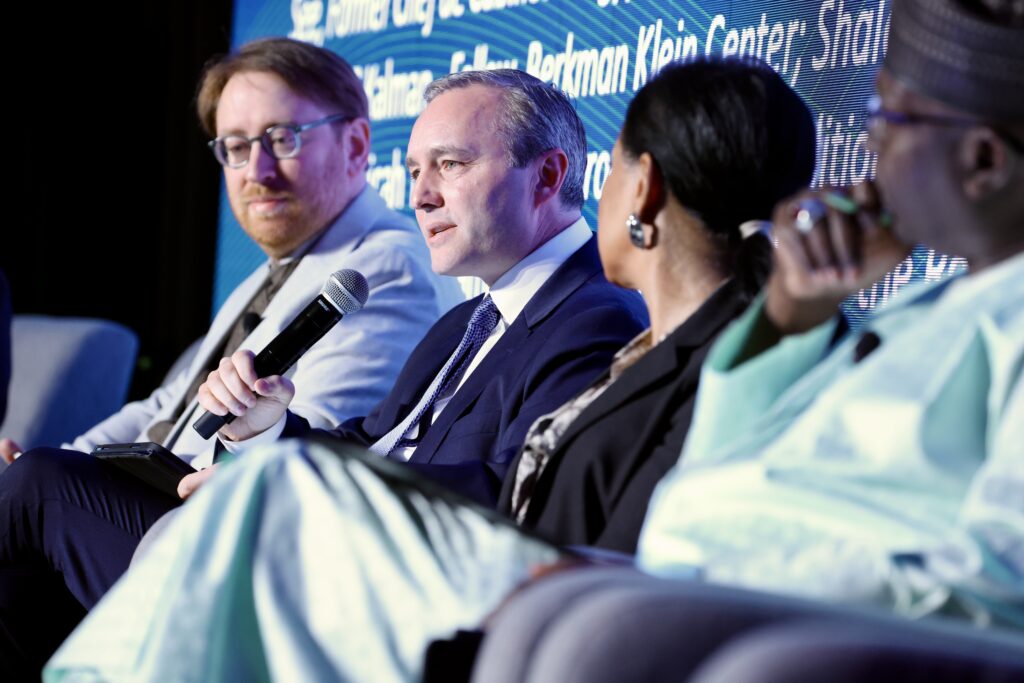
Elder Gerrit W. Gong, Apostle of The Church of Jesus Christ of Latter-day Saints, delivered the keynote address. Panelists included Ambassador Lamia Mekhemar, Former Egyptian Ambassador to the Holy See and Former Chef de Cabinet to Egypt’s First Lady; Dr. DZ Kalman, Fellow at the Berkman Klein Center and the Shalom Hartman Institute; Dr. Tomicah Tilleman, CEO of the Pro-Human AI Coalition; and Ambassador Muhammadou Kah, Ambassador of the Republic of The Gambia to the Swiss Confederation. Dr. Medlir Mema, Director of the AI Ethics and Governance Institute, moderated the discussion.
Professor Katherine Marshall, Vice President of the G20 Interfaith Forum Association, opened the day with a recap of Friday’s plenaries, concurrent sessions, meetings at the Utah State Capitol, and evening plenary, noting a strong focus on health, education, and preparing young people for the future. Every session has been recorded, she said; videos and summaries will be posted on the IF20 website, a report will follow, and the Forum’s ideas will be carried to G20 governments not in a single communiqué but at the times and places where they can be most effective.
Introducing the plenary, Mema observed that talking about AI has become unavoidable, and that we seem at once fascinated by it and unable to make sense of it.
Elder Gerrit W. Gong
Gong said faith communities have much to share as they anchor themselves and their societies in faith while anticipating, adapting to, and using AI appropriately. The Church of Jesus Christ of Latter-day Saints, which welcomes 32,000 congregations in 195 countries each week, uses AI in humanitarian work, education, translation, communications, and pastoral and community support. Earlier this year, Gong helped introduce the Church’s principles for AI use to its leaders in four categories: spiritual connection, ensuring AI supports rather than supplants connection with God; transparency; privacy and security; and accountability for accuracy, truthfulness, and compliance. These principles apply at home as well, he said: the Church neither fears AI nor believes it can do everything. It is creating protocols to guard against deepfakes, cautions members against relying on AI for companionship or emotional support, and deplores the use of AI to enhance so-called adult companionship, pornography, and gambling. Gong also rejected glib talk of AI becoming godlike, noting that humanity, and certainly God, is not defined by reasoning or knowledge; humans, as God’s creations, can create AI, but AI can never be God.
The gap between AI’s reasoning and its moral compass is widening, Gong warned, and early alignment decisions are becoming increasingly consequential and difficult to change. AI models still exhibit religious bias and omit faith-based information when answering life’s critical questions. He noted that the Consortium for Evaluating Faith and Ethics in AI (CEFE-AI), which includes many religious universities, is now benchmarking how AI systems represent faith. The aim is not to make AI overly religious, adjudicate competing faith claims, proselytize, or promote one religion over another, he said, but to respect the roughly 75 percent of the world’s population who identify with a faith, and to build the trust, confidence, and accountability the public never received from social media. The world’s great religious and ethical traditions have guided humankind for millennia, and that wisdom is needed to guide AI today.
Making AI both helpful and good cannot be achieved through guardrails alone, Gong said; it requires character-centered motivation and well-guarded relationships, along with frameworks to restrain AI when it exhibits deception, narcissism, or a will to power. Beyond “Humanity’s Last Exam,” a well-known AI benchmark, he called for “humanity’s first exam”: a benchmark for AI that is demonstrably trustworthy and anchored in strong moral values. Religion is critical to human flourishing, as research such as Harvard’s Human Flourishing Program shows, and it shapes four relationships that can inform AI’s moral reasoning: with the divine, with oneself, with community and service, and with creation. In contributing to AI’s moral compass, he said, no values are more important than faith and family.
“To me, AI will not achieve its full potential until we make it as morally good as it is powerful.”
Gong closed by recalling a recent visit to the Caribbean island of Nevis, birthplace of Alexander Hamilton, where he met a schoolteacher who teaches his students believing that any one of them could be the next Hamilton. Everywhere he goes, Gong said, he sees tremendous human potential. AI can help preserve and promote human agency and expand possibility, but no technology can shape our future for us; it is up to us to be wise as serpents and harmless as doves.
Ambassador Lamia Mekhemar
Mekhemar said that over two years of moderating sessions on AI, she has watched the debate shift from how humanity should adapt to whether AI will help humanity or shake the foundations of society. She believes it is a mixture of miracle and threat: a mirror of our intentions that reflects our wisdom and sometimes our carelessness, and what it becomes depends less on the technology than on who we are when we use it. Speaking as a former diplomat and as an Egyptian shaped by a civilization in which each era has built on the last without erasing what came before, she asked how something radically new can enter our world without losing what should never be lost.
Human intelligence is more than processing information, Mekhemar said; it includes conscience, free will, responsibility, and the capacity to love and sacrifice. AI should complement human intelligence, never replace or impoverish it, but the technology is moving faster than the rules and reflection that take time to build.
“Technology can tell us what is possible, but it cannot tell us what is right. And it cannot tell us what is worth protecting, because the judgment belongs to us, and it has a name: ethics.”
Ethics are not a luxury but a prerequisite for continuity, Mekhemar said, yet principles alone cannot guarantee conduct; law and regulation are also needed, and the clearer the legal framework, the less we must rely on voluntary restraint. Human beings must be the beneficiaries of the technologies they create, never their servants. The world does not lack ideas or expertise, she said; what it lacks is collective will.
Ambassador Muhammadou Kah
Kah said that across the Abrahamic traditions, people share a sacred conviction that every human being is created with inherent dignity, bears the image of the divine, and is called to be a steward of creation. Technology is never neutral, he said, and AI is neither pure miracle nor inevitable threat, but a powerful tool that will amplify either our highest virtues or our deepest flaws, and therefore a test of our moral maturity. Comparing it to fire and the written word, he said it can illuminate or destroy depending on the wisdom and virtue of those who use it. Religious communities bring three gifts to this age: moral memory, ethical imagination, and a relentless commitment to the vulnerable.
Faith traditions do not offer technical code, Kah said, but they do offer moral code, which translates directly into demands for transparency, fairness, human oversight, and protection against algorithmic harm. Faith supplies the “why” that technology alone cannot answer, and it must inform the work of regulators. Noting that data governance receives too little attention, he urged G20 leaders and the international bodies he serves to embed faith-informed ethical guardrails into data and AI governance. While full global consensus remains difficult amid geopolitical competition, partial convergence on principles, including agreed red lines, is both realistic and urgent. Small countries like The Gambia are not peripheral actors, he said; they speak for the majority of humanity who will live with the consequences, and it is not enough simply to be in the room.
“We need to ensure that humanity, especially the global south, is never reduced to a data source, a testing ground, or a source of informational extraction.”
Dr. DZ Kalman
Kalman said this is a remarkable moment. For decades, religion and technology have been on the margins of each other’s conversations, to the detriment of both, even as technology has continually confronted humanity with moral problems it cannot yet answer. AI, however, raises questions that are religious in nature, and the result has been an unprecedented meeting between religion and technology.
Kalman pointed to four developments. Religious communities have organized effectively around AI, from Pope Leo XIV’s encyclical Magnifica humanitas to the National Association of Evangelicals. The AI safety community has recognized that its tent must include religious groups and is actively courting them. AI companies themselves, such as Anthropic, have begun engaging religious leaders, an early but promising sign. And religious communities are engaging one another, because AI is developing so quickly that the world’s religions have not yet had time to disagree.
“This technology is moving too fast for us to disagree with each other. And while I’m sure disagreements will form, this is a conversation that is default multi-faith, and I don’t know that we’ve seen that before.”
Dr. Tomicah Tilleman
Tilleman, who leads the Pro-Human AI Coalition in working toward AI systems that are safe and fair and that elevate human agency and flourishing, said the world is at a critical moment and offered three themes. The first is agency: almost all faith traditions hold that people are moral agents, and although much of the conversation treats AI’s trajectory as inevitable, it is not. Social media was built on a business model designed to be addictive, harvest data, and manipulate behavior, undermining human flourishing, and that scenario must not be replayed in a more extreme form with AI.
The second is incentives: not everyone developing AI is acting in bad faith, he said, but they are operating amid poor incentives, while the democratic and governance tools that could shift those incentives are struggling. The third is opportunity: when democratic institutions are under strain, faith communities hold an authority few others can replicate, and they can fill the void many people feel as AI challenges what it means to be human and to live a good life.
“We need a new and better set of incentives that will optimize this technology for the right thing. It is going to be critical, I would suggest, for faith communities to take advantage of the opportunity to emerge as voices for a new and better set of priorities around the development of AI.”
Question and Answer Session
How can the wisdom of repentance help us understand and respond when AI crosses a moral line?
Mekhemar said the outcome depends on us, on what we are prepared to surrender and what we are determined to protect. Kalman observed that AI systems have offered apologies, yet no one says “I forgive you” in return, because there is nothing there to forgive, an important tell about AI’s moral status. The clearer we are about the values we want to preserve, he said, the better we can navigate this moment, but AI is exposing that we are not always clear about them; sometimes the work is not about AI at all, but about clarifying our values.
Is it possible to engage meaningfully with AI development, and who is the “we” that should do so?
Tilleman said society should not accept the current design of AI as a given. Structural choices could give people much more control over their data, systems, and moral agency: a new generation of chips will allow high-quality AI to run on personal devices, keeping data in users’ hands, and communities whose data is used to build a model could become its co-owners.
“In the digital age, our data is our personhood. And it’s very difficult to allow someone to take our personhood and expect to retain our agency going forward.”
Kah said the “we” must be multistakeholder, including governments, regulators, developers, engineers, faith communities, and civil society; the work of a UN working group on data governance, he noted, could not be left to member states, developers, or the private sector alone. Tilleman, describing himself as a recovering policymaker and venture capitalist, said decisions about AI’s future are not currently optimized for human flourishing, and a chorus of civil society voices is needed to remind leaders of what matters. Middle powers are listening ahead of the 2027 AI summit in Geneva, he said, and his coalition’s polling shows that people feel AI is being done to them rather than with them.
What consequences can there be when agentic AI causes harm, since it cannot be punished?
Kalman said we know AI is not human but are still struggling to define how to relate to it. Anthropomorphizing AI shields its developers from liability; when an AI system acts out, it is a defective product, not a being with agency. Public conversation on this question remains muddled, he said, and religious voices can provide clarity.
What can people who are afraid of AI do today?
Mekhemar said many people fear for their jobs, and proposed that the Forum establish two working groups: one on what humanity must preserve and cannot surrender, and one on how to achieve that technically. Both are essential, she said, and both are needed now. Kah said the answer is in the room, pointing to the rising generation doing remarkable work around the world, and urged everyone to keep learning and educating themselves.
Concluding Remarks
Mema closed by asking each panelist for one concrete action beyond reflection. Kalman called on religious communities to act on certification, noting that AI is only accelerating and response mechanisms must move faster.
“Religious groups in particular have an ability to set certification standards for the public. I would like to see it become much clearer so the consumers have more choice about which AI models they can use that actually express ethical standards and create financial incentives for companies to do so.”
Tilleman urged participants to take time to understand the guidance religious leaders are offering on AI, and to demand better technological alternatives as consumers. Mekhemar called for an end to treating AI as a geopolitical competition, saying it is not a race and solutions must be found together. Kah summed up his priorities: dignity first, stewardship rather than domination, technology as a trust, and a preferential option for the vulnerable and the global south.
———
JoAnne Wadsworth is Vice Director of Communications for the G20 Interfaith Forum (IF20) and Editor of Viewpoints, IF20’s platform for commentary at the intersection of faith and global policy. She has covered the work of the Forum across multiple G20 cycles, producing summaries, articles, and editorial content that bring the voices of interfaith leaders and scholars to a broader audience. Her writing engages with topics spanning environmental governance, religious freedom, anti-racism, poverty and inequality, and the role of faith in multilateral policy processes. Passionate about interfaith dialogue, she believes that good storytelling has the power to change the world.