

By JoAnne Wadsworth, Vice Director of Communications for the G20 Interfaith Forum (IF20)
———
On October 17, 2026, the G20 Interfaith Forum held “Plenary 5: Energy Needs and Building Peace: Challenges Facing the G20” on the final day of the Salt Lake City G20 Interfaith Forum in in Salt Lake City. With unlocking affordable and secure energy supply chains among the G20 USA’s priorities for 2026, the session explored faith perspectives on energy security, access, and the transition ahead.
H.E. Dr. Mohammed bin Said Al Maamari, Minister of Endowments and Religious Affairs of the Sultanate of Oman, delivered a video address. Panelists included The Honorable Scott Morrison AC, 30th Prime Minister of Australia; Professor Husna Ahmad OBE, CEO of Global One 2015; Ambassador Amr Aljowaily, Director of the Citizens and Diaspora Directorate at the African Union Commission; and Professor Azza Karam, President of Lead Integrity and Professor of Diplomacy and World Affairs at Occidental College. Professor Peter Mandaville, Senior Fellow at Georgetown University’s Berkley Center for Religion, Peace & World Affairs, moderated the discussion.
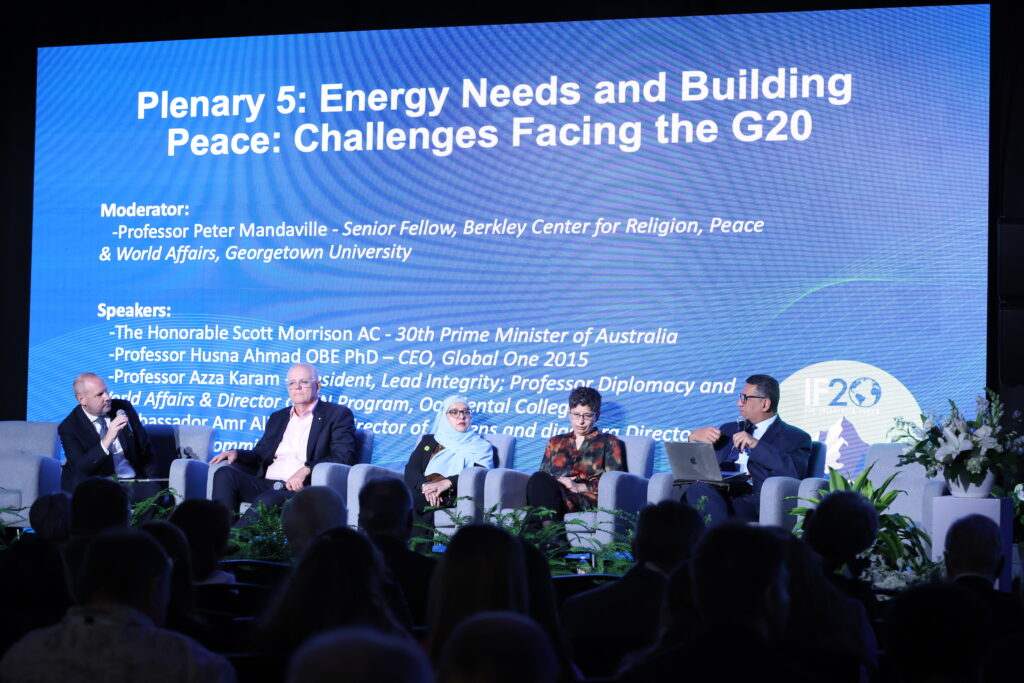
Introducing the plenary, Mandaville framed its central question: can we build energy systems that are at once abundant, equitable, sustainable, and conducive to peace? He said he suspected, and hoped, that the panel would offer a diversity of opinion.
H.E. Dr. Mohammed bin Said Al Maamari
Speaking by video, Al Maamari said the session’s question begins with energy but reaches far deeper: how to turn the resources we hold into shared prosperity, trusted peace, and a future the next generations will inherit. Balancing security of supply, affordable access, and environmental protection is a technical matter, he said, but also a matter of values that religions have long recognized.
Al Maamari offered Oman’s centuries of experience as a contribution, from Omani ships that carried values of integrity, fidelity to one’s word, and respect for those who differ to East Africa, India, and China, to the 1840 arrival in New York of the Sultanah, bearing the first Arab envoy to the United States. At home, Oman’s aflaj irrigation systems, five of which are inscribed on UNESCO’s World Heritage List, rest on the principle that the right to benefit from a resource carries responsibility for its preservation, while the waqf, or endowment, extends that responsibility across generations. In June, Oman launched the Muscat Plan at UN Headquarters in New York with the United Nations, the UN Alliance of Civilizations, and the Network for Religious and Traditional Peacemakers, aiming to strengthen the role of religious and traditional leaders in preventing conflict and countering hate speech.
Religions hold that what is owed to those in need is a right, not a favor, Al Maamari said, so fairness means giving priority to those whom energy has not yet reached; they call for moderation and forbid waste, so abundance and sustainability need not conflict. All of this comes together in trusteeship: human beings are entrusted with the earth, not its absolute owners, and decision-makers must account for the generations who will inherit the consequences of their choices. He called on G20 leaders to adopt energy and development policies that safeguard security of supply, broaden opportunity, protect the rights of future generations, and value religious and community institutions as genuine partners in the transition.
“In a world of interwoven interests, energy security cannot be achieved for anyone unless it is achieved for all, and what we share in resources, we must also share in responsibility.”
The Honorable Scott Morrison AC
Asked how governments should weigh affordable, reliable energy against long-term environmental commitments, Morrison called it one of the most vexing issues in public policy. Over the last 20 years, he said, climate has become an article of faith on both the right and the left, when it is a genuine challenge that needs a solution, one that should play out differently in different countries. He found himself disagreeing with both sides, and worked most closely on the issue with Japan because it wanted technical answers rather than geopolitics. Until people are willing to walk out of the pews and back into a policy discussion, he said, the debate will remain on its current unhappy path.
“When it became an ideological and, indeed, religious issue, when politics became religion, I think it led us into a cul-de-sac, and we are still not out of it.”
Mandaville noted that the faith sector runs schools, hospitals, and humanitarian and development organizations, and asked what distinguishes a well-intentioned statement from something that can actually influence policy. Morrison said that because Australia lives next door to developing economies, it understood their energy challenges acutely, and its policy settled on an “all of the above” approach to energy that is accessible, affordable, and sustainable. The only thing that will radically change the paradigm, he argued, is technology that makes energy radically cheaper and more reliable, and governments should invest in science that can be scaled and delivered in developing countries. The energy curve is flat, and no one invests in a flat curve, but he predicted that the energy demands of AI will finally draw in the capital needed to crack the puzzle. Without that investment, he said, everyone is left arguing at the bottom of the cliff, and developed nations have spent too much time going to conferences about it.
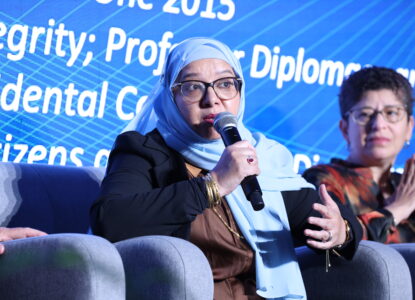
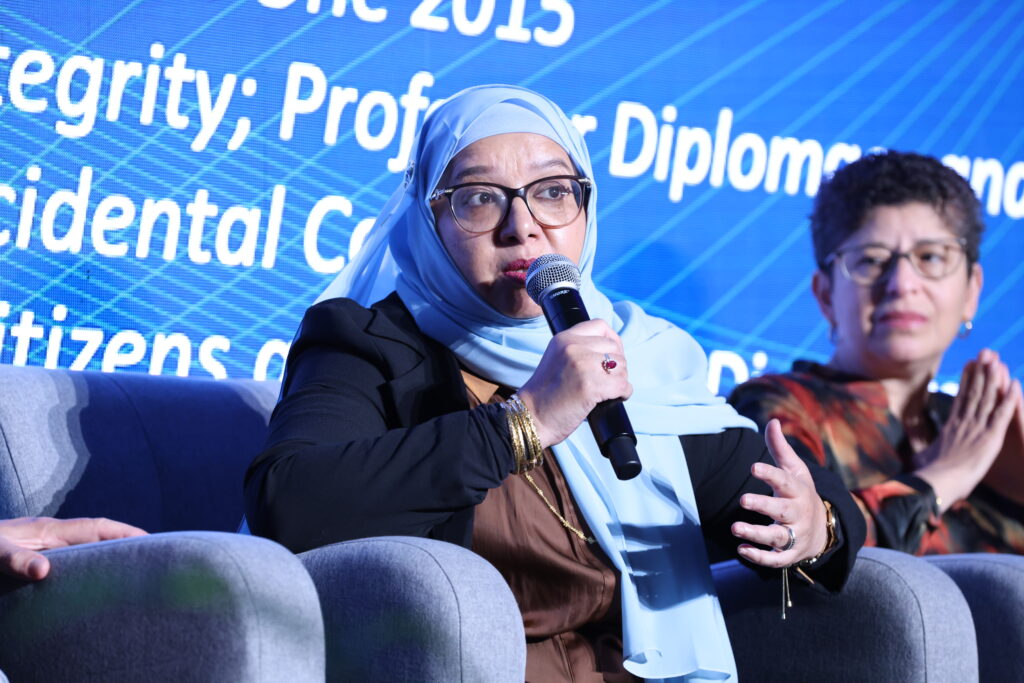
Professor Husna Ahmad OBE
Asked what energy security looks like for women and underserved populations, Ahmad said the key word is security: unless people have the physical security to live without fear of external threats, it is impossible to think about anything else. There is a clear global imbalance in power and resources, she said, and the injustices done to the global south must be addressed.
“Energy security is not an abstract policy issue, it determines whether a hospital can keep their lights on, whether a child can study at night, whether a farmer can irrigate a field, and whether a family can afford to cook.”
When supplies are disrupted or prices surge, Ahmad said, the burdens fall hardest on those with the least room in their household budgets, and communities also pay for polluting fuels through dirty air and a changing climate. That is why faith communities must take part in the energy conversation, raising moral questions that engineering and economics cannot answer. The transition, she said, cannot expand opportunity while locking the global south in insecurity.
Islam, Ahmad said, teaches that creation has an order that should not be thrown into disorder and warns against wastefulness, asking us to distinguish need from waste and prosperity from excess. Responding to Morrison, she agreed that the COP space can be a circus, but said faith communities must be present there, since the SDGs will never be achieved without a whole-of-community approach. Pointing to Project Dandelion and the Women, Faith and Climate Network, she called for radical collaboration, noting that women of faith are too often left on the sidelines and that the conversation must include faith-based actors, not only religious leaders.
Ambassador Amr Aljowaily
Asked about the relationship between energy security, development, and peace from an African perspective, Aljowaily said the African Union’s priority is its people, and their situation is stark: some 600 million Africans, nearly half the continent’s population, live without electricity, and 900 million cook without clean fuels.
“Here we are not only talking about light as a luxury, but actually light as a link, as a first link, as a first connection to what it could provide later on.”
Universal access is the point of departure, Aljowaily said, and the base on which infrastructure, digital connectivity, and industrial development can be built. Africa needs fairer terms of international cooperation, including grants rather than loans and value chains that are more inclusive of Africa and respectful of its rights.
The AU itself offers a model for engaging religious communities, Aljowaily said, through a directorate dedicated to civil institutions and an African forum, similar to the IF20, that brings together religious councils. Faith communities contribute in three ways: through reframing, since the language of diplomacy does not reach the grassroots, and reframing access as justice reaches the deepest and most committed levels of society; through reinforcement, carrying what governments agree on to the community level; and through representation.
Professor Azza Karam
Asked to consider energy through the lens of peacebuilding and human security, Karam said that although we tend to treat energy as a silo, questions of access, inequality, and power relations are among the oldest in human history. Geopolitically, she said, the world is witnessing a complete disregard for international law, and when we disregard what holds us together, we all go downhill together.
Religious communities are just as divided as political ones, Karam said, and there is a price to pay for being a prophetic voice: one cannot be aligned with a political regime and still speak truth to power. We have a moral obligation, she said, to hold accountable the religious institutions and leaders that have been co-opted and are often leading the charge against the common good, an obligation that has yet to be exercised.
“We’re hearing religious politics and political religion far more often than we’re hearing a prophetic voice for the common good.”
Agreeing with Morrison that paradigms must change, Karam noted that the last ten COPs have included systematic religious representation, some even a faith pavilion, with little impact; the policymaking table has remained disengaged from religious voices unless they were aligned with political regimes. Paradigms change not through law alone, she said, but through moral persuasion and education at the grassroots, and the paradigm most in need of change is between and within religions. Rather than only pointing fingers at politics, religious communities have a responsibility to change their own behaviors and attitudes.
Concluding Remarks
In closing, Mandaville asked each panelist for a single recommendation. Morrison proposed electrifying the health services that faith-based organizations run, and Ahmad called for using digital platforms to reframe the language of energy policy from technical to practical. Karam said the global interfaith movement must take stock of what it has and has not achieved, acknowledge the divides within religious worlds, and hold its own communities accountable. Aljowaily summed up his recommendation as “read and reach,” asking participants to read what the African Union has been saying and help its message reach the global policymaking tables where it is often absent.
———
JoAnne Wadsworth is Vice Director of Communications for the G20 Interfaith Forum (IF20) and Editor of Viewpoints, IF20’s platform for commentary at the intersection of faith and global policy. She has covered the work of the Forum across multiple G20 cycles, producing summaries, articles, and editorial content that bring the voices of interfaith leaders and scholars to a broader audience. Her writing engages with topics spanning environmental governance, religious freedom, anti-racism, poverty and inequality, and the role of faith in multilateral policy processes. Passionate about interfaith dialogue, she believes that good storytelling has the power to change the world.