
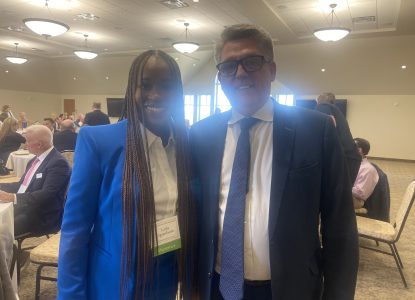
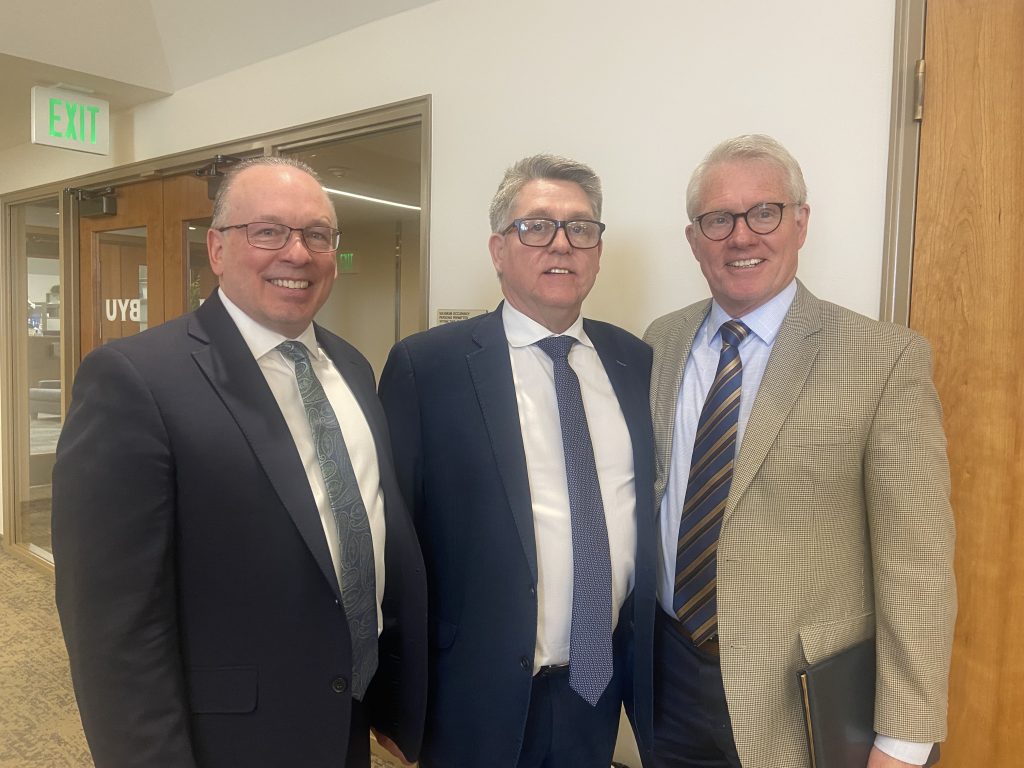
On April 6, 2026, Kevin Hyland was a keynote speaker at the International Society 36th Annual Conference in Provo, Utah. The following blog is a summary of his speech written by Marianna Richardson.
———
Kevin Hyland’s Leadership and Legacy
In his address, Hyland reflected on faith, service, and human dignity. He described his journey from soldier to commissioner as one shaped by witnessing suffering but also extraordinary goodness. He emphasized that every person is a child of God, deserving inherent dignity and protection. Hyland warned that modern slavery thrives because prevention, which needs to be government‑led and adequately funded, remains the missing piece. Despite global spending, trafficking remains a quarter‑trillion‑dollar criminal industry, demanding far greater collective action.
The Scale and Economics of Exploitation
Hyland emphasized that despite global commitments to human rights, the world continues to tolerate a vast criminal economy built on the exploitation of children, women, and men. Financial crime is often dismissed as non‑violent, but it drains economies of an estimated $5 trillion annually, undermining development, destroying livelihoods, and enabling criminal business models. Modern slavery and human trafficking alone generate $236 billion each year, exceeding the total global aid budget. With 50 million victims worldwide, the crime is driven entirely by profit, treating human beings as commodities for sexual exploitation, forced labor, organ trafficking, domestic servitude, and online abuse.
Failure of Global Frameworks
Although the world has adopted extensive legal instruments, such as the 1926 Slavery Convention to the Palermo Protocol, U.S. Trafficking Victims Protection Act, ILO conventions, and 180 national laws, implementation remains weak. In 2024, only 102,000 victims were recovered from human trafficking and fewer than 8,000 prosecutions occurred. This means only 0.2% of victims are identified, and 0.02% of cases result in convictions, making trafficking one of the most profitable and least risky crimes globally.
Human trafficking permeates global supply chains, from tea plantations and garment factories to cobalt mines, car washes, and public procurement systems. Even essential goods, such as mobile phones, cars, medical supplies, often rely on forced or child labor. Technology companies, despite their capacity to prevent online exploitation, face repeated sanctions for failing to protect children. Kevin Hyland underscores the moral urgency by comparing the annual deaths of 22,000 exploited children to the equivalent of more than one hundred fatal airline crashes each year. If 100 fatal airline crashes happened, there would be an international uproar. Yet, these deaths of exploited children are an unacceptable but largely invisible catastrophe.
Unequal Value of Human Life
Hyland argued that the world applies unequal standards to human life. When lives are lost in wealthy countries, the deaths are treated as tragedies; when exploited children die in mines or supply chains, their deaths become mere statistics. This disparity violates the belief that every person is created in the image of God. Restoring equal dignity requires returning to shared moral values and embedding them into business practices, public institutions, and community life.
Faith, Standards, and Prevention
To address these failures, interfaith partners and the British Standards Institution are developing a global standard on human dignity. Effective implementation requires community engagement, long‑term development, and a rule‑of‑law approach that extends beyond criminal justice to civil and human rights protections. Although the UN Sustainable Development Goals call for ending modern slavery and child labor by 2030, global progress has stalled, and child labor has worsened.
Some governments have begun using procurement rules, due‑diligence laws, and import bans to prevent forced labor in supply chains. These measures can work when implemented humanely, as shown in successful interventions in Pakistan. The United States is now investigating supply chains in 60 economies to strengthen prevention.
Victim‑centered investigations and partnerships with faith communities build trust and uncover trafficking networks. Stories of exploited children in Congo, abused migrant girls in Libya and Europe, and trafficked youth in the United States illustrate the profound human cost. Our global society has allowed this resurgence of exploitation and therefore bears responsibility to end it because every life holds equal, immeasurable worth.
Conclusion: Globally Establish a New Moral Compass
Hyland concluded by emphasizing that every human life is created in the image of Christ, and therefore societies have a moral obligation to confront modern slavery with seriousness and urgency. He outlines essential actions for governments, businesses, and communities. First, no institution should fund or benefit from slavery within supply chains, and profits derived from exploitation should be seized and redirected to victim compensation and anti‑trafficking efforts. Second, technology companies must be held accountable through regulation, not voluntary promises, because online platforms currently enable real‑time child exploitation across borders. Third, nations must better use international legal instruments and strengthen cooperation through bodies, such as the United Nations, the G20 Interfaith Forum, and faith‑based networks.
Hyland stressed that the most important requirement is a renewed moral compass rooted in human dignity. Governments, businesses, and individuals must take responsibility and demand change without being overwhelmed by the scale of the problem. He draws on the example of Jesus, who prioritized the vulnerable and demonstrated that true strength lies in compassion and service.
Hyland reflected on encounters with survivors and grieving families whose faith and resilience strengthened his own commitment. Stories from Nigeria, Africa, and other regions illustrate both the suffering caused by trafficking and the extraordinary courage of those who endure it. He argues that people of faith must lead efforts to restore human dignity and protect the vulnerable. He concludes by urging communities—especially in Utah—to build coalitions, integrate anti‑trafficking work into education and planning, and ensure that future events, including the 2034 Olympics, are free from exploitation.
———
Kevin Hyland helped establish the Santa Marta Group with Pope Francis in 2014, creating a global partnership between law enforcement, civil society, and faith communities. He also chairs the Institute for Human Rights and Business Leadership Group on responsible recruitment, highlighting how deceptive online manipulation and false job offers lure vulnerable people into exploitation. His contributions shaped the UN Sustainable Development Goal on human trafficking, adopted in 2015, which strengthened global coordination led by the International Labour Organization.
Marianna Richardson is the Director of Communications for the G20 Interfaith Forum. She is also an adjunct professor at the Marriott School of Business at Brigham Young University.