

By JoAnne Wadsworth, Communications Consultant, G20 Interfaith Forum
———
On June 4, 2026, the G20 Interfaith Forum, in conjunction with the International Academy for Multicultural Cooperation, held a webinar entitled “Spiritual Exploration of Possible Pathways for Providing Energy Security for All.” Speakers included Aisake Casimira, Dean of Strategic Visioning at Pacifika Communities University in Suva, Fiji, whose work is grounded in a whole-of-life philosophy rooted in Pasifika spirituality; Fletcher Harper, an Episcopal priest and Executive Director of GreenFaith, an international interfaith environmental organization campaigning for climate justice across thirteen countries; Tariq Al-Olaimy, co-founder of FutureFaith, a nonprofit that mobilizes the wisdom of faith and spiritual traditions to reshape climate and biodiversity action; and Sima Luipert, a Namibian development practitioner and human rights activist of the Nama people. Ja:no’s—Janine Bowen, Director of Seneca Language Teacher Support and Community Outreach for the Seneca Nation, a faith keeper of Haudenosaunee ceremonies, and a member of the IF20 Anti-Racism Initiative, moderated the discussion.
Aisake Casimira
Casimira opened by reframing the energy conversation as, at its core, a crisis of narrative. Quoting a church leader from Tahiti, he argued that many Pasifika peoples have been “educated in stories that are not of their own,” taught to understand development, progress, leadership, and even religion through lenses formed elsewhere—a dislocation that produces not only climate change and economic inequality but cultural and spiritual weakening. The questions that follow, he said, are who tells us who we are, and whose story shapes our future. He pressed the panel’s own framing as well, asking why, in G20 contexts, spirituality is treated as merely one optional pathway, when for most Pasifika and Indigenous peoples it is not an option at all but the mainstay of life.
To illustrate an alternative, Casimira drew on a proverb from his own dialect containing three idioms. The first, to always look up, names a cosmic spirituality that situates humanity within a vast, conscious universe. The second, to always look out, names an ecological spirituality of responsibility and care for the sea, the forest, the land, and one another. The third, to always look inside, names a human spirituality attentive to the universe within each person. These three dimensions, he explained, are not separate spiritualities but facets of a single whole-of-life vision that his university articulates as a philosophy of distinguishing without separating and embracing the parts without compromising the whole.
Running through each idiom was a single conviction: that the human being is not the summit of creation but a participant in it. That posture of humility, he suggested, is precisely what a just approach to energy requires.
“It places the human being not as the pinnacle, not as the center of the universe, but as a part of it.”
Fletcher Harper
Harper offered his remarks as a practical case study in putting Casimira’s values into action. GreenFaith, the organization he leads, now works with faith leaders in thirteen countries, but its energy journey began roughly two decades ago in New Jersey, where people from diverse religious traditions worked with state government, solar developers, and financial institutions to install solar arrays on twenty-five religious facilities—projects communities celebrated, in one case, with a full Catholic blessing of the equipment. That enthusiasm carried into a second stage in which congregations hosted “solar socializing” events, helping more than a hundred households across the state go solar.
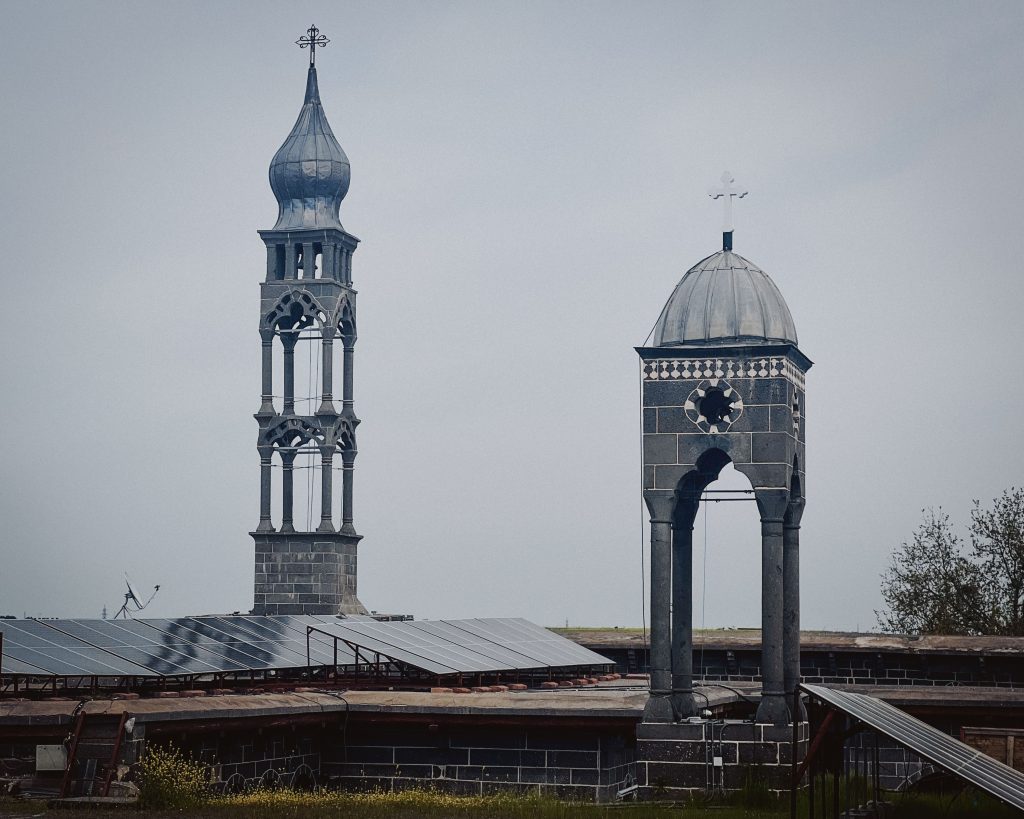
As GreenFaith expanded nationally and internationally, Harper said, the dimensions of racism, colonialism, and discrimination against women came quickly to the fore—both in who is harmed most by current energy systems and in how the clean energy transition does or does not work. He described SHINE, an Africa-based initiative now under the leadership of Bella Chipondya that works at the intersection of climate, energy access, and gender. Operating in roughly a dozen African countries, SHINE provides technical and modest financial support to women-led renewable energy enterprises and has so far empowered more than a thousand women.
Harper’s central critique was that policymakers too often assume the only viable solutions operate at a large corporate scale, overlooking what sits in front of them. The final stage of GreenFaith’s journey, he said, returns to movement-building: following a pilot mobilization in the United States last September, the organization is planning a global day of action in June 2027, convinced that religious and spiritual communities have an essential role in calling for an energy future that reflects shared values.
“Around the world, there are hundreds of community-owned and -led, women-owned and -led renewable energy enterprises that are ready to scale and that simply need access to financing at non-extractive levels of interest in order to thrive.”
Tariq Al-Olaimy
Al-Olaimy began with a simple gesture—reaching for a light switch—and the questions hidden inside it: who has light and who does not, what it costs, who pays, and at what consequence. We are living through a crisis of the invisible, he argued: carbon has no color, methane no smell, and the map of who receives energy and who receives smoke still follows the old maps of race and empire. Invisibility, he observed, is a privilege of distance. Yet faith and spiritual traditions have spent millennia generating commitment to precisely what cannot be seen—to ancestors and descendants, and to the sacred within all things—which makes them uniquely equipped for this moment.
Drawing on his Islamic tradition, he introduced the concept of Al-Mizan, the balance. Because the Qur’an, in his reading, describes one balance rather than two, the same equilibrium that holds the planets steady also holds the climate steady and wealth in just circulation. From that premise follows a striking moral equivalence.
“From an Islamic perspective, to wreck the climate and to hoard wealth are the same transgression.”
Energy security for all, he continued, is therefore an ancient obligation rather than a modern policy slogan—and security purchased through war or through another’s darkness is no security at all, since there is no peace without justice. A just transition, he insisted, is a moral and cultural project as much as a fiscal one. As an advisor to Greenpeace MENA on Islamic finance—a roughly six-trillion-dollar movement whose requirements of risk-sharing, prohibition of interest-bearing debt, and circulation of wealth mirror the principles of a just transition—he offered that sector as one concrete spiritual pathway, while conceding it still finances deforestation and coal and so remains a path that must be walked.
Sima Luipert
Luipert turned the discussion to decolonizing the green transition, speaking from the perspective of Indigenous sovereignty and sacred memory in Namibia. She described a “green paradox” of two futures in which well-intentioned climate policy can inadvertently accelerate harm. Using an image of two competing realities bound together by interlocking gears, she argued that the clean-tech narrative and the extractive, fossil-dependent one are not separate eras but mechanically linked: one cannot spin the gear of green transition without simultaneously grinding the gear of extraction and mining.
She then traced what she called new maps of extraction, in which global powers use the language of salvation to justify the displacement patterns of the colonial era. Where colonial expansion relied on the doctrine of terra nullius—the fiction of empty land—its modern variant is a “sacrifice zone” mentality that maps ancestral deserts and coastlands as barren and ideal for massive wind farms, erasing the sacred geography of ancestral graves. A just transition, she argued from the standpoint of the Nama people, is impossible unless the methodologies of the past are made right. To make climate justice operational, she set out six pillars: legally binding free, prior, and informed consent; recognition of Indigenous sovereignty; mandatory cumulative impact assessments; independent Indigenous-led monitoring; protection of sacred and genocide-memorial landscapes; and the inseparability of ecological and spiritual values.
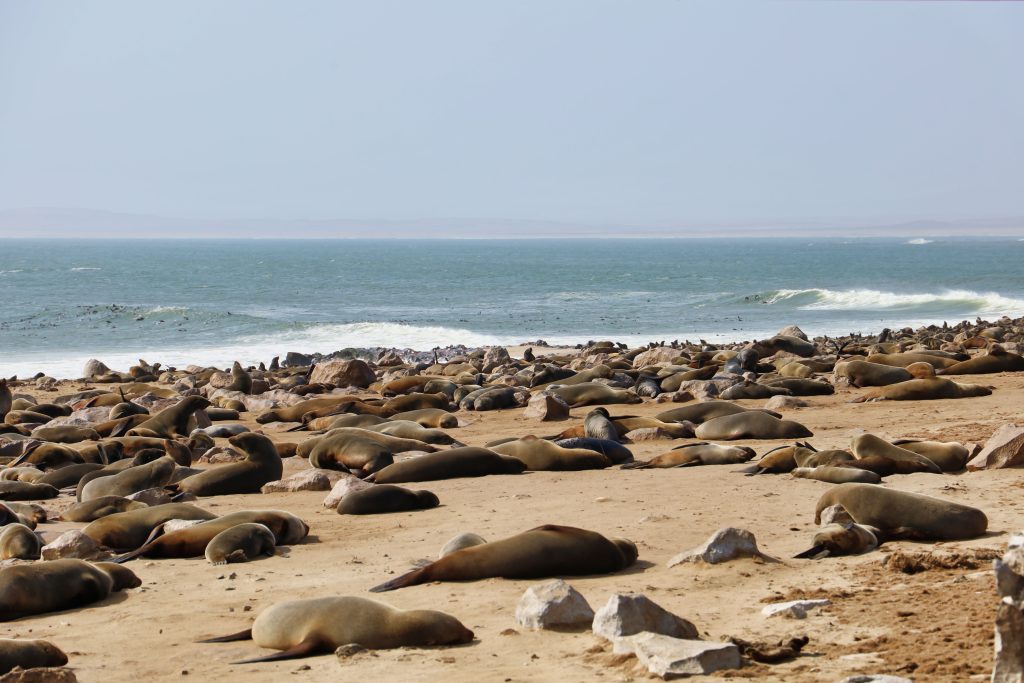
Pointing to Shark Island in Namibia, a site of genocide where such developments are now promoted, she insisted that the dead are not silent but speak through the water and through those who remain. The crisis there, she said, reveals a larger truth: a transition that reproduces colonial extraction is spiritually bankrupt.
“The Earth is not an empty land waiting to be conquered. The ocean is not vacant infrastructure. The desert is not disposable. The Earth is a living relation to whom we owe responsibility, humility, and respect.”
Question and Answer Session
Are our centers of faith addressing the spiritual aspects of who owns the energy grid, who controls the data, and who decides what counts as energy security, and for whom?
Harper described a small but growing number of religious institutions taking up these questions, citing a GreenFaith Germany tour with activists from the Gulf South raising awareness of communities ravaged by the petrochemical industry and urging the German government to stop importing fossil fuels from the United States. Al-Olaimy added that faith communities are increasingly moving beyond being asked merely to bless the transition toward actually building it with their land, capital, trust, and patience, pointing again to Islamic finance as a multi-trillion-dollar experiment in that direction—while cautioning that the rise of AI has made the question of who owns the grid considerably murkier. Luipert noted that the movement is slow in Namibia but real, as Nama communities increasingly ask at what cost development comes, on whose land it occurs, and how that land was lost.
How can faith communities help make right the past to support a just transition?
Responding, Luipert explained that in Namibia the energy transition is inseparable from a violent German colonial history whose impacts are still felt across generations. The developments now being pursued sit on the very land where people were dispossessed and murdered and where mass graves remain. The Nama people exist only because some survived that violence, she said, and so they carry an obligation to those who made their survival possible—meaning that whatever is done should be done in their honor.
Are any of you looking at bringing free energy forward, or is this still too risky to discuss?
Casimira welcomed the idea but observed that the dominant energy narrative is built around development, capital, and endless growth, leaving little room for alternatives. Just as justice and compassion should work by multiplication rather than the division of politics, he suggested, communities might build a network of energy that spreads compassion and justice and centers the well-being of the least among us. Moving free energy forward, he concluded, first requires changing the narrative—no small task, and one that will take many voices.
Concluding Remarks
In closing, Al-Olaimy returned to the question of risk, asking who is threatened by energy that cannot be owned, and answering that the scarcity at issue is not physical. A just transition, he said, is not a matter of swapping the fuel in the same machine but a deeper invitation to sufficiency: the sun rises on everyone, and the spiritual task is to build an economy that finally does the same. Harper named fossil fuels and the extractive mindset behind them as the root of the crisis and framed the transition as both spiritual and material, urging religious communities to learn about genuinely ethical renewable projects, to speak to what they represent, and to advocate for them publicly against powerful opposing interests. Luipert framed the panel’s collective message as a challenge to the world’s moral conscience—that climate change is a physical crisis with spiritual roots, requiring the moral courage to look at history honestly, the legal courage to honor Indigenous sovereignty, and the spiritual humility to recognize that humanity does not own the Earth.
Casimira offered perhaps the discussion’s clearest summation, reflecting that the world needs not only an energy transition but a transition of heart, and that the deeper question is one of humanity itself—pointing to the First Nations peoples of Australia, whose understanding of holding the universe in balance was met for generations with attempted erasure.
“The world is in need of an energy transition, but the world also needs a transition of heart.”
Bowen closed by thanking the G20 Interfaith Forum and the International Academy for Multicultural Cooperation for hosting, the panelists for deepening the audience’s understanding, and the attendees for their presence—inviting everyone, the next time they reach for a light switch, to consider the invisible systems and consequences behind it.
———
JoAnne Wadsworth is a Communications Consultant for the G20 Interfaith Forum Association and Editor of the Viewpoints Blog, IF20’s platform for commentary at the intersection of faith and global policy. She has covered the work of the Forum across multiple G20 cycles, producing summaries, articles, and editorial content that bring the voices of interfaith leaders and scholars to a broader audience. Her writing engages with topics spanning environmental governance, religious freedom, anti-racism, and the role of faith in multilateral policy processes. She is based in the United States.