

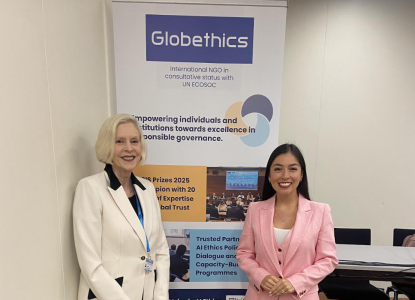
By Marianna Richardson, Director of Communications for the G20 Interfaith Forum and head of its AI working group
– – –
On July 6-7, the United Nations held the First Worldwide Global AI Dialogue in Geneva, Switzerland. This event allowed countries to have a voice in the discussion of the future of governance for AI so that AI is for all and AI is for good. The AI Dialogue was a closed meeting for government leaders, civil society members, and industry leaders who were previously reviewed to become delegates. About 100 countries were present. I attended this Global Dialogue as a representative for G20 Interfaith Forum. For IF20, the purpose of attending was to make sure that religion had a voice in the dialogue. This summary covers the second half of the first day of meetings.
Side Event: AI for Every Mind: Education, Human Agency & Governance
Along with the major plenaries, time was given to side events in smaller rooms and with fewer people where panels presented their ideas and discussions were encouraged. The first side event I attended was on the theme of education.
Ambassador Professor Muhammadou Kah underscored that education is the most important foundation for responsible AI governance. He argued that rapid advances in AI raise an urgent question: How are people being prepared to use these systems ethically and with critical judgment? Access to tools alone is insufficient. Societies need the human readiness, ethical confidence, and data literacy required to keep people meaningfully “in the loop.” Without this foundation, governance becomes performative rather than effective.
Kah stressed that the widening gap between AI capabilities and human preparedness is more dangerous than the technology itself. He called for inclusive curricula, scalable collaboration, and investment in human capability so that learners at the margins benefit as much as those at the frontier. Success, he noted, will be measured not by the number of tools deployed but by the strength of the ecosystem and the accountability of the humans within it. He outlined four commitments: (1) recognizing education as a cornerstone of governance, (2) bridging capability gaps, (3) translating principles into measurable skills, and (4) building human‑centered intelligence through collaboration.
Dr. Tucaman, UNESCO, reinforced that preparing people is as important as developing technology. He warned that simply placing “a human in the loop” hides deeper questions about which human holds power and whether they understand the system’s outcomes. He emphasized AI literacy, critical thinking, and responsible use of sensitive data, especially for students and future generations.
Professor Li, ICAIO, added that AI must be both a teacher and a student, and that societies must act as custodians of knowledge rather than allowing Western‑centric or rapidly obsolete systems to dominate. He stressed that capacity building, accountability, and collaborative learning are essential to shaping AI systems that remain relevant and beneficial over time.
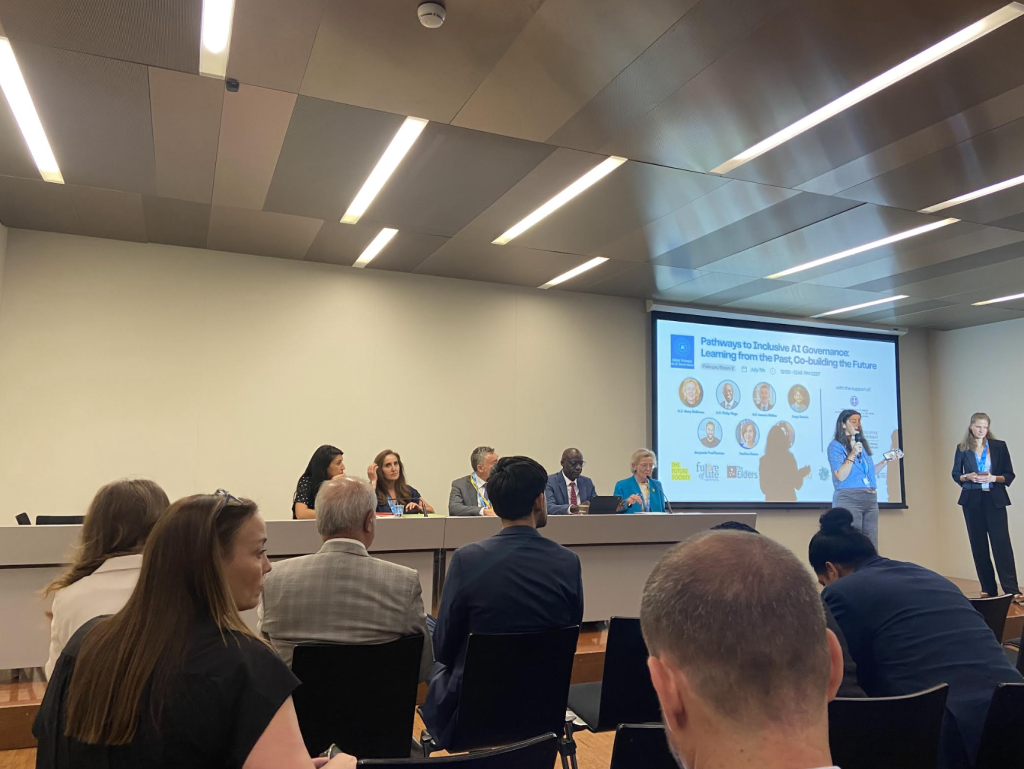
PANEL: AI for inclusive development and impact
Mary Robinson, former president of Ireland, moderated this panel, introducing the subject by emphasizing that curiosity, wisdom, and shared responsibility will shape the future of AI, reminding participants that trusted innovation must be built across borders and sectors. Delegates from small nations, including Estonia, stressed that linguistic and cultural preservation is essential, as AI systems trained primarily on English. This mono-lingual approach to AI risks the erosion of national languages and limiting access to literature and knowledge.
Experts, such as Yossi Matias, vice president of Google, highlighted global efforts to expand multilingual AI, including Google’s work on data collection, cultural nuance, and open‑source models that support hundreds of languages, particularly in the Global South.
Environmental concerns were also raised, with civil society leaders noting that AI’s ecological footprint disproportionately affects regions that do not benefit from its use. Lacina Koné, Director General and CEO, Smart Africa, called for transparency, mandatory reporting, and stronger international frameworks to monitor harms. Lan Xue, Professor and Dean, Tsinghua University, underscored the importance of open models, capacity building, and guardrails that enable countries to adopt AI safely while addressing local realities such as food security, health care, and education.
Access alone does not create economic opportunity; instead, nations must invest in enabling environments, leadership, and societal readiness. Manipulative design, deepfakes, and gender‑based harms require stronger oversight and data literacy so that vulnerable groups are protected. Across all interventions, the central message was clear: AI must be shaped deliberately, inclusively, and with human agency at its core.
Highlights from Three-Minute Worldwide Presentations
Finland’s digital minister emphasized the country’s long experience with high‑quality computational models and noted that while AI can optimize economic outcomes, excessive concentration of technological power creates strategic dependencies and risks. Finland stressed that respectful competition and strong AI governance must remain central to global digital goals.
The Russian Federation highlighted its participation in the “Friends of AI” group alongside Zambia and reaffirmed its commitment to security, sovereign equality, and non‑discriminatory access to AI development. Russia emphasized the importance of open‑source models, national legal frameworks, and trust‑based cooperation, noting its long history in machine learning research and its readiness to share resources.
The Republic of Iran framed AI as a test of global values, expressing deep concern over an April 6 incident that damaged scientific infrastructure. Iran insisted that universities must never become battlefields and called for deterrence frameworks that protect research institutions. It proposed five regional initiatives, including an AI academy, innovation hubs, shared infrastructure, a digital free zone, and a legal framework for regional governance.
Several interventions addressed global sovereignty and digital fragmentation, noting that countries must choose between a single interoperable internet or increasingly separated national systems. Speakers argued that no country can replicate AI capabilities alone and that cooperation and competition must coexist.
AI Safety Asia stressed that countries benefiting from AI will be those that adapt and correct fastest, not necessarily those that develop the most advanced systems. Southeast Asian officials are already focusing on procurement, coordination, and readiness across diverse legal and linguistic systems.
Oman emphasized that AI must reflect cultural and linguistic realities, especially for Arabic‑speaking nations, and encouraged countries to build their own solutions with confidence.
IEEE highlighted the need for shared terminology, verification standards, cultural inclusion, and age‑appropriate AI safeguards.
Armenia concluded by urging precise, cooperative action, noting that AI must remain a tool created for humans and used to expand equal opportunities and human rights.
PANEL: International Standardization of AI
Jian Wang, founder of Ali Baba Cloud, emphasized the need for international standardization in AI rather than fragmented company‑by‑company approaches. He noted that AI infrastructure consumes enormous energy, making model use increasingly expensive. Wang proposed a global system in which AI applications are “charged by token,” allowing every user to understand the cost and ensuring consistent international standards for AI deployment.
Ambassador Thigo, special envoy on technology of Kenya, focused on the environmental footprint of AI and asked what it would take for the world to agree on sustainable AI practices. He stressed that AI must be designed with practical needs in mind, including tools that support both small and large farmers. Kenya called for “Green AI,” environmental toolkits, and safety definitions that include climate and ecological risks. He argued that countries must adopt reporting standards and measurement systems that give confidence in environmental transitions.
Kitty van der Heijden, Deputy Executive Director of UNICEF, highlighted that children, which comprises half of the world’s extreme poor, are the most exposed to AI. New research across ten countries shows children adopt AI three times faster than adults. She warned that AI can accelerate both opportunity and harm and insisted on three principles: (1) designing for inclusion from the start, (2) treating children’s data as a rights issue, and(3) ensuring AI supports child development rather than replacing education. She urged member states to ensure children are never treated as experimental subjects.
Bilal Mateen, Chief AI Officer for PATH, stressed the need for accountability, comparing AI governance to decades of climate‑change coordination. He argued that developers must be held responsible for harms such as sexual violence enabled by deepfakes and that standards are essential for transparency, especially where evidence is thin.
Deema Al Yahya of the Digital Cooperation Organization (DCO) emphasized interoperability and the importance of enabling environments rather than simply building data banks. She highlighted the need for private‑sector collaboration and frameworks that accelerate local content creation. Data governance is the foundation of AI governance, noting that the drafting group, composed of both state and non‑state actors, worked within UN constraints to produce a text grounded in shared principles and active participation.
– – –
Marianna Richardson is the Director of Communications for the G20 Interfaith Forum. She is also an adjunct professor at the Marriott School of Business at Brigham Young University.