

By JoAnne Wadsworth, Communications Consultant, G20 Interfaith Forum
———
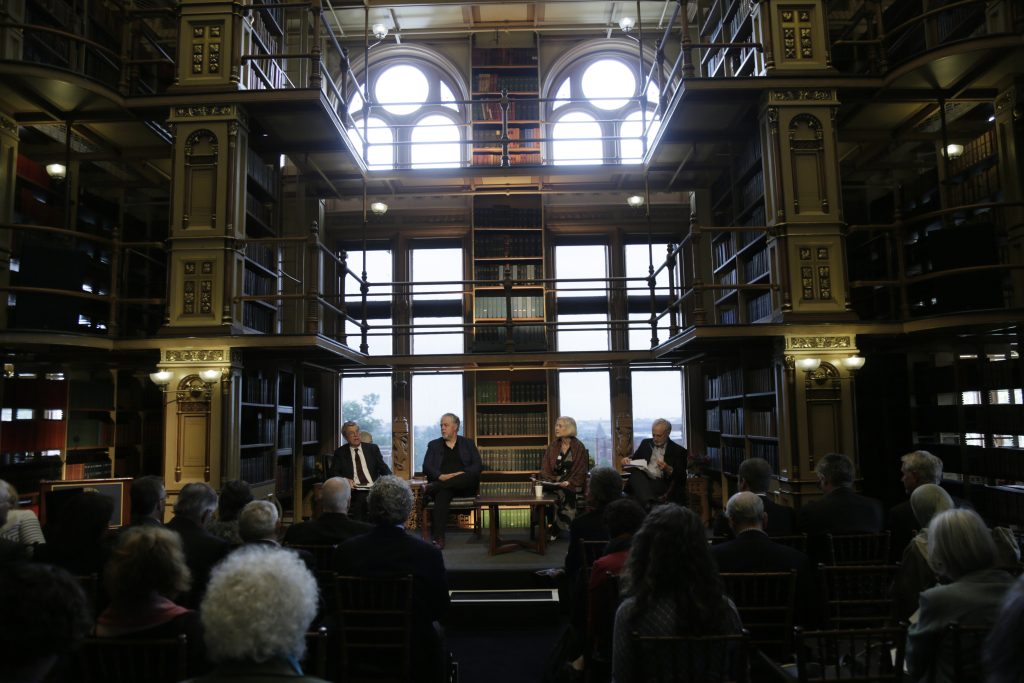
On May 26, 2026, the G20 Interfaith Forum (IF20), in partnership with Georgetown University’s Berkley Center for Religion, Peace, and World Affairs and Brigham Young University’s International Center for Law and Religion Studies (ICLRS), continued its policy meetings in the historic Riggs Library at Georgetown University. This summary—the third in a four-part series—covers the gathering’s third focus area: artificial intelligence and human dignity. As before, the meetings were held under the Chatham House Rule to encourage candor, so the discussion is presented thematically, and no remarks or quotations are attributed to individual participants.
Setting the Stage: A Transformative Tool Without a Moral Frame
The session opened on a note of timeliness no one in the room could miss. Just a day prior, Pope Leo XIV had released his first encyclical, Magnifica Humanitas (“Magnificent Humanity”), on safeguarding the human person in the time of artificial intelligence, and it quickly became a shared reference point. Signed on the 135th anniversary of Leo XIII’s Rerum Novarum, the letter frames the moment as a choice between building a new Tower of Babel—driven by self-assertion and efficiency—and building a city in which God and humanity dwell together, with technology placed in the service of community and human dignity. Its appeal, participants noted, was to safeguard “the grandeur of humanity—the splendor of which no machine can ever replace.”
Against that backdrop, the group welcomed a strong draft policy paper and turned to the central difficulty: a technology of staggering power is racing ahead of any shared agreement on how it should be used.
“We are witnessing the emergence of a radically transformative tool without an agreed moral framework or code of ethics to guide its development.”
What the Traditions Bring: Dignity, Empathy, and Equality
Much of the discussion drew on the moral resources religious traditions bring to the question. The first is the conviction that human beings are created in the image of the divine, carrying an inherent dignity that extends to the dignity of work itself. The second is a cluster of distinctly human capacities—kindness, wonder, compassion, the ability to love—that a model can be trained to imitate but can never actually possess. One participant captured the difference with a simple image: ask a system to teach you to play blues harmonica, then compare its answer to someone who has lived the instrument for forty years. The words may match; the lived reality does not.
The third resource is equality. If all people descend from a common origin, then no one’s lineage carries more inherent worth than another’s, and with that conviction comes a mandate to do justice and protect the vulnerable—the widow, the orphan, the child. Translated into AI, participants argued, these commitments demand the active elimination of bias, a fair distribution of the technology’s benefits and burdens, and real accountability when machines make decisions about people’s lives.
“We can teach a model to talk like this, but we cannot build a machine that empathizes.”
From Moral Principle to Governance
A recurring surprise was how directly ancient religious law speaks to twenty-first-century technology. Traditions of economic regulation—limits on unfair pricing, the periodic cancellation of debts, the jubilee’s restorative justice—model the idea that markets operate within moral bounds. Early forms of copyright and of privacy law emerged from these same traditions, with privacy grounded not in property but in human dignity: prohibitions on overseeing and overhearing because surveillance itself offends the person. The point, participants stressed, is that these are not narrowly sectarian values but broadly shared human ones.
From principle the conversation moved to mechanism. The group called for developmental transparency, rigorous testing before gradual deployment, and a firm default to human control—most absolutely in the case of weapons, where lethal decisions can never be autonomous. Underlying it all was a plea for enforceable constraints rather than voluntary ones: science and human ingenuity are to be celebrated, but only within a rule of law that can actually hold power to account.
“In a world where technology allows us to do almost anything, what we should and should not do becomes the ultimate question.”
Truth, Consent, and What AI Is Not
Several participants pushed back hard on the tendency to anthropomorphize these systems. AI is not alive; when a model uses “I” and addresses a user by name, that is a design choice meant to deepen engagement, not evidence of an inner life—and claims that such tools may be conscious were described as marketing and liability avoidance rather than science.
That led to what one participant called the need for “sacred exactitude”: preserving the integrity of original human expression at a time when generative summaries quietly introduce bias and AI has already fabricated legal citations out of thin air. Consent emerged as a foundational concern. The authors and creators whose work trained these models were never asked for permission, even though a consent-based approach would have been both feasible and consistent with a basic respect for persons. Participants also flagged a problem of special concern to faith communities: asked religious questions, today’s systems frequently return confident but inaccurate answers.
“We don’t want synthetic data—we can call for the exactitude of the original words.”
The Future of Work
If any theme carried the most human weight, it was work. Echoing the concern for labor that runs from Rerum Novarum to the new encyclical, participants warned that earlier technological transitions failed ordinary workers, and that AI threatens a far larger—and possibly permanent—displacement. The reflexive policy answer, retraining, met open skepticism. People sense when a promise is hollow, and a generation told simply to retrain into new professions has good reason to doubt it.
The discussion connected this directly to public trust and political grievance, and to the anxiety of young people entering a labor market that seems to be contracting beneath them. The call was for something more honest and more aggressive than retraining slogans: genuine protection for the jobs people hold, and a serious reckoning with what dignified work will mean in an automated economy.
“Telling workers we will simply retrain them is unrealistic—and they know it.”
Governing a Borderless Technology
Because AI respects no border, participants agreed that no single government can govern it alone. Meaningful guardrails will require international cooperation—including, pointedly, between the United States and China—and venues such as the forthcoming United Nations AI summit in Geneva were identified as critical proving grounds. Military applications drew particular concern as the domain where the technology is most likely to outpace human control.
Faith communities, the group concluded, have concrete and credible roles to play: building AI-literacy curricula for congregations and families, establishing benchmarks that require models to represent religious traditions accurately, and pressing for accountability mechanisms, including liability frameworks. Nor is the picture only defensive. Participants pointed to real opportunities—cataloguing and protecting religious heritage sites, building early-warning models for ethnic and religious violence, and using computational tools to support endangered, low-resource languages.
“In the mad rush to be first, technology cannot move faster than our ability to control it.”
A Closing Keynote: Faith for Impact
The day closed with a keynote conversation on faith and policy impact that looked ahead to the United Kingdom’s 2027 G20 presidency—a horizon several participants see as a major strategic opportunity for the IF20. In keeping with the Chatham House Rule, its substance is noted here only in broad strokes and without attribution. The through-line was resolutely practical: faith communities will carry the most weight when they lead with an offer rather than an ask, framing their contributions in terms policymakers can act on rather than moral appeals alone, and when they invest in the mutual literacy that lets the worlds of faith and policy understand one another. Sovereign debt was identified as the single most promising campaign on which the forum might concentrate, with the caveat that real progress will require engaging major creditors and partnering with business and philanthropy that have direct access to financial decision-makers. Participants also urged the IF20 to reach well beyond the Abrahamic traditions. These threads carry directly into the second day of meetings, taken up in the final installment of this series.
———
JoAnne Wadsworth is a Communications Consultant for the G20 Interfaith Forum Association and Editor of the Viewpoints Blog, IF20’s platform for commentary at the intersection of faith and global policy. She has covered the work of the Forum across multiple G20 cycles, producing summaries, articles, and editorial content that bring the voices of interfaith leaders and scholars to a broader audience. Her writing engages with topics spanning environmental governance, religious freedom, anti-racism, and the role of faith in multilateral policy processes. She is based in the United States.